

If you are around 160 cm, top length decides your proportion faster than size does. The short answer: three hem positions work at a 160 cm frame — a top that ends at the waist, one that ends at the high hip, or any length resolved with a front tuck. The zone between low hip and mid-thigh, worn untucked, is the one that quietly shortens the leg line. This guide fixes the vocabulary (waist, high hip, low hip), shows how to check a garment's length before you buy it online, and maps the shorter-cut knit tops at RQFashion that are drafted with a 160 cm-plus frame in mind — no guessing and no tailoring required.
Key Takeaways
- At 160 cm, the hem positions that read cleanest are waist-length, high-hip and tucked; the untucked mid-thigh zone is the one that cuts the leg line.
- Top length is measured on the garment, not on the body: lay it flat, find the shoulder seam's high point, and measure straight down to the hem.
- A too-long top is fixable without a needle and thread — the front tuck restores the waistline in seconds.
- Fibre matters here too: a fine-gauge knit tucks flat and stays tucked, which is why top length and fabric work together.
- RQFashion trousers are drafted for a 160 cm-plus frame; if you are under 160 cm, plan on a hem alteration for pants and lean on the shorter-cut tops instead.
Where should a top hit on a 160 cm frame?
Proportion at 160 cm is decided by where the eye reads your waistline — and the hem of your top is the loudest signal on the whole outfit. Three positions cover essentially every top you will ever own:
| Hem position | Where it ends | What it does at 160 cm | Works well with |
|---|---|---|---|
| Waist (cropped) | At or just above the waistbone | Lifts the waistline; legs read longer | High-rise trousers, midi skirts |
| High hip | Just below the hip bone | Balanced and easy; the safest untucked length | Straight-leg pants, denim, wide legs |
| Low hip to mid-thigh | Below the hip, toward the thigh | Cuts the leg line and emphasizes the widest point of the body | Only when tucked, belted or half-tucked |
The reason the third row misbehaves is simple geometry: a hem that lands at the widest point of the body draws the eye exactly there, and the remaining visible leg line is the shortest it can be. Neither effect is about weight or age — a 175cm wearer loses leg line to a mid-thigh hem for the same reason; at 160 cm the math is simply less forgiving. This is why stylists keep repeating the same instruction: end the top where the body turns, not where it bulges.
Cropped or hip-length — which reads quieter?
If the goal is a quiet-luxury wardrobe, the hip-length hem is the workhorse and the cropped hem is the accent — most 160 cm wardrobes need more of the former and one or two of the latter. Cropped cuts lift the waistline instantly and read a touch younger; hip-length cuts skim smoothly under open layers and read calm. Both are honest lengths; they simply do different jobs.
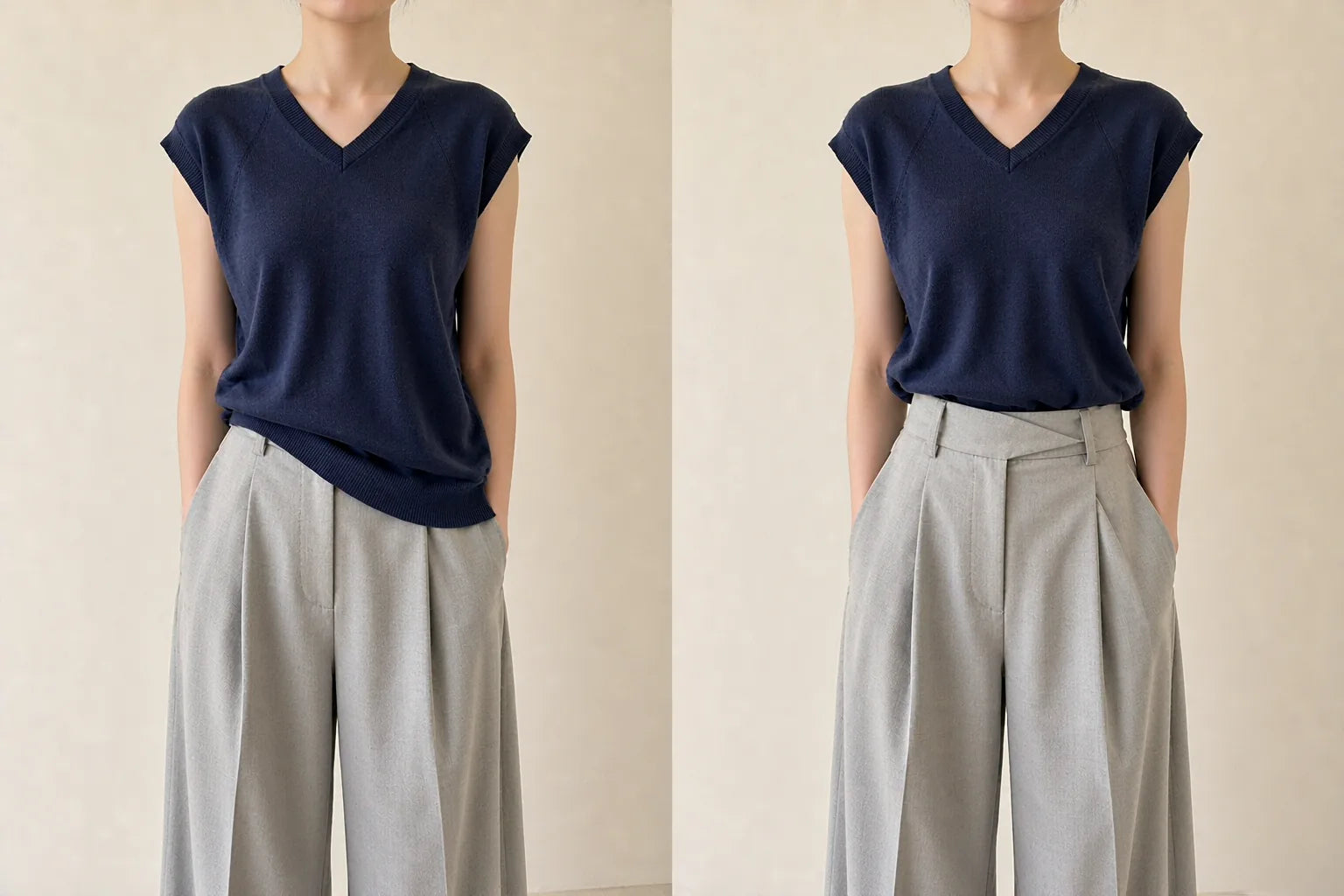
A practical way to choose: if the bottom half is wide or high-waisted, go hip-length and let the trousers hold the structure; if the bottom half is slim and sits low, a cropped or tucked top restores the proportion. Neither rule requires a tape measure on your body — only a decision about which half of the outfit leads.
How do you check a top's length before buying online?
You can predict where a hem will land without trying anything on: three checks take less than two minutes. Online returns mostly happen because none of these were done.
- Measure the garment, not yourself. Lay the top flat and measure from the high point of the shoulder seam straight down to the hem. That number is the back length — the only one that matters for hem position.
- Compare it with your favorite well-fitting top. Lay that top over the new one, hem to hem. The difference in centimetres is exactly where the new hem will land on you — above or below the position you already know works.
- Read the listing language and the size chart. Descriptions that say a top "sits at the hip" or a cardigan that "sits at the hip for easy proportion" are telling you the hem point; the size chart carries the garment's measured lengths per size. On RQFashion product pages both are present — and the fit note is worth reading too, because some pieces run petite, which changes where the hem lands within one size run.
This method also settles the between-sizes question: if two sizes share a length but differ in the chest, length is not the deciding dimension — and our guide on sizing up or down between sizes walks that choice separately.
What goes wrong when a top is too long?
The classic complaint is not that a long top looks bad — it is that it makes everything else look shorter. Two things happen at once when a hem passes the low-hip zone untucked: the visible leg line shrinks from below, and the eye is parked at the widest reading of the torso. Layer a long top over wide trousers and both effects compound; the outfit reads heavier than the sum of its pieces.
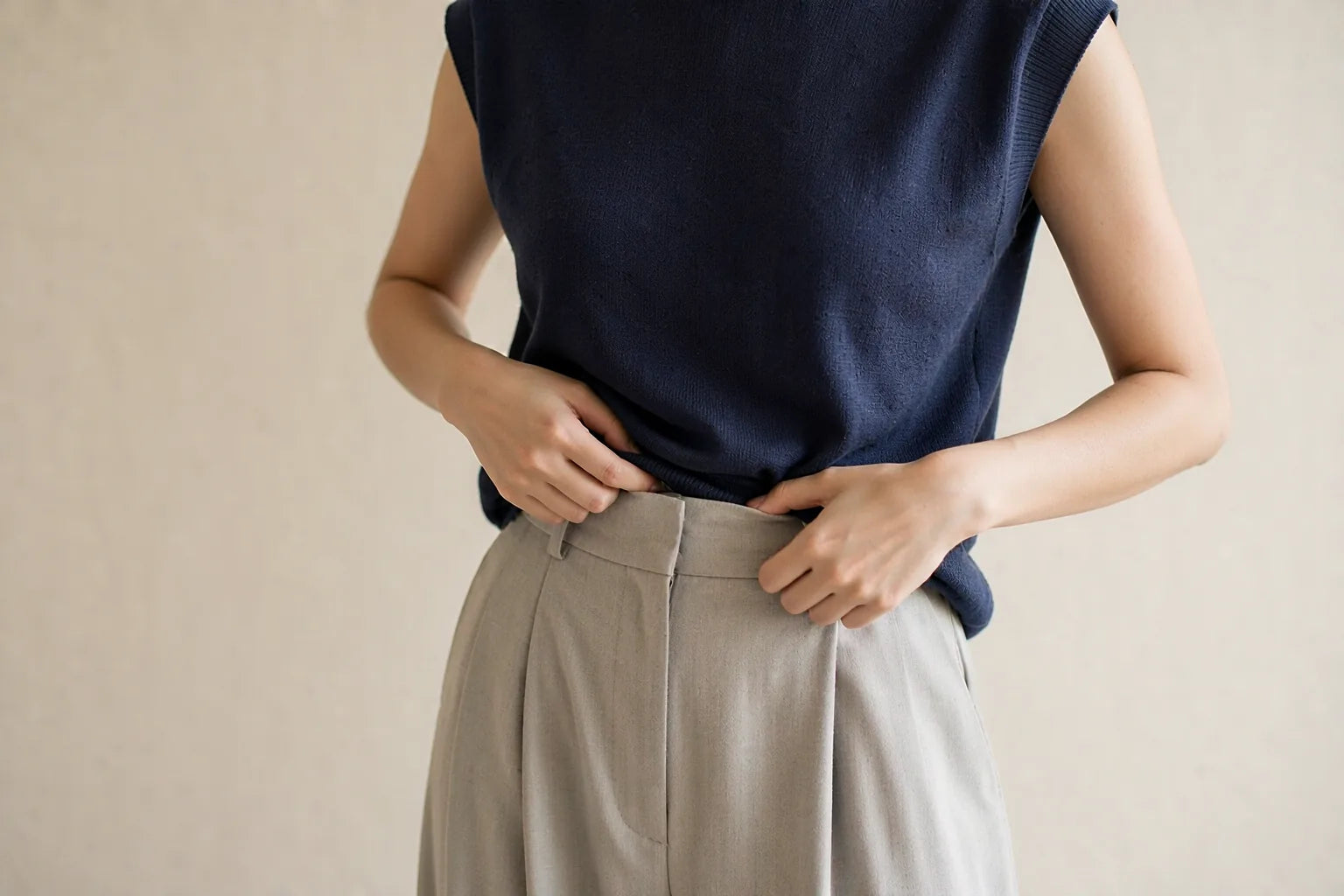
The fix costs nothing. A front tuck — hem gathered at the fly, sides released — moves the visual waistline back up in seconds. A belt does the same work for thicker knits that will not tuck flat. This is also where fabric choice quietly matters: a fine-gauge knit tucks and stays put, while a chunky one fights the tuck all day. Fit and length interact in the same way — our five-point walkthrough of how a knit top should fit covers the shoulder, bust and ease side of that equation.
Which shorter-cut knit tops work at 160 cm?
Within the RQ knit edit, four tops are natural fits for the waist-to-high-hip rule — each for a slightly different reason. All are drafted with the brand's 160 cm-plus guidance in mind, and all four tuck flat when a cropped reading is wanted:
| Top | Colour | Fabric character | Why it works at 160 cm | Price |
|---|---|---|---|---|
| Minimal Crew-Neck Cardigan Top | Apricot | Combed-cotton blend with a smooth hand | Short-sleeve cardigan cut — the shortest, cleanest hem in the edit | $38.99 |
| Cap-Sleeve Crew Knit Top | Navy Blue | Cellulose-rich viscose-lyocell knit | Cap sleeve keeps the shoulder line high while the hem sits neat | $46.99 |
| Skin-Soft V-Neck Knit Top | Black | Fine-gauge wool-and-mulberry-silk blend | Tucks flat and stays tucked; reads long when worn out | $37.99 |
| Seamless-Knit Short-Sleeve Top | Apricot | Seamless construction, light hand | Clean waist-length line with zero bulk at the tuck | $32.99 |
Notice what the list is not: it is not a petite-size range. These are regular tops whose hems land in the working zone — the difference between buying a shorter garment and buying a smarter hem point.
Should you tuck a knit top at 160 cm?
Most of the time, yes — but the tuck has three gears, and picking the right one matters more at 160 cm than anywhere else. The full tuck is the strongest: everything tucks, the waistline reads at its highest, and a belt finishes it. The front tuck is the everyday default — structure at the front, ease at the sides, and it survives lunch. The untucked wear is reserved for hems that genuinely end at the high hip.
Fine-gauge knits are the tuck's ideal partner because thin yarn lies flat under a waistband without the bunching a heavy cable would cause — the same reason a fine-gauge cardigan sits at the hip for easy proportion when worn out. Pair a tucked fine-gauge top with high-waisted trousers and the leg line runs unbroken from waist to hem; the wide-leg pants guide for petite styling shows that pairing from the trouser side.
How long should a cardigan or a blazer be at 160 cm?
The hem-point ladder works for every layer, not just tops — each garment category simply has its own reading of the three positions. A cardigan reads cleanest at the high hip, which is exactly where the fine-gauge button-front styles in the RQ edit are drafted — a fine-gauge cardigan that sits at the hip for easy proportion is the template. Below-hip cardigans are not forbidden; they simply ask for a belt or a full tuck of the layer underneath to hold the waistline.
A blazer should end at the hip bone — long enough to skim, short enough to keep the leg line unbroken. Cropped or waist-length outerwear is the strongest proportion tool a 160 cm frame owns, because it raises the visual waist more decisively than any styling trick underneath. The one category to buy with caution is the long, straight, untucked layer — kimonos, longline vests, thigh-grazing cardigans — which behaves like the mid-thigh top in the table above and usually needs the same fixes.
Knit vests sit between the two: the tailored vest layering guide shows how a vest's hem interacts with the shirt beneath it, and the same high-hip reading applies. In short: measure every layer against the three-point ladder, and let the eye read one clean waistline per outfit.
What if you're under 160 cm — can you still wear the pants?
Honest answer: the tops are the easy half; the pants need one extra decision. RQFashion trousers — the linen straight legs, the wide-leg drape pairs, the lyocell-linen stripes — are drafted for a 160 cm-plus frame, which is exactly why the length looks right on the model shots. If you measure under 160 cm, expect a full-length trouser to pool at the ankle: plan on a simple hem alteration (a straightforward job on straight and wide legs), or lean on the shorter-cut tops and midi skirts where the hem decision is already solved for you.
That is not a petite-friendly claim in the sizing sense — some pieces run petite in fit, and the product pages say so when they do — it is a statement about where the hem is drafted. The petite capsule wardrobe guide builds full outfits around exactly this reality, and the pants-length guide for petite women covers the trouser-hem question in depth.
Frequently Asked Questions
What is the ideal top length for a 160 cm frame?
A: The high hip. A hem that ends just below the hip bone keeps the leg line long without reading cropped, and it works untucked with every bottom half. If you want more lift, go waist-length or front-tuck a longer top; reserve the untucked low-hip zone for belted layers.
How do I measure top length correctly?
A: Lay the garment flat, face up, and measure from the high point of the shoulder seam straight down to the hem — that is the back length. Then lay your favorite well-fitting top on top of it, hems aligned. The centimetre difference tells you exactly where the new hem will land relative to one you already know works.
Is 160 cm considered petite?
A: In fashion terms, petite sizing generally covers around 160 cm and under, though the cut-off differs by store — and petite refers to height, not build. In fabric terms, some RQ pieces run petite in fit, meaning the size runs smaller than the number suggests; those product pages carry a sizing-up note. Length, however, is drafted for a 160 cm-plus frame across the range.
How long should a cardigan be at 160 cm?
A: Aim for the high hip — the point where a cardigan skims the body without covering it. That is where most RQ cardigans are drafted, and it layers cleanly over both trousers and midi skirts. Longer cardigans work when belted or worn over a tucked base layer, so the waistline still reads.
Should I size up in knit tops if I'm between sizes?
A: Not for length. Within one size run the hem usually moves less than the chest does, so if the length is right, take the smaller size and let the stretch-knit structure do its work. Our guide on sizing up or down between sizes covers the full decision, and the five-point check in how a knit top should fit settles the rest.
Try the two-minute hem check on the knit edit
Start with the Minimal Crew-Neck Cardigan Top in Apricot for the shortest, cleanest hem in the edit, or the Cap-Sleeve Crew Knit Top in Navy Blue when you want the hem to sit neat under an open layer. For the tuck that stays put, the Skin-Soft V-Neck Knit Top in Black is the fine-gauge partner. Browse the full knit selection in new-in and the office-ready pieces in workwear — and read every hem with the three-point ladder above.
0 comments