

The short answer to how to style wide leg pants on a petite frame: raise the waistline to your natural waist, keep the hem close to your shoe, and pair the volume with a top that defines where your legs begin. Get those three levers right and wide-leg pants stop swallowing you and start doing what they do on taller frames — lengthening the line. Get them wrong and you know the result: the fabric pools around your ankles, your torso disappears, and the outfit wears you. I'm 163cm and wide-leg trousers are the backbone of my tropical wardrobe. Everything below is drawn from my own fitting-room failures as much as our counter's successes.
Key takeaways:
- - Three things make wide-leg pants look short on petite frames: a low waistline, excess fabric piling at the hem, and shoes that cut the leg line.
- - A high waist worn at the natural waist is the single biggest lever — it resets where the eye reads your legs as starting.
- - Match hem to shoe: full break with loafers, a clean hover with sandals, a slight taper-cuff look with sneakers.
- - Tuck or crop the top — either defines the waist; a long untucked hem over wide legs erases it.
- - In tropical heat, drape beats stiffness: a fluid, lightweight fabric falls in one clean vertical line instead of boxing out.
Why Do Wide-Leg Pants Make Petite Frames Look Shorter?
Because wide legs add visual width, and width without counterbalance reads as shorter height. Three specific things cause it, and all three are fixable.
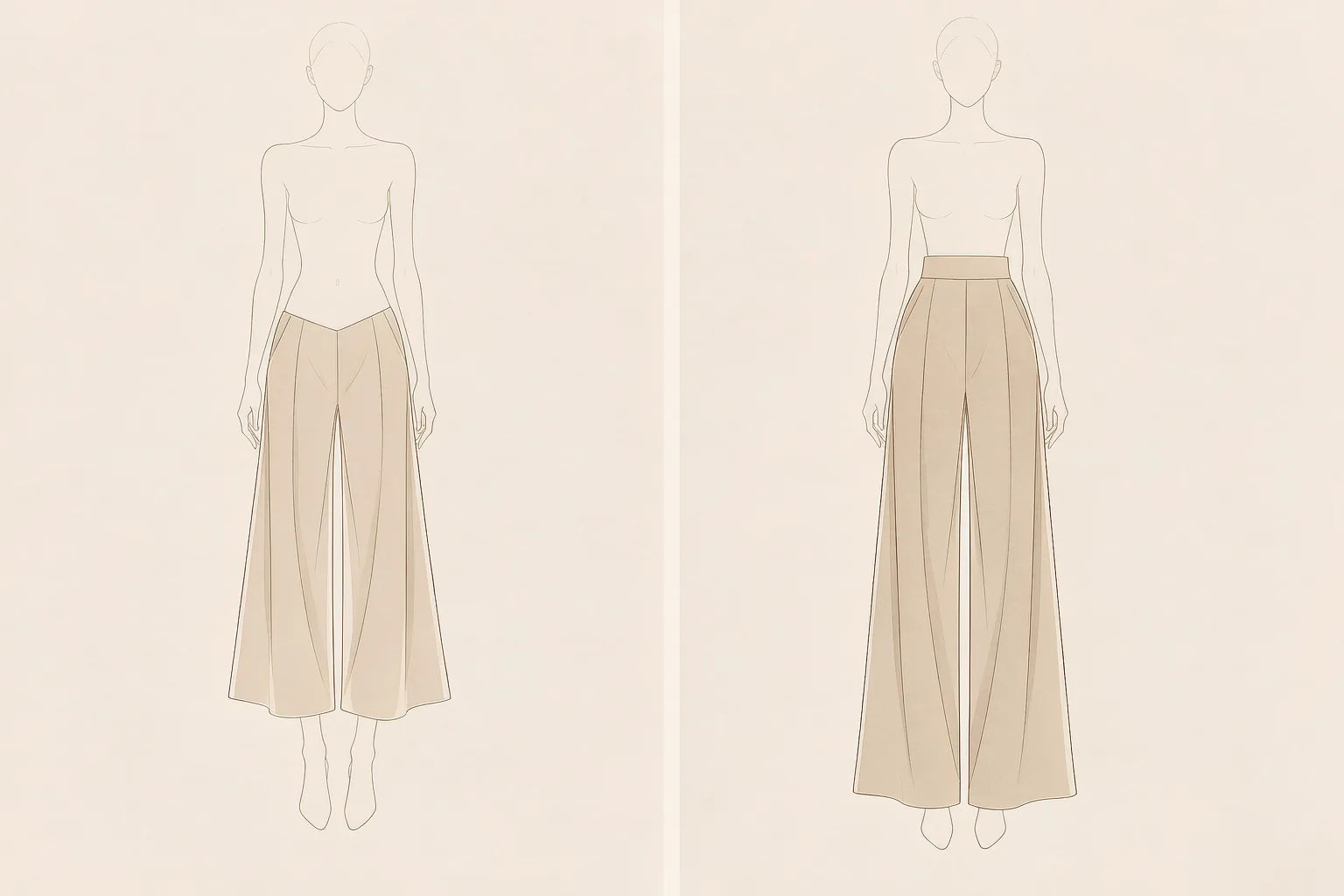
First: the waistline sits too low. When the waistband rides at the hip, your legs are read as starting at your hips — which, on a shorter frame, costs you several centimetres of apparent leg. The pant also flares from a lower point, so the silhouette spreads outward earlier and wider. Same woman, same body, two very different proportions.
Second: the hem piles up. Extra length pooling in folds at the ankle adds horizontal clutter exactly where the eye finishes reading the leg. Every fold is a small "the line stops here" signal. On a tall frame a soft break looks deliberate; on a petite frame two folds of excess fabric can undo the whole vertical line.
Third: the shoe cuts the line. A chunky sole, a strapped ankle, or a dark shoe with a stark gap of bare leg before the hem — each one interrupts the vertical flow. The eye stops at the interruption, and whatever comes after it reads as separate, shorter segments.
None of these is about height itself. That's worth saying, because petite fashion advice often drifts into "avoid wide legs" — which is the wrong conclusion. The cut isn't the problem; the styling is. Wide leg pants look their best on petite women when they're styled with the three levers below.
How Does a High Waist Change Everything for Petite Frames?
A high waistband is the closest thing wide-leg trousers have to a cheat code, and it works for one simple reason: it moves the point where the eye reads your legs as beginning. Wear the waistband at your natural waist — the narrowest part of your torso, roughly a thumb's width above the navel — and every centimetre from there down is read as leg. Wear it at the hip and you surrender that territory.
There's a secondary effect too. A wide leg flaring from a high waist creates a long, uninterrupted A-line: narrow at the top, wide at the hem, no shelf or pocket bulge breaking the fall. That clean slope is what makes the silhouette look intentional rather than oversized. On my own pairs, the difference between a mid-rise and a high-rise cut of near-identical trousers is the difference between needing a tuck and not needing one.
This is why our high-waist wide-leg relaxed pants are the piece I recommend first to petite customers around 160 cm and up — the waistband sits where it should, and the relaxed cut keeps the volume airy rather than clingy. Under 160 cm, the honest answer is tailoring: these pants are drafted on regular proportions, so order only if altering both waist and hem is part of the plan — my own pairs are hemmed, and that is the part the photos never show. That matters the moment you step into 33°C. If you're unsure where your natural waist sits or how your inseam measures up, our guide on how to measure yourself for womenswear walks through it in a few minutes with a soft tape.
One caveat from experience: not every pair sold as high waist wide leg pants actually sits at your natural waist — brands vary wildly. If you're torn between two sizes, our guide on how to size up or down between sizes settles it before you try anything on. Then check where the waistband actually lands on your body, not where the label says it does.
What Is the Right Trouser Length for Each Shoe?
Hem and shoe are a pair decision, made together. The same trousers that look sharp with loafers look unfinished with sandals at the same length, so I run one rule: decide the shoe first, then set the hem. Here's the pairing map I use at the counter:
| Hem Length | Best Shoe Pairing | Effect on a Petite Frame |
|---|---|---|
| Full break (hem skims the floor, one soft fold) | Flat loafers, closed leather shoes | Most elongating with covered shoes — the vertical line runs unbroken to the toe |
| Slight break (hem just kisses the shoe, no fold) | Low block heels, pointed flats | Safest all-rounder; keeps the line long without risking a puddle hem |
| Ankle hover (hem ends at the ankle bone) | Flat sandals, slingbacks | Clean and airy for the tropics; pairs best with skin-toned or low-contrast footwear |
| Cropped well above the ankle | Sneakers, slides | Casual; shows the most leg but widens the silhouette — keep the top fitted to balance |
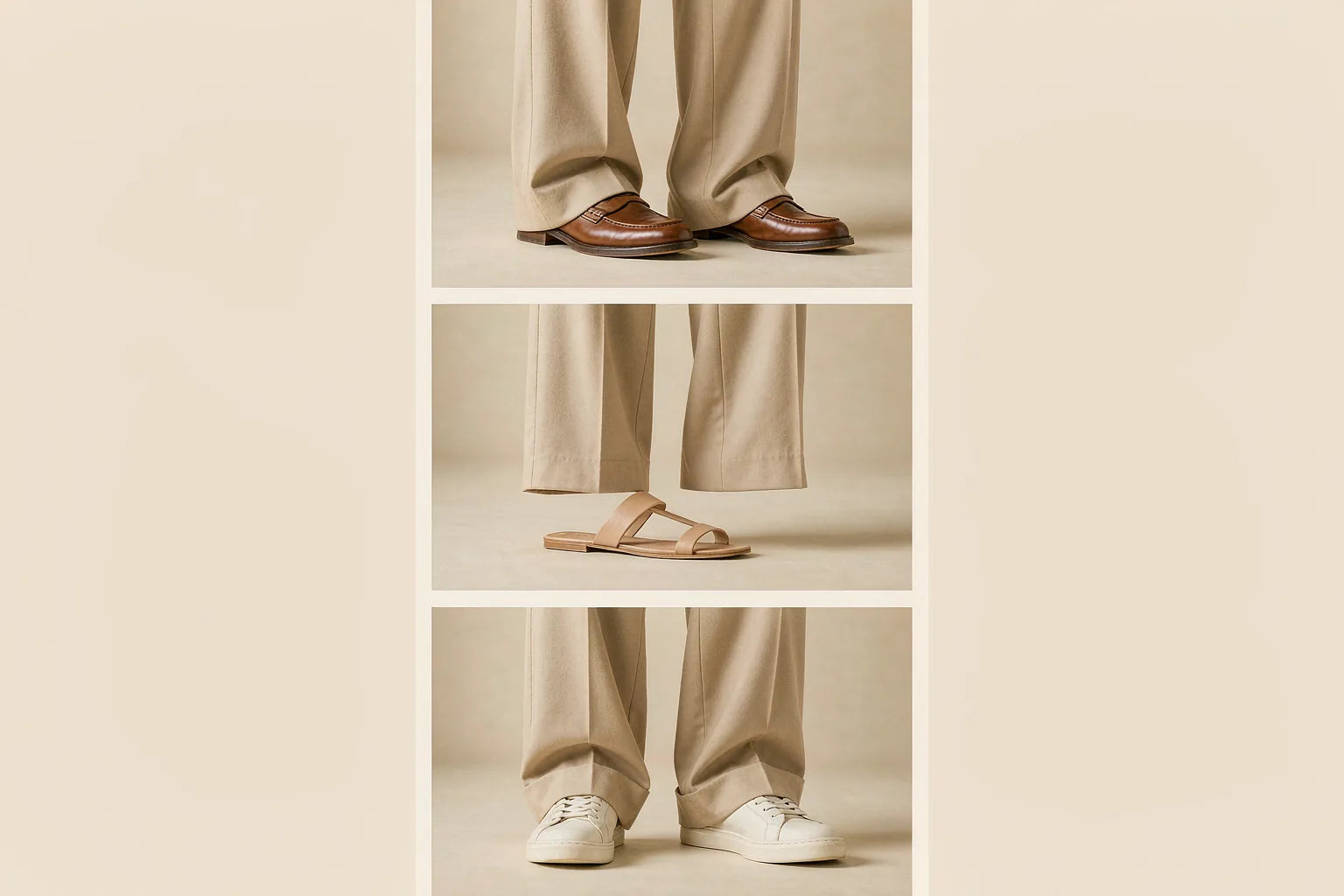
A few notes from wear. Full break is the most elegant but demands tailoring precision. Buy the trousers long enough to touch your shoe with shoes on, not barefoot. Ankle hover is my tropical default: with a flat sandal and bare ankle, it reads light and keeps you cooler, which matters more than we admit in this climate. Sneakers are the trickiest pairing for petite frames; a chunky sole plus full volume at the hem is a lot of mass at both ends. When I wear sneakers I either choose a slim profile or push the hem slightly shorter.
The one pairing I'd gently steer petites away from: ankle straps. A strap across the ankle plus a wide hem chopping the leg just above it divides the line into thirds. Not forbidden — just working against you.
Should You Tuck, Crop or Leave the Top Untucked?
Untucked and long is the outfit-killer. A long hem falling over high-volume trousers buries your waist — the very point the high waistband was hired to highlight — and turns the silhouette into one wide rectangle. Once the waist disappears, so does the leg length.
The fix is either of two moves, both of which define the waist:
- The tuck. A full or front tuck on a fine-knit top pulls the waistline back into view. This works best with thinner fabrics — a bulky layer blouses out over the waistband and undoes its own work. My everyday move is a front tuck with the soft crew-neck knit top: thin enough to lie flat against the waistband, and the fine knit adds hardly any bulk at the tuck point.
- The crop. A hem ending at or just above the waistband does the defining for you. The slim V-neck base layer top tucks cleanly without bunching, and the V-shape draws the eye upward — a quiet vertical that a crew hem doesn't offer.

If you refuse to tuck anything, work with volume instead: tuck a light layer into the front only, or belt nothing but choose a top that ends where the waistband begins. The principle underneath both options is the same — somewhere in the outfit, the eye needs to find your waist. Where it finds it is up to you.
Which Fabrics Let Wide-Leg Pants Drape Properly in Tropical Heat?
Fabric is the quiet half of proportion. A wide leg only lengthens the body when the fabric falls — one clean vertical line from waist to hem. A stiff or heavy fabric doesn't fall; it boxes out, standing away from the leg in rigid cones that add width at the ankle, and on a petite frame that outward flare eats the line you just built.
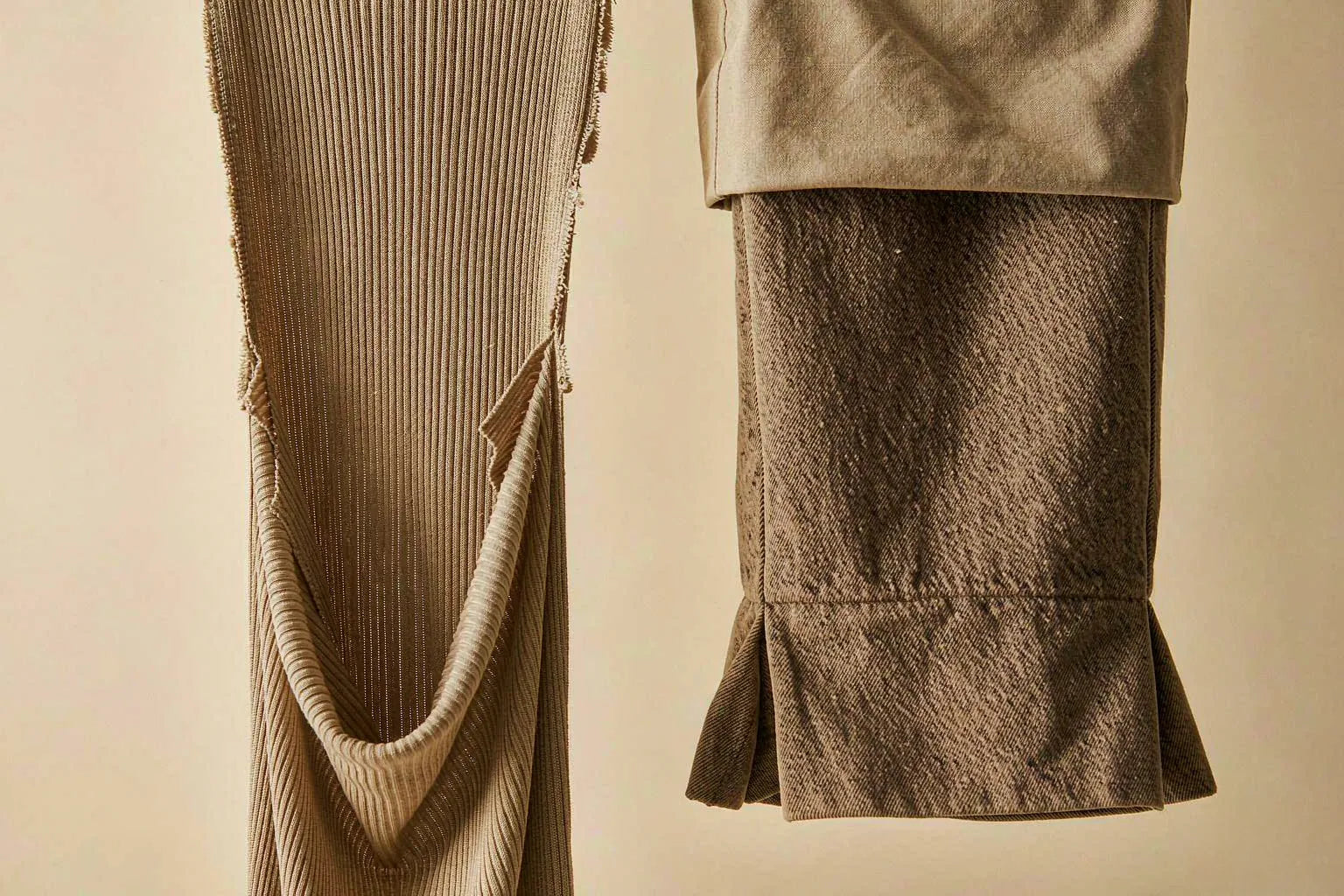
In tropical weather, the fabrics that drape well tend to be the ones that breathe well too, because both qualities come from the same place: a light, fluid construction. Lyocell blends and fine cotton knits are my two go-tos — they swing rather than stand, resist the deep creasing that stiff wovens collect after one MRT ride, and weigh almost nothing in a tote. Heavier linens and dense denim-style wovens do the opposite: they hold their own shape and impose it on yours. The full science is in our guide to the best fabrics for hot humid weather; the fit-guide version of the same idea is shorter — pinch the fabric between your fingers, let go, and watch how it falls. Fluid recovery means the hem will hang where you want it; a slow, stiff settle means it won't.
There's a comfort dividend too. A fluid lightweight wide leg moves air with every step — on a hawker-centre Saturday that ventilation is the reason I reach for these trousers over anything fitted. For the care side of keeping that drape season after season, washing and drying habits matter more than people expect. Our hot-weather capsule wardrobe guide covers how I rotate and rest a small set of pieces so each one lasts.
How to Style Wide Leg Pants Week After Week? Three Formulas
Formulas beat inspiration on weekday mornings. Here are the three I rotate, all built on the same trousers because one great pair beats three mediocre ones.
The Commute Default
The high-waist wide-leg relaxed pants with the slim V-neck base layer top, front-tucked, ankle-hover hem over pointed flats. Every lever engaged: high waist, defined waist, clean hem. It survives the MRT crush, reads office-appropriate under air-con, and the collared knit cardigan in soft wool rides in my tote for the overcooled meeting room — its collar does the polish work a blazer would, at a fraction of the weight.
The Weekend Relaxed
Same trousers, but with the cap-sleeve crew knit top tucked fully, flat sandals, hem at ankle hover. The cap sleeve keeps shoulders light in the heat and the short sleeve balances the wide hem. This is my Orchard Road-then-hawker formula — put-together enough for a café, loose enough for three hours in the humidity.
The One-Piece Shortcut
On days when deciding is too much, the knit two-piece set does the proportion work itself: the top and trousers were cut to sit together, so the waist lands where it should without any tucking decisions from me. I add loafers with a slight break and it's a full wide leg trousers outfit in the time it takes to lock the door. The set also splits — top with shorts, trousers with another fine knit — which is why it earns drawer space in a small wardrobe.
If you'd rather browse than assemble, you can browse all RUIJIN pieces and try the tuck-and-hem checks in person — your mirror is the final authority on proportion, not any guide.
Ready to Give Wide-Leg Pants a Petite-Friendly Try?
Three levers, one rule: high waist at the natural waist, hem matched to the shoe, top that finds the waist. Add fluid, lightweight fabric for the climate and the same trousers that once swam on you become one of the most lengthening things in your wardrobe. Start with one pair worn three ways — commute, weekend, shortcut — before adding anything new. The proportions will tell you within a week whether the levers are set right; the mirror in good daylight rarely lies.
FAQ
Can petite women wear wide-leg pants?
Yes — with the waistline, hem and shoe handled properly. A high waistband at the natural waist, a hem that matches your shoe, and a defined waist on top turn the wide silhouette from overwhelming to lengthening.
What Trouser Length Works Best if You Are Short?
Match the hem to the shoe: a full or slight break with loafers and closed shoes, an ankle hover with sandals. Excess fabric piling in folds at the ankle is the most common length mistake on petite frames.
Do wide-leg pants make you look shorter?
Only when styled against you — a low rise, a puddling hem, or a heavy shoe that cuts the leg line. Styled with a high waist, a clean hem and a tucked or cropped top, they visually lengthen the legs.
What Top Works Best on a Petite Frame?
A fine-knit top tucked fully or in front, or a cropped hem that meets the waistband. The goal is to mark the waist; a long untucked hem over wide legs hides it and flattens the whole silhouette.
What shoes look best with wide-leg pants for petite frames?
Flat loafers with a full break, low block heels with a slight break, or flat sandals with an ankle hover. Ankle straps chop the line at its narrowest point, and chunky soles add mass at both ends of the outfit.
0 comments