

How should a knit top fit? Four checkpoints settle it. The shoulder seam lands right on the point of your shoulder bone. The bust holds one to two fingers of room, so you can move without the fabric pressing into you. The hem ends where you actually intend to tuck or layer, and the armholes stay put when you lift your arms. One difference from shirts matters before anything else: knits stretch, so a body-skimming fit — even a slight negative ease — is a design choice, not a size error. Below I break down each checkpoint, the signs a knit has gone too far in either direction, and the two-minute check I run before buying anything online.
Key takeaways:
- - Four checkpoints decide knit fit: seam at the shoulder bone, 1–2 fingers of bust room, hem where you plan to tuck, armholes that survive the lift test.
- - Knits are built to stretch — zero or slight negative ease at the bust is intentional, unlike wovens which need 1–2 inches of ease.
- - Pinch test: more than two fingers of fabric at the side waist means the knit runs big; skin-tight and sheer under light means it runs small.
- - Hem position is the fit point most people ignore: hipbone for half-tucks, at the trouser waistband for full tucks, longer for layering.
- - Online, compare the flat-lay bust measurement in centimetres against a knit you own — it beats every size chart.
Where Should the Shoulder Seam Sit on a Knit Top?
The seam is the foundation everything else hangs from — which is why it's the first place I look, before price, before colour, before anything.
The correct position: the seam sits directly on the bony point at the edge of your shoulder. Stand side-on to a mirror and trace a finger along it; the seam should finish where the shoulder bone finishes. From there, the sleeve hangs cleanly off the true end of your shoulder and the whole upper body reads neat.
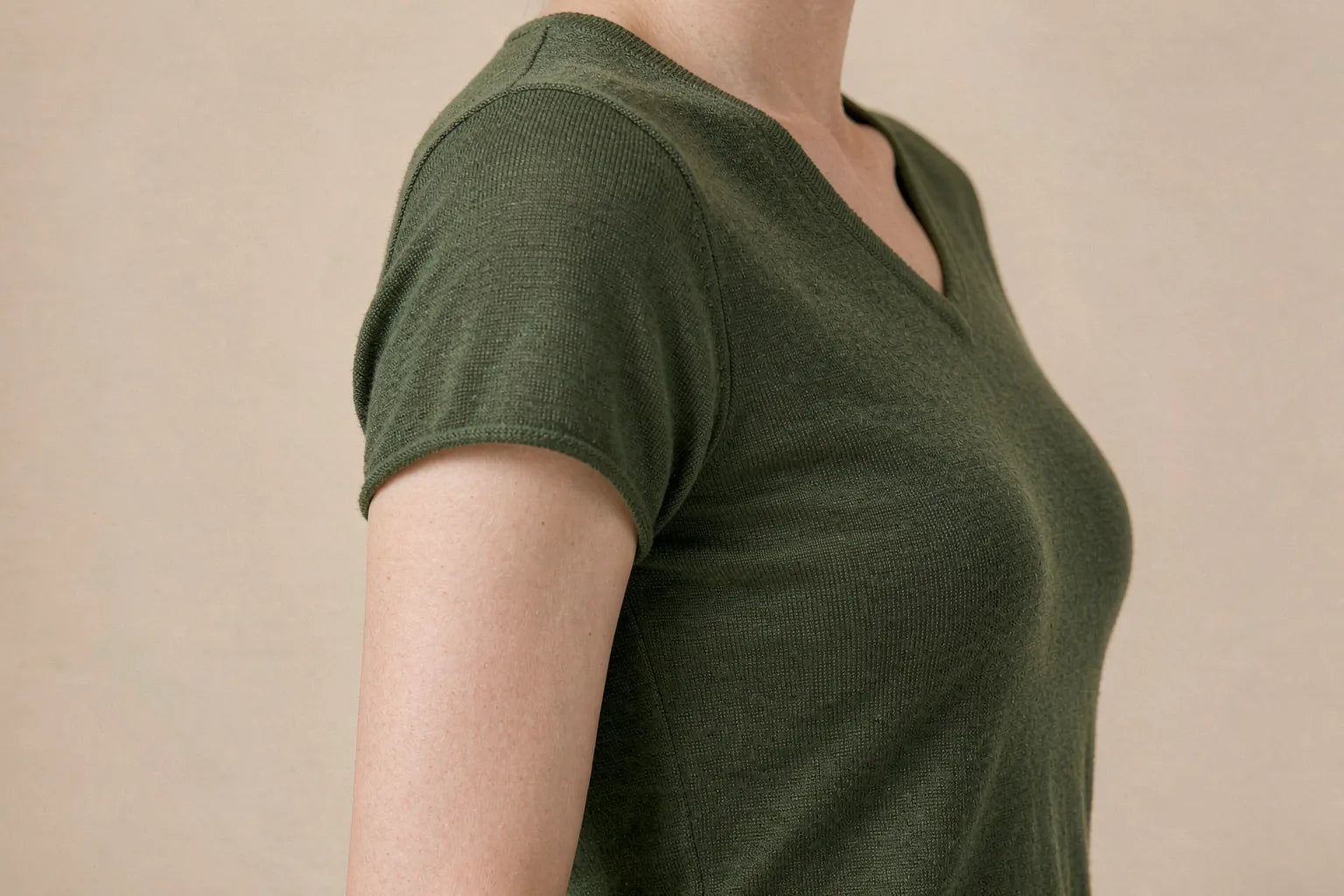
When the seam slides down onto the upper arm, two things happen. The shoulder visually widens — drooping fabric past your natural shoulder point reads as broader shoulders and a bigger frame. And the armhole drops with it, so the whole garment shifts and re-settles every time you move. On a packed MRT morning, that creeping seam is a small misery you feel every ten minutes.
Now the nuance that trips people up: a knit can legitimately have a dropped shoulder — wide, slouchy seams are a deliberate design language in relaxed knits. The test is whether the drop looks proportioned. A designed dropped shoulder falls just a few centimetres past the bone, and the sleeve stays structured. An accidental one sags halfway to the elbow while the rest of the top fits slim — the two don't agree with each other. If your shoulders sit between standard sizes, our guide on between sizes: size up or down covers whether to size up or down for exactly this seam.
How Much Ease Should a Knit Top Have at the Bust?
Bust ease — the gap between your measurements and the garment's — works differently in knits than in anything woven, and this is where most size-chart confusion starts.
A woven shirt needs 1–2 inches of ease at the bust because the fabric can't stretch; without that room you can't cross your arms. A knit needs far less, because the fabric itself gives. A slim knit worn with zero ease — a true negative ease knit — is functioning as designed: the fabric rests gently against the body without pressing. Our Slim V-Neck Base-Layer Top is cut exactly this way: it skims rather than presses, and the stretch does the work a woven would need inches of allowance for.
Two quick tests separate a close fit from a wrong fit:
- The pinch test. At the side waist, pinch the fabric between your fingers. About one to two fingers of extra cloth is the comfortable zone. More than two fingers of pinch means the knit runs big; you'll see it pooling by lunch.
- The light test. Under bright light — office fluorescents will do — check whether the fabric stretches so far across the bust that it turns sheer and the texture thins visibly. Stretched-to-translucence means the size is doing more work than the fabric was engineered for.
For reference against your own numbers, measure a knit you already love, flat across the chest, and compare — the method in our how to measure yourself guide takes minutes and ends the guesswork.
Where Should a Knit Top Hit?
Hem length is the fit dimension nobody checks in the fitting room and everyone regrets at the office. Where the hem lands decides what you can do with the top: tuck it, layer it, or leave it.
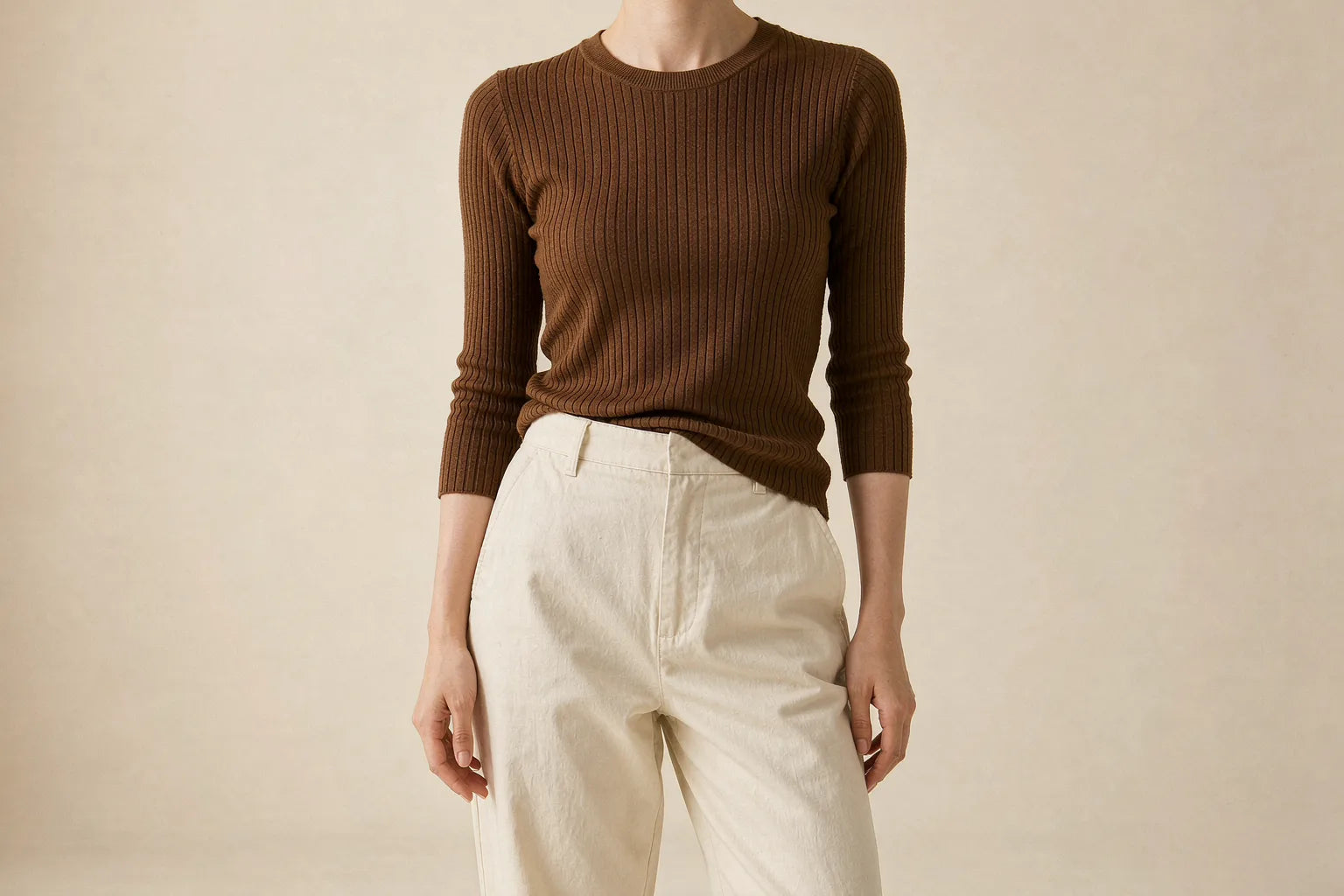
So where should a knit top hit? As a working rule:
- At the hipbone. The versatile everyday length: enough fabric for a half-tuck that survives a commute, short enough to leave untucked without swallowing your waist. The Mid-Sleeve Crew Knit Top lands here on me at 163cm — the piece I reach for when one top has to do a morning meeting and a kopitiam lunch.
- Just past the trouser waistband. The tucking length. A hem a couple of centimetres below the waistband tucks fully without escaping by mid-afternoon — what I want in a commuter piece like the Matte-Texture Short-Sleeve Knit Top for Workwear, which stays matte and smooth under an office cardigan.
- At the hip or just below. The layering length, meant to sit over bottoms untucked. Fine for tall frames, risky for shorter ones: on a petite frame this length cuts the leg line, unless the trousers are high-waisted and the knit is slim and drapey — the pairing rules in our wide-leg pants styling guide for petite frames apply here too. A petite knit top in this zone should be slimmer through the body than the same length would be on a taller frame — our Soft Slim Crew-Neck Knit Top with Gentle Drape pulls it off because the fabric falls inward rather than standing away.
What Are the Signs a Knit Top Is Too Big?
Because knits forgive so much, an oversized one hides longer than a woven does — the stretch keeps promising it'll settle. These are the knit top too big signs I check for, in order of how much they matter:
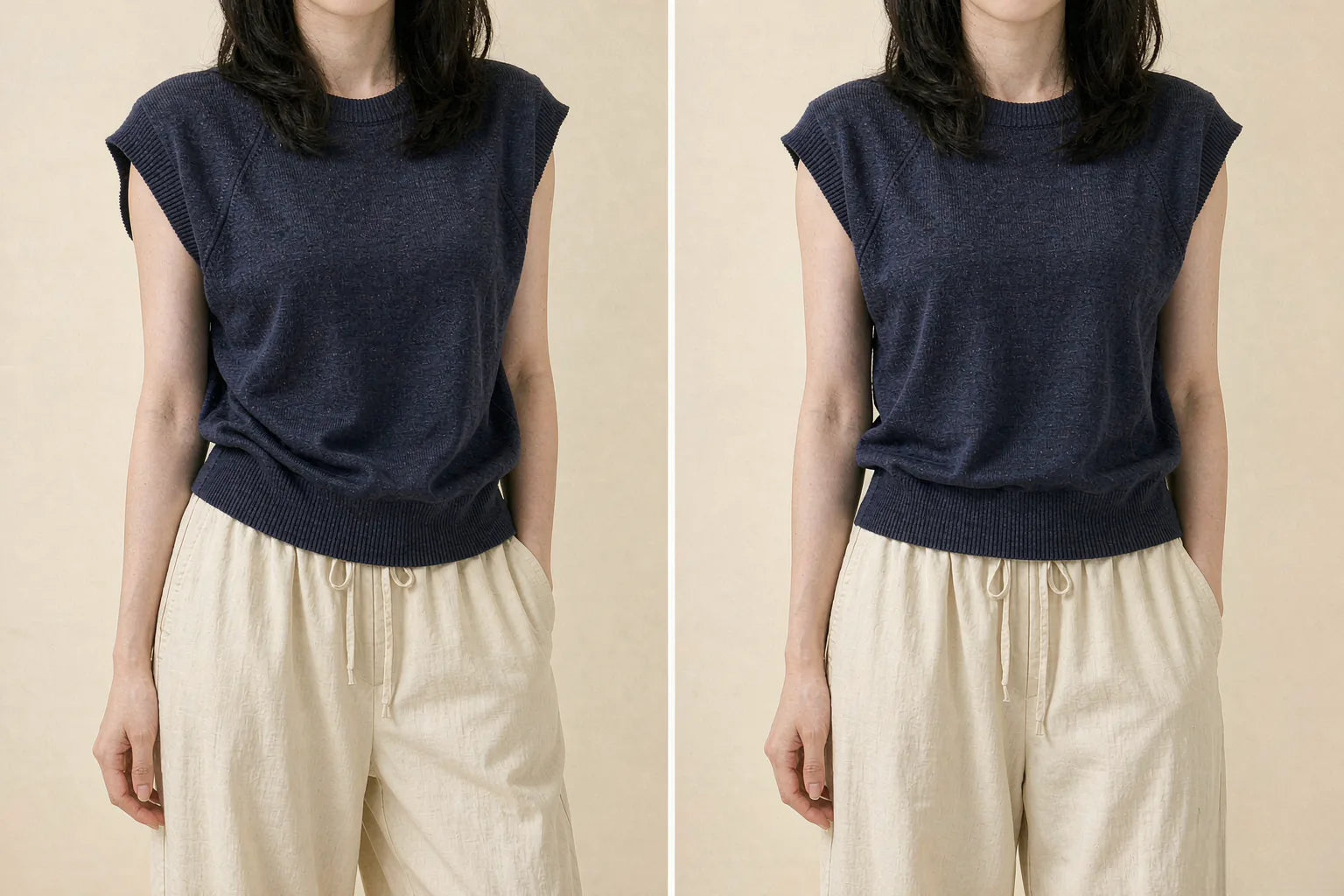
- The seam slides past the shoulder bone and keeps going through the day. First sign, and the one that disqualifies a piece fastest.
- The armhole drops — you feel fabric gape under the arm, and a bra strap or the side of a camisole shows every time you reach.
- The hem stacks. Extra length piles into horizontal folds at the hip, adding width exactly where the eye finishes reading your silhouette.
- The neckline loosens. A ribbed collar that stands away from the body turns every forward lean into a wardrobe calculation — the collar should rest against the skin at the base of the neck.
- The ribbing goes slack. Ribbed cuffs and hems are knitted to grip; if the rib already hangs loose in the shop, it has done its stretch and won't recover.
Any one of these can be a design quirk; three or more together mean the size is wrong. The Cap-Sleeve Crew Knit Top is a useful benchmark — cut close through the shoulder, so trying it makes a drooping seam on another piece instantly obvious.
Here is the whole fit conversation compressed into one table — the four checkpoints, plus the neckline that quietly undoes the other four:
| Fit Checkpoint | What Right Looks Like | Too Big | Too Small |
|---|---|---|---|
| Shoulder | Seam ends at the shoulder bone point | Seam droops onto the upper arm | Seam rides up the neck, pulls across the back |
| Bust | 1–2 fingers of pinch at the side waist | More than two fingers of loose fabric | Fabric stretches sheer; side seams pull |
| Hem | Lands where you intend to tuck or layer | Stacks in folds at the hip | Rides above the waistband when you reach |
| Armhole | Lift test: hem rises slightly, falls back | Gapes open under the arm | Whole body of the top climbs with your arms |
| Neckline | Collar rests against the base of the neck | Stands away; gaps on a forward lean | Collar digs; feels tight when you swallow |
Do Sleeves and Armholes Change the Fit?
More than most people credit. Two knits with identical bodies can fit completely differently above the bicep, because sleeve length and armhole height move together.
Sleeve length sets the expectations. A cap sleeve ends on the shoulder cap itself and reads tidy — but only if the armhole sits high enough to hold it there. A low armhole turns a cap sleeve into a flutter that rides outward. A short sleeve should end mid-bicep or just above, and a mid sleeve, past the elbow, needs the armhole to sit close or the whole sleeve pools at the forearm.
Armhole height is the quiet variable. A higher armhole — fabric cut closer into the armpit — lets you move without the body of the top travelling with you. The simple test: lift both arms overhead. If the hem rises and stays lifted, or the whole chest of the top climbs with your arms, the bust is too tight. A well-fitted knit's hem will lift slightly and fall right back. The Seamless-Knit Short-Sleeve Top is built with this in mind — the seamless construction removes the side seams that normally bind first, so the lift test comes out cleaner than on most seamed knits.
How Is Knit Fit Different From Woven Fit?
The whole difference comes down to one property: recovery. A woven keeps whatever shape it's cut into; a knit stretches and then either springs back or doesn't, depending on how it was made.
Three practical consequences follow. First, fit tolerance is narrower than it feels — a knit that stretches but recovers poorly will sag by afternoon, so recovery, not stretch, is what you're buying. Second, ribbing changes local fit: ribbed panels grip and release in ways flat jersey doesn't, which is why ribbed collars and cuffs can rescue an otherwise simple cut. Third, weight shapes drape — a fine-gauge knit skims and follows the body, a heavy dense knit stands away and boxes out the silhouette. Weight also decides how a piece breathes — our guide to which fabrics breathe best covers that properly. Here it's enough to say: the same fibre at a lighter weight will hang closer, move more, and suit a slim cut.
How Should a Knit Top Fit? The Five-Step Check Before Buying Online
Online removes the mirror and adds the size chart, so the checks change shape. This is the sequence I run before any knit enters my basket:
- Get the flat-lay bust measurement in centimetres. Product pages worth their salt list the garment measured flat, pit to pit — double it for the full bust. Compare against a knit you already own and like. Numbers beat charts: an "M" means different things in every brand on earth, and our US, UK, EU and SG/MY size conversion guide covers how much those labels drift across markets.
- Read the composition for stretch content. A few percent of elastane signals a body-skimming cut with recovery built in; a fully rigid cotton knit runs closer to woven logic and needs more ease.
- Check the model's stated height and size. A hem that hits the hipbone on a 175cm model lands lower on a 163cm frame. Recalculate where the hem will sit on you before trusting the photo.
- Re-read the seam position in the photos. Straight-on product shots hide it; any lifestyle shot from the front reveals whether the seam sits at the bone or droops past it.
- Buy the shoulder first. If two sizes bracket you, size for the shoulder — a seam is the one thing a tailor struggles to move on a knit, while bust and length are far more forgiving.
It compresses fast with practice — I run the whole list in about two minutes now, and the returns drawer at my flat has stayed quiet ever since. Bookmark this page as your knit top fit guide — the four checkpoints and the table above cover every decision you'll make at the rack. When in doubt between two sizes, the size up or down decision tree settles it by garment type.
Ready to Run the Four-Point Check on Your Own Knit Drawer?
Shoulder at the bone, one to two fingers at the bust, hem where you'll use it, armholes that survive the lift test — four checkpoints, two minutes, and most of the sizing regret in your wardrobe disappears. Try it tonight on the knits you reach for most and the ones you avoid; the difference between the two piles usually traces back to one of the four. For fine-gauge knits cut around these checkpoints, browse all RUIJIN pieces — and run the four-point check on anything before it earns a place in the drawer.
FAQ
How do I know if a knit top is too big?
Check five signs in order: the seam sits past the shoulder bone, the armholes gape when you reach, the hem stacks in folds at the hip, the neckline stands away from the skin, and ribbed cuffs or hems feel slack. Three or more together mean it's the wrong size, not a design feature.
Should I size up in knits?
Usually no — knits are engineered to stretch, so sizing up often lands you the drooping seams and pooling hems that wovens keep hidden. Size up only for rigid, low-stretch knits or deliberate oversized cuts, and let the seam at the shoulder be the decider when you're caught between two sizes.
Where should a knit top hit on a petite frame?
At the hipbone for everyday half-tucks, or just past the trouser waistband for full tucks. Longer hems work on a petite frame only when the knit is slim and drapey and the bottoms are high-waisted — a boxy untucked length cuts the leg line and flattens the whole silhouette.
Can a too-big knit top be altered?
Partly. A tailor can take in side seams and shorten the hem easily on most knits, though ribbed hems and fine gauges need an experienced hand. The seam at the shoulder is the exception — moving it on a set-in knit is difficult and rarely worth the cost, which is why fitting the shoulder correctly at purchase matters most.
How tight is too tight for a knit top?
When the fabric stretches to translucence across the bust, pulls visibly at the side seams, or the hem climbs and stays up when you lift your arms — that's the fabric working harder than it was designed to. A slim knit should skim and recover, not grip.
0 comments