

What's the right pants length for petite women? For most petites, full-length pants land somewhere in a 25–29 inch (64–74 cm) inseam range, and the exact number is decided by three inputs: your height, your shoe, and the silhouette of the pant. The same wide-leg trouser that reads as an ankle grazer on a 175 cm model can puddle over your shoes at 157 cm — the garment did not change, the arithmetic did. Below: what inseam actually measures, inseam ranges by height in inches and centimetres, where the hem should stop with flats versus heels, how the rules bend between straight and wide legs, and what to do about a pair that arrives too long.
A scope note first: the inseam tables below are general petite knowledge for all readers. Our own pants are drafted on regular proportions, and we recommend the collection for 160 cm and up — under that height, a shortened hem solves length but not rise or waist, so order only with tailoring in mind.
Key takeaways:
- - Full-length inseam ranges for petites: roughly 26–28″ (66–71 cm) under 5'2″ and 27–29″ (69–74 cm) between 5'2″ and 5'4″ — treat them as ranges to verify, not verdicts.
- - With flats, a full-length hem touches the top edge of the shoe; with heels it can drop to the heel root. One pair rarely does both jobs well.
- - Straight legs stop at the shoe's top edge and punish stacking; wide legs can fall toward the heel root but never past it.
- - The boutique's eight linen pants all ship in S/M/L regular sizing with no petite-labelled cut — so check the PDP garment length against the tables here before ordering.
- - Under about 160 cm (5′3″), be honest with yourself: the pants here are drafted on regular proportions — even a shortened hem leaves the rise and waist unsolved. Knits and tops are the easier entry point, and pants need a tailor’s plan for both waist and hem.
- - Pants that arrive too long: a twice-turned cuff holds on an elastic-waist pair, hem pins buy time, and permanent shortening belongs to a tailor — or to the 30-day return window.
What Does Pants Length Actually Measure — Inseam, Outseam and Rise?
Three measurements govern a pant's length, and only one of them is the number you want. The inseam runs from the crotch seam down the inner leg to the hem — it decides where the hem lands on your shoe. The outseam runs from the waistband straight down the outer side to the hem; product pages usually list this as the garment length, which is why two pairs with the same outseam can still sit differently — a higher rise consumes centimetres before the fabric ever passes your hip. The rise — waistband to crotch seam — sets where the pants sit and how much leg the outseam has left to cover.
This is why the tables in this guide work in inseam, and why outseam numbers on a product page need one step of translation: subtract roughly your rise from the outseam to estimate the hem's working length. Measure yourself at home once — waist, rise and inseam — and every table below becomes checkable against your own body rather than a model's.
To measure your inseam two ways:
- From a pair you own. Lay the pants flat, smooth the inner leg, and measure from crotch seam to hem along the inner seam. Use the pair whose length you have never once thought about.
- From your body. Standing straight in bare feet, measure from your inner thigh at the crotch down to where you want the hem to end — for full-length, that point is the top edge of your shoe.
What's the Right Full-Length Inseam for Petites, by Height?
The petite-shopping guides that circulate widely — the measurement cheat sheet on petitefashion.org, the inseam guide on ruesophie, and the height-band tables on hotpossessions — converge on the same territory: petite full-length inseams cluster between 25 and 29 inches, shifting up with height. Consolidated as a range reference:
| Height | Full-length inseam | Ankle-length inseam |
|---|---|---|
| Under 5'0″ (under 152 cm) | 25–27″ / 64–69 cm | 23–25″ / 58–64 cm |
| 5'0″–5'2″ (152–157 cm) | 26–28″ / 66–71 cm | 24–26″ / 61–66 cm |
| 5'2″–5'4″ (157–163 cm) | 27–29″ / 69–74 cm | 25–27″ / 64–69 cm |
| 5'4″–5'6″ (163–168 cm) | 28–30″ / 71–76 cm | 26–28″ / 66–71 cm |
Read these as consensus ranges to verify against your own measurement, not as verdicts — sources differ by an inch or so, and rise and shoe shift the target. Within one range, the move in between sizes: size up or down applies: shorten when the hem sits above a shoe, go longer when it must clear a heel.
My colleague Mei, 157 cm, learned the range the hard way. She ordered a wide-leg pair she had watched a 175 cm model wear as a clean ankle grazer. On her, the same garment finished about five centimetres under the sole of her sandal. Her inseam measured 27″; the pants asked for 31″. Nothing was wrong with the fit at the waist — only the third number, the one nobody had checked, had been left to chance.
Where Should Pants End — by Shoe Height?
The hem is a function of the shoe, which is why stylists who dress shorter clients professionally often keep one pair shortened for heels and one for flats rather than asking a single hem to serve both. Tailoring calls the contact point the break — how the hem meets the shoe. Three tiers matter here: a no break, where the hem just meets the top of the shoe with no fold; a slight break, one small fold of fabric at the front; and a full break, where the fabric stacks visibly — a look that on a petite frame almost always reads as "too long" rather than "intentional."
| Shoe | Straight or full-length hem | Wide-leg hem |
|---|---|---|
| Flat sandals, sneakers | No break: hem meets the shoe's top edge | Skims the shoe's top edge, never touching the floor |
| Loafers, ballet flats | No break to a hint of break at the shoe | Floats just above the shoe's top line |
| Low heel (2–4 cm) | Slight break at the shoe's edge | Falls to just above the heel root |
| High heel (5 cm and up) | Hem reaches the heel root, back edge clear of the ground | To the heel root, front edge covering the top of the shoe |
The wide-leg column runs longer because the fuller silhouette needs to cover more shoe to look deliberate — a wide leg that stops above the ankle bone can shorten the leg line instead of extending it. Want to see the rule on a real garment? The fluid-drape wide-leg linen pants in Khaki carry the weight that lets a wide leg fall to the heel root without pooling.
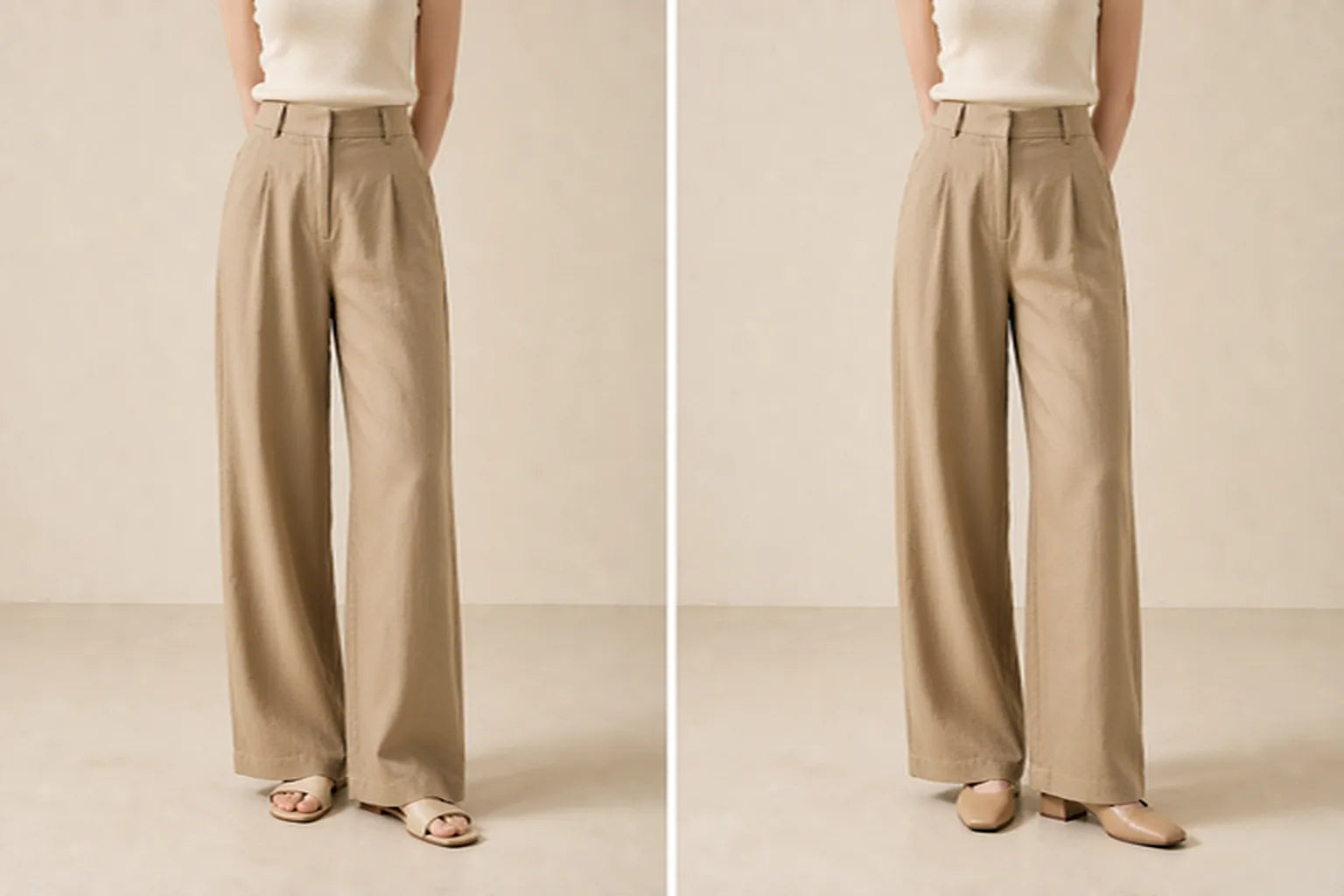
Wide-Leg vs Straight vs Tapered: Do Length Rules Differ?
They do — each silhouette has its own landing zone and its own way of failing. A straight leg hides nothing: extra length stacks at the ankle in a way the eye reads immediately. A wide leg absorbs length into its column of fabric, which is its advantage and its trap — it can fall farther without looking wrong, but it can also swallow the shoe entirely. And a cropped length has one hard boundary: stop before the calf's widest point.
| Silhouette | Where the hem belongs | The no-go zone |
|---|---|---|
| Straight leg | At the shoe's top edge, no break or barely one | Puddling or stacking over the shoe |
| Wide straight-leg | Between the shoe's top edge and the heel root | Stopping mid-calf at the leg's widest line |
| Wide-leg, fluid drape | Top of the shoe to the heel root | Dragging on the floor behind the heel |
| Cropped / 7/8 | At or just above the ankle bone | Ending at mid-calf |
Mapped to the pants carried by this boutique, the same three length tiers sort cleanly. The full-length straight group — the Italian-tailored high-waist straight-leg trousers, the 100% linen straight-leg trousers and the elastic-waist pair covered below — takes the strictest hem rule and offers the highest length tolerance in the waistband. The wide straight-leg linen-cotton pants sit between the two logics, as their hybrid cut suggests. The fluid wide-leg group runs longest and leans on shoe height the most.
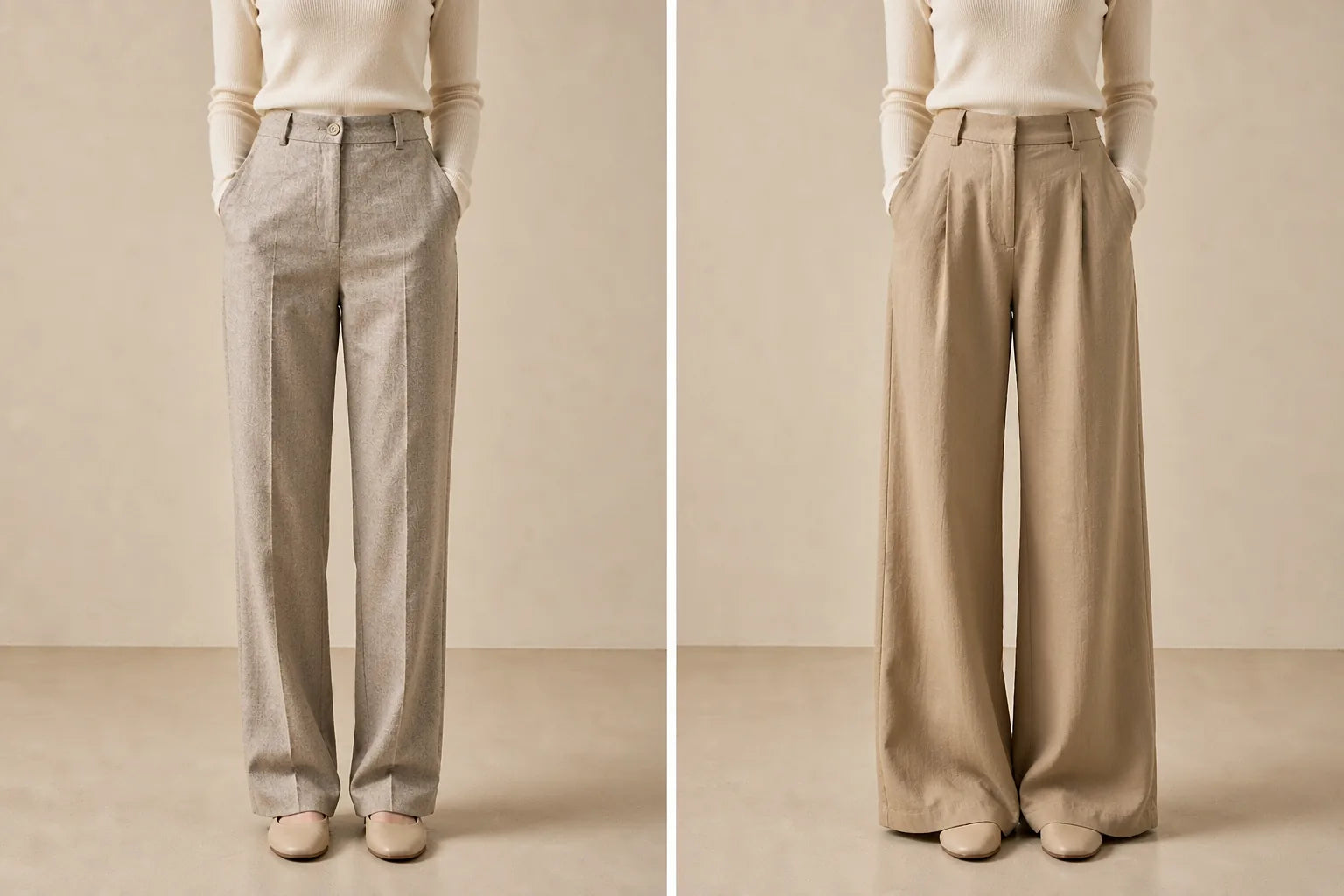
When Do Ankle and Cropped Lengths Flatter a Petite Frame?
Ankle length — hem at or just above the ankle bone — is the most forgiving length a petite wardrobe can own. It works with flats and low heels without alteration, it never drags, and it exposes the narrowest point of the leg, which reads as longer. In the ankle vs full length decision, ankle wins on versatility and full length wins on formality: with the right shoe, a true full-length straight leg elongates in a way no cropped hem can.
Cropped pants work on petite proportions with one condition — the hem stays above the calf's widest point.
There is also the 7/8 trick, documented by petite bloggers who test clothing at around 150 cm: regular-size styles cut to 7/8 length often land like full-length trousers on a shorter frame. The honest version of that trick for this boutique: the pants here come in S/M/L regular sizing — there is no petite-labelled cut — so a 7/8-proportioned regular size can genuinely serve as your full length. The verification is the same either way: read the garment length on the product page and check it against the height table above, the way the sizing logic in between sizes: size up or down suggests.
Pants Too Long? What You Can Do Before and After Checkout
Before checkout, do the arithmetic the product page leaves implicit. Take the listed garment length, subtract an estimated rise, and compare the remainder to your measured inseam against the height table. Check the model's listed height where the page gives one — a hem that hits mid-ankle on a 175 cm model will land near the floor on a 158 cm wearer.
After checkout, three temporary fixes hold without a tailor:
- The turned-up cuff. Fold the hem outward once, three to four centimetres, and press the fold with your fingers. A wide-leg pant carries enough fabric weight to hold the fold; worn over a shoe, it reads as a deliberate deep cuff.
- The elastic-waist advantage. The relaxed wide-leg pants with stretch are the one pair in this guide's picks with elastane in the blend, so a rolled cuff keeps its shape instead of sagging loose by lunch — and the pull-on waist lets you wear the waistband higher, which shortens the effective leg without touching the hem. The elastic-waist linen pants offer the same waistband adjustability in a straight leg.
- Hem pins or fabric tape. For a pair that must work tonight: turn the hem under to the right length and secure from the inside with safety pins placed vertically, or hem tape pressed with an iron. Invisible from outside, fully reversible.
The honest boundary: a permanent shortening — keeping the original hem finish, resewing it at your length — is tailor's work, and on lined or finished-hem trousers it costs more than many expect. Before paying for it, weigh the 30-day return window that applies to the boutique's orders — a pair bought at the wrong length is returnable.
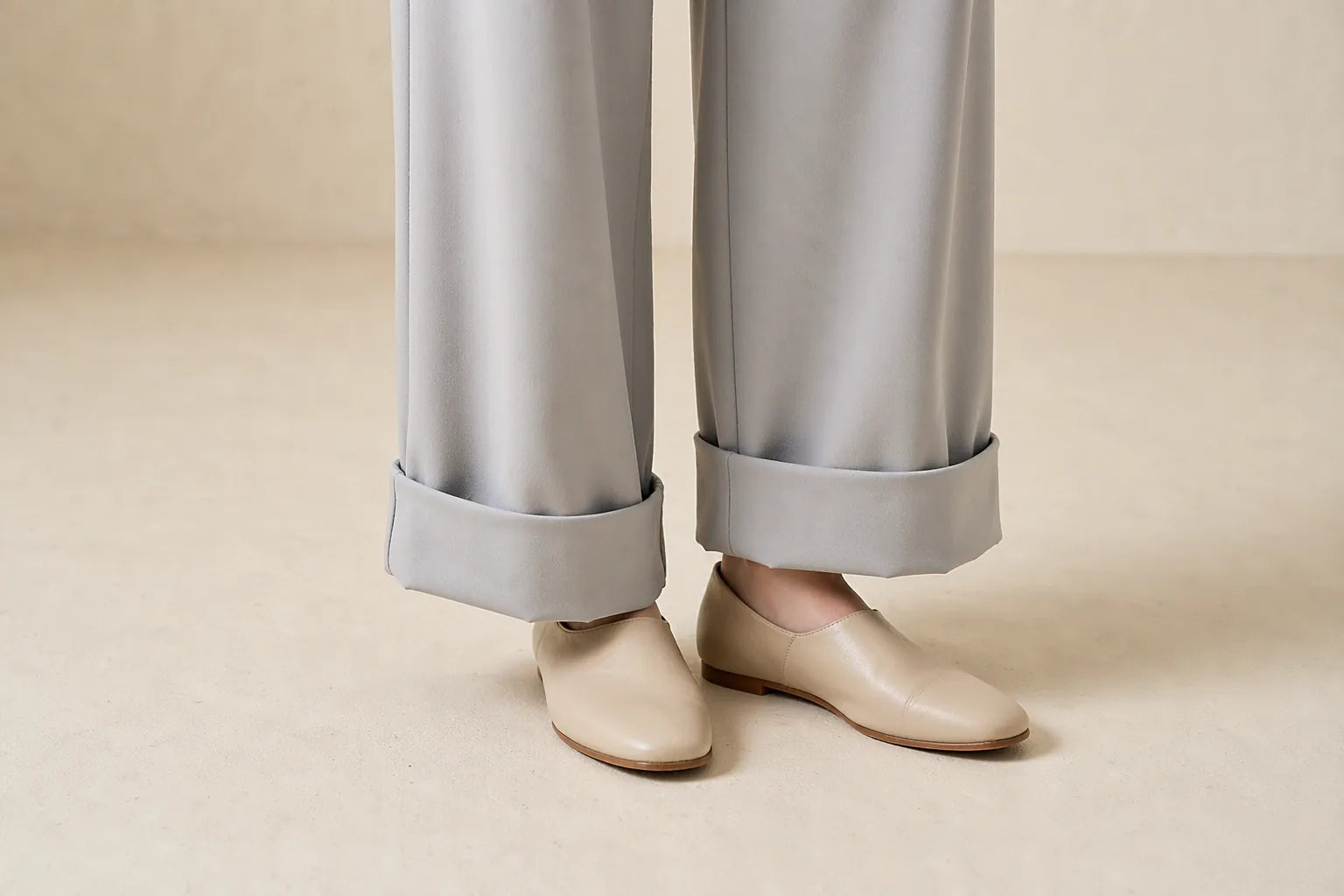
Fit Checklist Before You Order Pants Online
Five steps, in order, take about ten minutes the first time and two minutes on every pair after:
- Measure your inseam — from a pair you already trust, crotch seam to hem, following the method above.
- Read the PDP garment length — note whether the number is outseam or inseam, and convert if needed.
- Match the silhouette to its table — straight, wide straight-leg, fluid wide-leg or cropped, each has a different landing zone.
- Match your shoe — decide flats or heels first, then pick the hem target from the shoe table.
- Keep the exit open — orders ship to Singapore and Malaysia with Standard delivery at $6.00 (free over $80, Standard only), Expedited at a flat $46, checkout via PayPal, and a 30-day return window. Sizing decisions still get a margin; the fit rules for a blazer apply the same logic to the top half of the outfit.
A colleague in Kuala Lumpur ran this checklist before ordering the taupe straight-leg linen pair for a wedding weekend — flats for the day, low heels for dinner. The garment length on the page translated to a 28″ working inseam, right at the top of her band, and the pair needed nothing: no cuff, no pins, no tailor. That is what the checklist is for — not fuss, just skipping the return.
Ready to Choose Pants Length by Height and Shoe?
Three numbers decide every hem: your height sets the inseam band, your shoe sets the landing point, and the silhouette sets how far the hem may travel between them. Measure once, read the product page twice, and the guesswork leaves the process — the same wide-leg pants that puddled on Mei become an ankle grazer the moment the inseam matches the body wearing them. Length, though, is only the first half; what to wear over and around the hem is its own craft, covered in how to style wide-leg pants for petite frames. Start with the height table, then run your next order through the five-step checklist — the 100% linen straight-leg trousers are a pair that rewards exactly that process.
FAQ
What inseam should a petite woman get for full-length pants?
As a range reference drawn from widely circulated petite guides:
- Under 5'2″ (157 cm): 26–28″ (66–71 cm)
- 5'2″–5'4″ (157–163 cm): 27–29″ (69–74 cm)
- Over 5'4″ (163 cm): 28–30″ (71–76 cm)
Verify against your own measured inseam; rise and shoe shift the target.
Where should wide-leg pants hit on a petite woman?
Between the top edge of the shoe and the heel root:
- With flats: skimming the shoe's top edge, never touching the floor
- With heels: down to the heel root, front edge covering the top of the shoe
- Never: pooling on the floor or stopping at the calf's widest point
Are ankle pants or full-length pants better for petites?
Both work — under different rules:
- Ankle (at or just above the ankle bone): the versatile default; works with flats and low heels unaltered
- Full length: the formal option; elongates most with the correct shoe, but its hem is hostage to that shoe
How do you fix pants that are too long without tailoring?
Three temporary fixes, in order of durability:
- A turned-up cuff, folded outward 3–4 cm (holds longest on elastic-waist or stretch-blend pairs)
- Hem pins or fabric tape applied from the inside, fully reversible
- For a permanent result: a tailor — or the 30-day return window on the original order
Should petites size down in length instead of buying petite sizes?
Often, yes — with verification:
- Regular-size 7/8 or cropped cuts frequently land like full-length trousers on shorter frames
- This boutique's pants come in S/M/L regular sizing only, with no petite-labelled cut
- The method: read the garment length on the product page, compare against the height table here, and let the numbers — not the size letter — decide
- - If you are under about 160 cm (5′3″), factor in tailoring for both waist and hem before ordering — knits come closer, but the pants are drafted on regular proportions.
0 comments