

The answer to how to look expensive in hot weather: put your money where the heat tests hardest — matte natural fabrics, relaxed silhouettes that still hold a line, and a low-saturation colour palette. In Singapore or Malaysia — 33°C pavement, 80% humidity, ice-cold air-conditioning indoors — those three choices decide whether an outfit reads polished or parched. There is nowhere to hide — no blazer to cover creases, no layers to disguise shine. This guide turns the answer into a system — fabric, fit, colour, accessories, upkeep — plus a five-mistake checklist, one comparison table and two outfit formulas.
You already know the failure mode. You leave the house crisp and by the first uncovered crossing the shirt is clinging, the outfit whispering sale rack. Stylists call summer the season where cheap shows, and in the tropics it never ends. The good news: looking expensive in heat is not about spending more. It is about fabric-first rules that hold up at 33°C, ordered below from the fibre outward so you can fix the biggest leak first.
Key Takeaways - Matte natural fibres — combed cotton, linen, lyocell — absorb moisture instead of reflecting it: the fastest single upgrade. - Fit rule for heat: relaxed but anchored. Fabric hovers, never clings; structure comes from knit gauge, not tightness. - Low-saturation earth tones age gracefully under strong sun; saturated brights bleach and read cheap within weeks. - A lightweight cotton cardigan for summer is the tropics' third piece: one degree of warmth for ice-cold offices. - Every RUIJIN knit featured here sits between $38 and $48, so the system fits a modest budget.
Why Does Hot Weather Make Outfits Look Cheap First?
Because the season strips away every camouflage an outfit has. In cooler months a coat hides a creased shirt. In a tropical climate, fabric is the entire visual — whatever sits against your skin is roughly ninety per cent of what people see, so a mediocre fibre becomes the whole message.
Heat runs three specific tests. The sweat test: damp fabric shifts colour and clings, and synthetics announce every patch. The light test: equatorial sun makes shiny filaments throw back a glare that matte cotton never would. The crease test: humidity sets folds along seat lines and bag straps, exactly where you cannot smooth them.
None of these tests care about price tags: an expensive polyester blouse fails all three, a $38 cotton knit can pass them. Choose materials that behave well when wet and warm, then let silhouette and colour do the rest.
Which Fabrics Look Expensive in Humid Heat?
Four fibres pass the humidity test: combed cotton, linen, lyocell, and natural-fibre-majority blends. All four are matte and absorb — the trait that matters most in damp heat. Linen can take on roughly a fifth of its weight in moisture before it feels damp to the touch, which is why a linen-blend knit stays composed through a wet commute. Combed cotton breathes and softens with washing; lyocell drapes like silk. Common synthetics behave in reverse: polyester absorbs under one per cent of its weight, so moisture sits on skin and surface alike, and the light bouncing off that surface is the shine that reads cheap.
Two field tests settle it. Tilt: hold the garment under light and rotate — expensive-looking fabric stays matte throughout. Crush: squeeze a handful for ten seconds and release; fibres that spring back softly will survive a day of sitting, while deep set creases broadcast neglect by lunch.
Mei, a 34-year-old teacher in Johor Bahru, learned the tilt test the hard way. For inspection day she wore a glossy polyester blouse. One outdoor assembly at 8am and the shoulders were shining — with sweat, not crispness — and the fabric clung in a map of damp patches she spent the day hiding behind a file. Her replacement, a fine-gauge cotton top in a warm neutral, has survived two years of assemblies since.
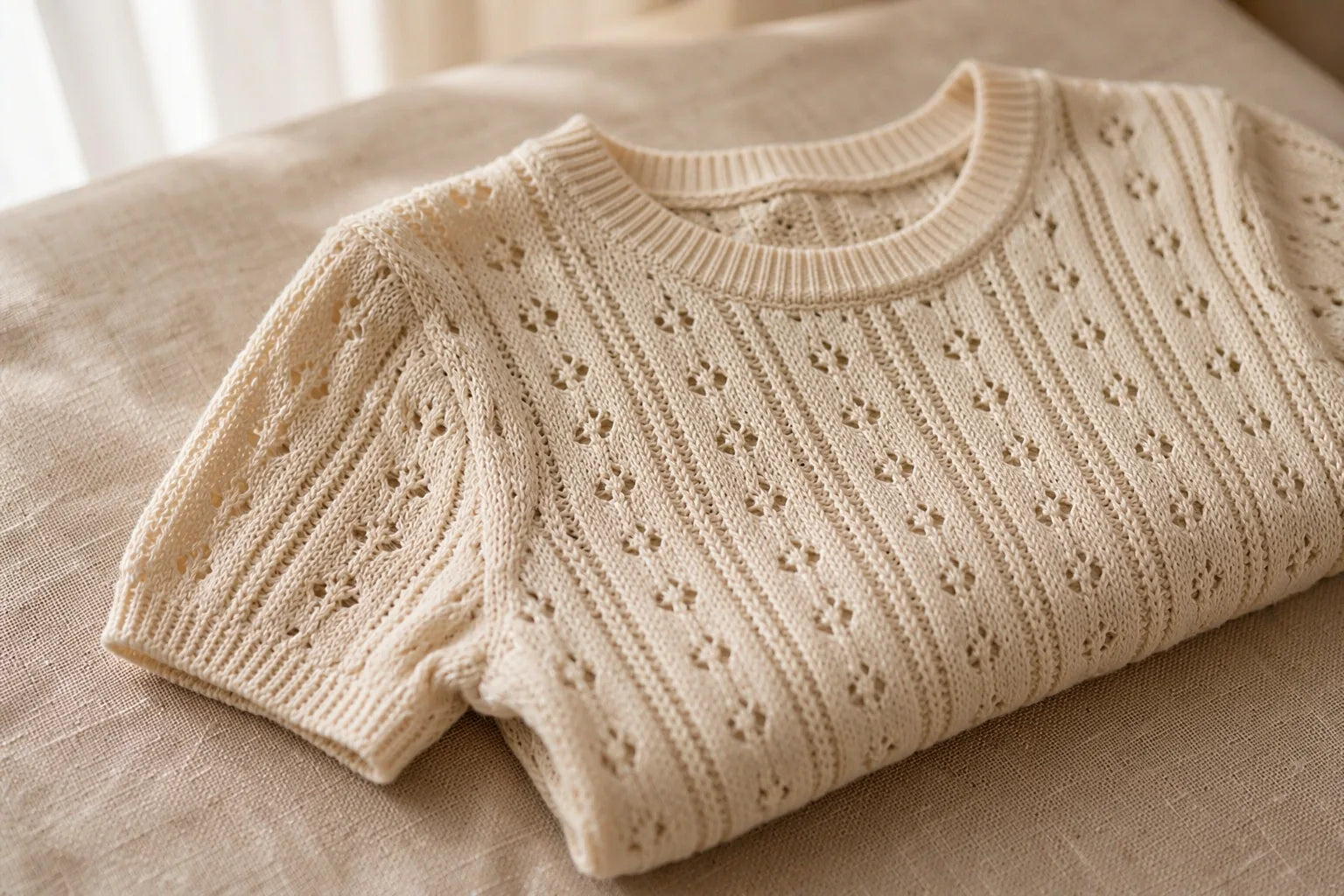
The cable-knit short-sleeve top in 100% combed cotton at RQFashion is the shortlist in practice. For the full fibre-by-fibre breakdown, see our guide to why these fabrics stay cool in 33°C humidity.
What Silhouettes Read Expensive When It's 33°C Outside?
The rule is relaxed but anchored: fabric should hover, not cling. Skin-tight cuts map every curve and sweat line; oversize cuts read like sleepwear. The zone in between is built from a handful of shapes: H-line dresses, straight or wide trousers hanging from the hip with an air gap at the thigh, and high waistlines that lengthen the leg without squeezing the waist.
In knits, structure comes from gauge, not tightness. A fine-gauge knit holds a clean edge at the neckline and shoulder while still letting air move, which is why knit tops outlast flimsy woven blouses in tropical offices. If a hem or sleeve edge ripples, the fabric is too light for its cut.
If you are petite, scale the rules down: raise the waistline, crop the trouser length to skim the ankle, and keep one colour family so the eye reads a single long column. Our petite guide to styling wide-leg pants covers those proportions, and the same logic powers the work outfits we built for hot humid weather.
Which Colours Look Expensive in a Tropical Summer?
Low-saturation earth tones photograph expensive: apricot, oatmeal, khaki, beech green, navy and black — the Maillard palette we keep returning to — carry depth without demanding attention. Saturated brights do the opposite in strong sun: they bleach unevenly, and faded neon reads thrifted within weeks.
Mid-value earth tones also behave better around water: pale greys and powdery blues show sweat marks fastest, while warm mid-tones hide minor damp patches and dried salt. In a climate where you sweat daily, colour choice is maintenance strategy. Tone-on-tone is the quickest upgrade inside the palette — oatmeal over khaki, apricot against cream, navy with black. Our colour combinations guide shows the tones assembled into full outfits.
How Do You Look Expensive on a Budget?
The honest answer to how to look expensive on a budget is a spending order: fabric first, fit second, colour third. Fabric is the one element you cannot fake at close range — shine and cling announce themselves across a room. Fit is fixable cheaply; a hem adjustment upgrades a garment more than a pile of accessories would. Colour is nearly free.
Applied to a tropical wardrobe: buy fewer, better fibres near the body — tops and knits — and let trend pieces sit at the edges where their weaknesses have nowhere to show. Three of the knits featured here cost between $38 and $48, which puts the whole system within reach of one modest payday.
Nurul, a reader in Petaling Jaya, traded a drawer of five never-worn synthetic tops for a knit two-piece set in oatmeal plus one combed-cotton knit top — four wearable outfits from two purchases, each pairing with trousers she owned. Six months on, the synthetics are gym clothes and the knits have logged more wears per dollar than anything else she owns.
The psychology matters too: expensive is an impression of restraint, not abundance — the distinction we unpacked in quiet luxury versus logo luxury. The quiet side of the ledger is the one that reads costly in heat.
Can a Lightweight Knit Be Your Summer Power Layer?
Yes — and a lightweight cotton cardigan for summer is arguably the most underrated piece in a tropical wardrobe. The objection writes itself: it is 33 degrees. But your day is not. Offices, malls and trains run at 22–24°C, and the vent above your desk does not care what the pavement was doing at noon.
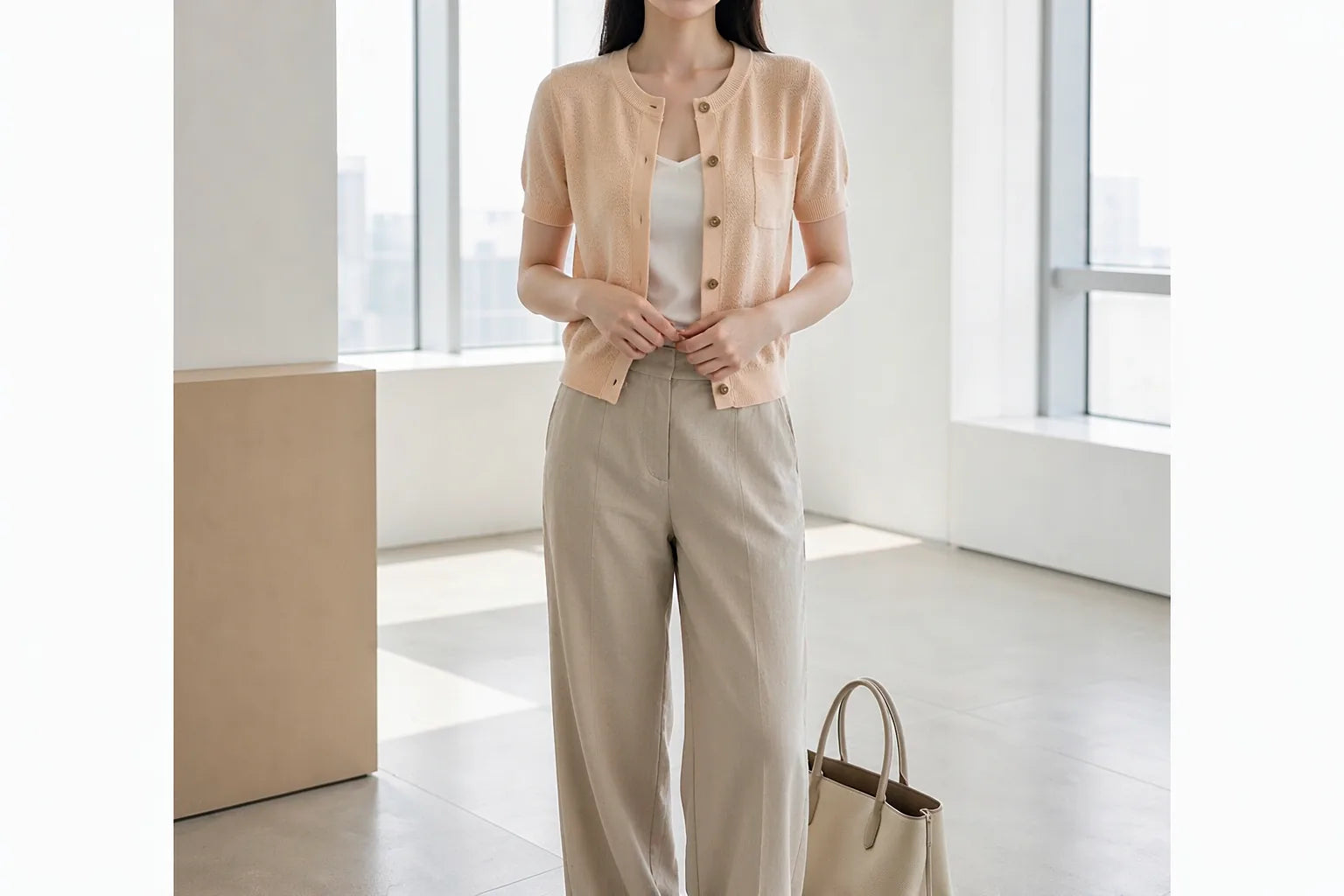
The tropics-specific version is a short-sleeve or fine-gauge cardigan worn open: it covers the shoulders that go cold first, adds one degree of warmth, and packs to nothing in a tote. A short-sleeve knit cardigan in a cotton-linen blend does this neatly — the linen keeps the layer breathable between air-conditioned islands, and the button front lets it double as a top.
Wear it third-piece style: over a camisole, sleeves pushed to the forearm, buttons closed only at the middle. For more ways to wear one, see how to wear a knit cardigan in the tropics and our guide to dressing for air-conditioned offices.
How Do Old Money Outfits Adapt to Hot, Humid Weather?
The old money summer outfits women actually wear in the tropics share three moves: swap the materials, keep the manners, recalibrate the skin. The code was never about tweed; it is restraint, fit and quiet colour, and all three translate to heat. Tweed blazers become fine-gauge knits; wool trousers become straight linen-blend pants; pearls shrink to studs; loafers stay, worn with no-show socks.
The adaptation most people miss is coverage. Paradoxically, covering slightly more reads wealthier in hot climates: covered shoulders, knee-grazing hemlines and one visible patch of skin look deliberate, while maximum exposure reads resort. Humid-weather old money is a linen skirt and a matte knit, not a bodycon dress and six bracelets.
For the full aesthetic, start with what old money style actually is, then see it applied street-level in how to wear old money style in Singapore heat.
What Do Accessories and Grooming Contribute to an Expensive Look?
Accessories decide whether an outfit reads curated or crowded. Keep it to three fine pieces: small gold hoops, a slim watch or chain, a structured bag in a neutral. Metals stay brushed rather than mirror-polished — the same tilt test applies. Pieces that jingle or catch every light distract; one quiet piece pulls the outfit together.
Grooming is the larger variable in humidity, and it costs nothing. Hair off the neck reads composed within seconds; blotting paper at noon beats powder over damp skin; nails short and clean; collars and hems pressed. Sweat is universal in the tropics — the expensive signal is evidence you planned around it: a pressed handkerchief, a spare top at the office, straps checked before leaving home.
Above all, the pieces should look chosen rather than accumulated. That intention — not the price of the bag — runs through our piece on dressing with intention.
Which Mistakes Cheapen a Hot-Weather Outfit Fastest?
Five, in descending order of speed:
- Shiny fabric in direct sun. Polyester and satin throw glare visible from metres away; matte natural fibres never do — the fastest giveaway on this list.
- Skin-tight fits meeting sweat. Clinging maps your body and your sweat lines simultaneously. Leave an air gap — drape is the whole secret.
- Wrinkle stacking. Heavy linen bunched at the waist, bag-creased cotton, crumpled hems — humidity sets those folds permanently by afternoon. Fine-gauge knits avoid it.
- Accessory overload. Stacked bangles and layered logos turn 33°C discomfort into costume. Two or three quiet pieces, chosen.
- Visible underwear lines. Straps and seams showing through thin knits undo everything above. Nude tones and seamless cuts solve it cheaply.
Condensed into one view:
| Element | Reads Expensive at 33°C | Reads Cheap at 33°C |
|---|---|---|
| Fabric | Matte natural fibres — combed cotton, linen, lyocell — that absorb quietly | Shiny polyester that reflects light and shows every damp patch |
| Silhouette | Relaxed but structured: H-line dresses, trousers hovering off the thigh | Skin-tight knits that map every crease and sweat line |
| Colour | Low-saturation earth tones: apricot, oatmeal, khaki, navy | High-saturation brights that bleach and magnify sweat marks |
| Accessories | Two or three fine pieces: small gold hoops, a structured neutral bag | Stacked logos and mirror-polished costume jewellery |
| Upkeep | Pressed hems, pill-free knit, blot-dried before you leave | Wrinkles, pilling and salt marks left untreated by noon |
How Do You Build One Outfit Formula That Always Looks Expensive?
Formulas beat decisions at 7am. Two that reuse everything above:
Formula 1 · The Cardigan Column
A short-sleeve knit cardigan worn open over a fitted camisole, wide-leg khaki trousers, small gold hoops, cushioned flats. Matte head to toe, an air gap at the thigh, one warm layer waiting for the office chiller. The apricot short-sleeve cardigan anchors it.
Formula 2 · The Textured Neutral
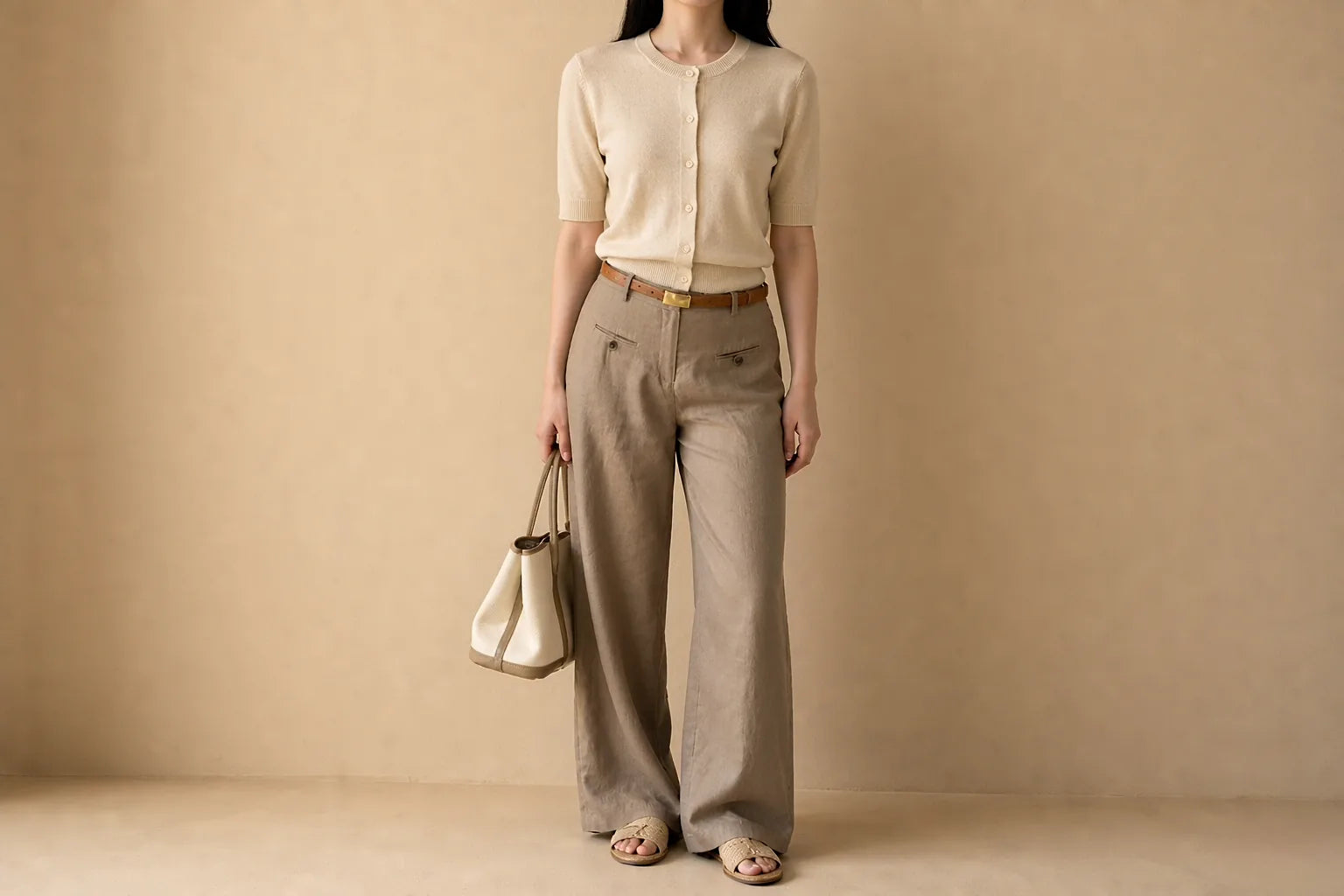
A cable-knit short-sleeve top in combed cotton, straight trousers in a deeper earth tone, loafers, a structured tote. The cable-knit crew-neck top supplies the texture that makes an all-neutral outfit read designed.
When mornings run short, a knit two-piece set removes coordination entirely — worn together it is a finished column; split apart, the halves feed both formulas. More combinations live in how to style a knit top; our capsule wardrobe guide for hot weather extends this into a full week.
What Else Do Readers Ask About Looking Expensive in the Heat?
How do you look expensive when it's extremely hot and humid?
Leave air between fabric and skin, and keep every layer matte. Loose, structured silhouettes in natural fibres let sweat evaporate instead of pooling, and matte surfaces deny light the chance to announce dampness. Cover slightly more than feels obvious, and blot rather than re-powder.
What fabrics look expensive in hot weather?
Combed cotton, linen, lyocell and natural-fibre-majority blends. They absorb moisture rather than reflecting it, and they drape instead of clinging. Run the tilt test and the crush test before buying — if a fabric stays matte and springs back from a squeeze, it will hold up in heat.
Can you look expensive on a budget?
Yes, by spending in order: fabric first, fit second, colour third. One $38 combed-cotton knit top outperforms five synthetic blouses because it passes the sweat, light and crease tests daily. Earth tones cost nothing extra, and a hem adjustment fixes fit for pocket change.
Does old money style work in tropical climates like Singapore?
It does, with material swaps: fine-gauge knits instead of tweed, linen-blend trousers instead of wool, studs instead of pearls. Keep the codes — restraint, quiet colour, covered-but-cool — and the style reads intentional rather than imported.
Is a knit cardigan too hot for summer?
A chunky one, yes; a fine-gauge or short-sleeve cotton cardigan, no. In the tropics it answers 22°C air-conditioning rather than the 33°C street: worn open over a camisole, it adds one degree of warmth and rolls up small enough to live in your tote.
What Is the One Rule to Remember?
Underneath everything, how to look expensive in hot weather is a physics problem with a wardrobe solution, not a shopping problem. Matte natural fibres absorb what heat throws at them; relaxed-but-anchored silhouettes keep air moving and deny sweat its map; low-saturation earth tones age gracefully under strong sun; quiet accessories and pressed hems finish the picture.
To start: tonight, audit your five most-worn warm-weather pieces against the tilt and crush tests. Replace whichever fails first with a matte natural-fibre knit — browse the RUIJIN knits at our boutique to see the rules already applied, most pieces between $38 and $48. Dress with the sweat in mind, not against it, and expensive is what remains.
0 comments