

# Maillard Colour Combinations: 6 Earth-Tone Outfit Formulas That Always Work
If you want earth tone outfit ideas that never fail, the Maillard palette is the most reliable place to start: build each outfit from one light tone, one deep tone and one dark anchor. Apricot, oatmeal, khaki and beech green carry the light work; golden brown, mocha, coffee and terracotta do the mid-range; black and navy finish the line. Combine any light with any deep, add the anchor at the extremities — shoes, bag, cardigan — and the combination reads intentional every time. Below are the six formulas I actually sell and wear, each mapped to real RUIJIN shades on our floor right now, so nothing here asks you to hunt for a colour that doesn't exist.
Key Takeaways
- The engine: light tone + deep tone + dark anchor. Six pairings cover a full month of outfits.
- Every formula maps to in-stock RUIJIN colourways — nothing theoretical.
- Texture does the work that pattern usually does: ribbed knits against fluid trousers, not prints.
- Black and navy are accents in a Maillard wardrobe — keep them at the edges.
- All six formulas survive Singapore heat if the fabric breathes; weight matters more than shade depth.
What Is the Maillard Palette, and Why Does It Flatter So Consistently?
The name comes from the Maillard reaction — the browning that happens when food cooks, from pale gold to deep crust. Applied to dressing, it describes the earth-tone spectrum: apricot, oatmeal, caramel, golden brown, coffee, chestnut, khaki, and the greens and navy that sit naturally beside them. Editors across Asia have run the trend for several seasons, and it hasn't faded, because it isn't really a trend — it's the discipline of staying inside one warm, low-saturation family.
It flatters for three reasons. Low-saturation colours are kinder to most Asian skin tones than stark white or black head-to-toe. Every shade shares a warm undertone, so even three pieces look coordinated without effort. And it photographs warmly, which sounds trivial until you notice how many of your favourite outfits turn out to be the brown ones.
I should be clear about what this article is not. It isn't a style philosophy piece — we already have a guide on what old money style actually is, and Maillard overlaps with that world quietly. This is the operating layer: six combinations, top by bottom by shoes and bag, that you can copy on a weekday morning without thinking.
Which Six Earth Tone Outfit Ideas Carry a Whole Month?
Here is the complete formula table — the six combinations I rotate at the counter and in my own wardrobe. Each one is named by its colour engine, then translated into actual garments and real in-stock shades.
| # | Formula (Colour Engine) | Top | Bottom | Shoes & Bag | Where It Works |
|---|---|---|---|---|---|
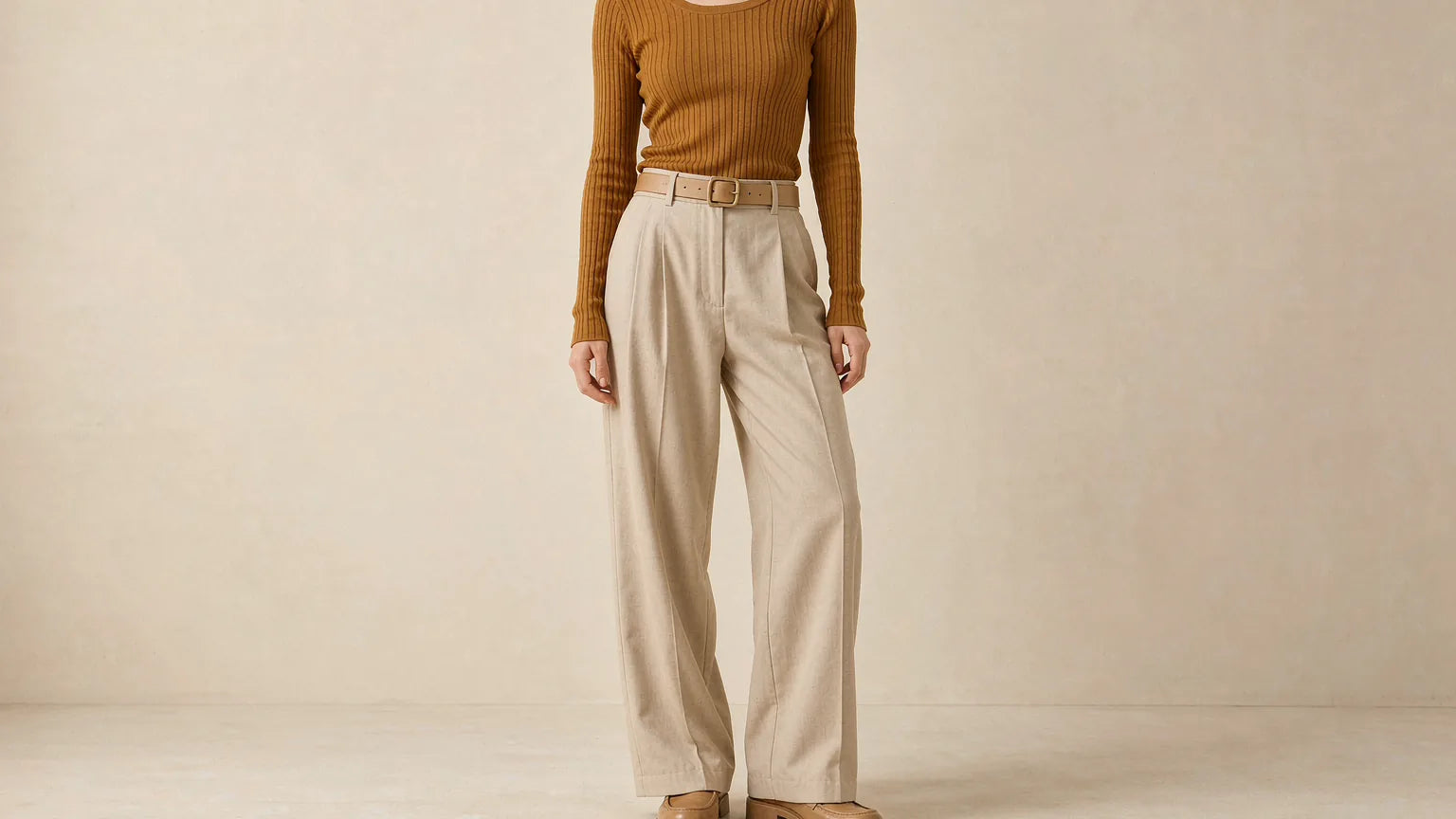
| 1 | Golden Brown × Oatmeal — tone-on-tone light | Golden-brown ribbed crew-neck knit | Oatmeal high-rise wide-leg pants | Tan loafers, tan leather tote | Office, client lunches |
| 2 | Coffee × Black — deep and grounded | Coffee mid-sleeve crew knit | Black wide-leg pants | Black loafers, chocolate bag | Long days, dinner after |
| 3 | Khaki × Off-white — soft contrast | Khaki seamless short-sleeve top | Off-white fluid trousers | Nude or bone sandals, straw tote | Weekends, kopitiam runs |
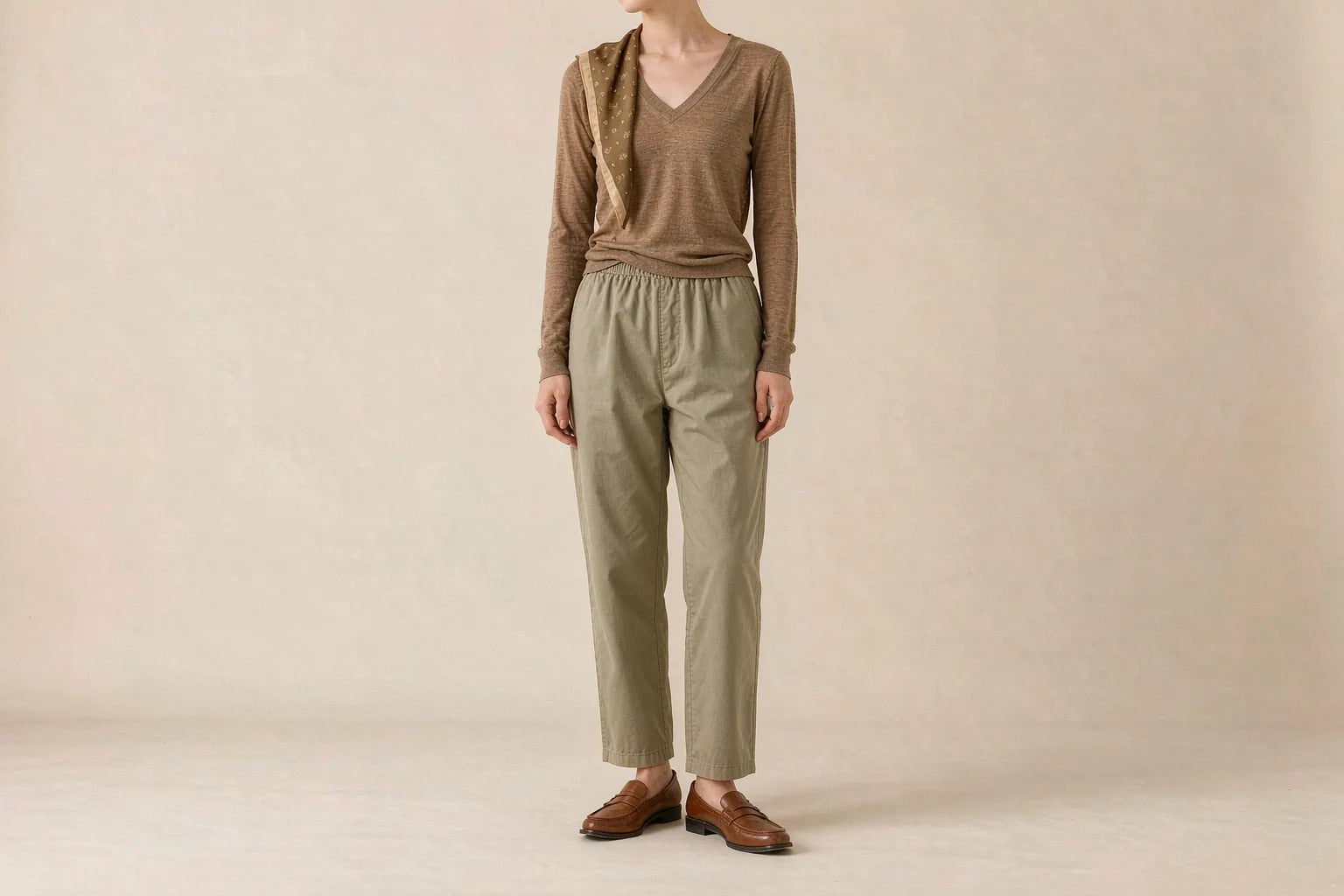
| 4 | Mocha × Beech Green — warm meets green | Mocha slim V-neck base layer | Beech green straight-leg pants | Brown loafers, canvas tote | Casual Fridays, gallery afternoons |
| 5 | Navy × Khaki — the cool anchor | Navy fine-gauge button cardigan | Khaki wide-leg pants | White sneakers or brown flats, navy bag | Travel days, air-con offices |
| 6 | Terracotta × Oatmeal — the warm statement | Terracotta ribbed sweater | Oatmeal tailored trousers | Chestnut loafers, tan shoulder bag | Brunch, presentations |
Notice the engine underneath all six: a light-to-mid tone against either a neighbouring tone or a dark anchor, with the darkest colour at the smallest surfaces. Once you see the pattern you can improvise infinitely — but run all six as written first, because each teaches a different lesson about balance.
Which RUIJIN Shades Actually Deliver Each Formula?
This is the part most Maillard articles skip: the palette means nothing until it maps onto clothes you can actually buy, in colours that actually exist. Here is the honest mapping for what's on our floor right now — and where a classic Maillard shade isn't stocked, I say so plainly.
| Shade Family | In Stock Now (RUIJIN) | Piece | Pairs With in This Article |
|---|---|---|---|
| Golden Brown | Yes | Soft slim crew-neck knit top | Oatmeal (Formula 1) |
| Coffee | Yes | Mid-sleeve crew knit top | Black (Formula 2) |
| Khaki | Yes | Seamless-knit short-sleeve top; high-waist wide-leg pants | Off-white (Formula 3), Navy (Formula 5) |
| Mocha | Yes | Slim V-neck base-layer top | Beech Green (Formula 4) |
| Beech Green | Yes | Effortless straight-leg pants | Mocha, oatmeal, off-white |
| Oatmeal / Off-white | Yes | High-rise wide-leg pants with fluid drape; Italian-tailored trousers | Every mid and deep tone |
| Navy Blue | Yes | Fine-gauge knit cardigan for layering | Khaki (Formula 5) |
| Terracotta | Yes | Crew-neck sweater with patch collar | Oatmeal (Formula 6) |
| Black | Yes, as accents and one pant colourway | Relaxed striped wide-leg pants (black colourway) | Coffee (Formula 2) |
| Camel / Caramel (as named in trend pieces) | Not in stock under that name — Golden Brown and Coffee carry this role | — | Substitute within Formulas 1–2 |
Two honest notes. Trend coverage often names camel or caramel as the hero shades — we don't stock those exact names, but golden brown and coffee sit in the same register and do the same job. And beech green appears in only one pant style at the moment, so if that's your shade in the table, check availability early.
Formulas One and Two: How Do Light Tones Layer Without Going Flat?
Formula 1 — golden brown over oatmeal — is the gentlest entry into Maillard dressing, and the one I hand to customers who say brown "isn't their colour". The trick is keeping the two shades clearly different in depth: a rich golden brown on top, a genuinely pale oatmeal below. When the gap is wide enough, the eye reads a gradient, and gradients look styled even when nothing else is happening. The soft slim crew-neck knit top in golden brown, front-tucked into the high-rise wide-leg pants with fluid drape in oatmeal, is my Monday uniform — tan loafers and a tan tote close the loop without a new colour family.
The classic failure in tone-on-tone dressing is flatness: two browns of nearly the same depth, in the same texture, read as a suit that doesn't match. Texture is the repair — a ribbed knit against a smooth, falling trouser gives the eye two surfaces even within one colour story. Fit matters quietly here too; if the top is fighting you, no palette rescues the outfit, and our guide on how a knit top should fit settles that in a few minutes.
Formula 2 — coffee over black — is the deep end of the palette and the one that behaves best on the longest days. Coffee is warmer and softer than black, so when it sits above black trousers the outfit keeps warmth near the face while the lower half recedes. It's the brown outfit combination I reach for when I want presence without brightness: the mid-sleeve crew knit top in coffee, black wide-leg trousers, black loafers, and — the detail that matters — a chocolate or tan bag, so the brown thread runs through the whole look.
Formulas Three and Four: Where Do Green and Contrast Belong?
Formula 3 — khaki against off-white — is the lightest formula in the set and the most tropical. Off-white bottoms reflect heat and lift everything around them, and khaki is deep enough to hold its own without turning the outfit heavy. The seamless-knit short-sleeve top in khaki with the same fluid wide-leg pants in the off-white colourway is my Saturday formula: bone sandals, a straw tote, done. If humidity decides the day, fabric choice matters more than colour — the mechanics are in our guide to which fabrics breathe best, and they apply to every formula here.
Formula 4 — mocha with beech green — is the pairing customers ask about most, usually with doubt in their voice. Brown and green feel like a risk until you see them together: they are the two most common colours in any natural landscape, which is why the combination reads calm rather than clever. Proportion keeps it safe. Mocha is quiet, so it takes the top — the slim V-neck base-layer top — and beech green takes the lower half in the effortless straight-leg pants. The V-neck matters here: with two mid-depth colours stacked vertically, an open neckline keeps the look from closing in on the face.
Formula Five: Can Navy Anchor an Earth Tone Wardrobe?
Navy is the wildcard in a Maillard wardrobe, and the purist answer is: yes, as the anchor, never as the whole story. Warm earth tones need one cool note to press against, the way a pinch of salt works in baking, and navy does that job better than black because it carries its own warmth underneath. In practice navy lives in layers and accessories — a cardigan over the shoulders, a bag on the shoulder — while the earth tones hold the main surfaces.
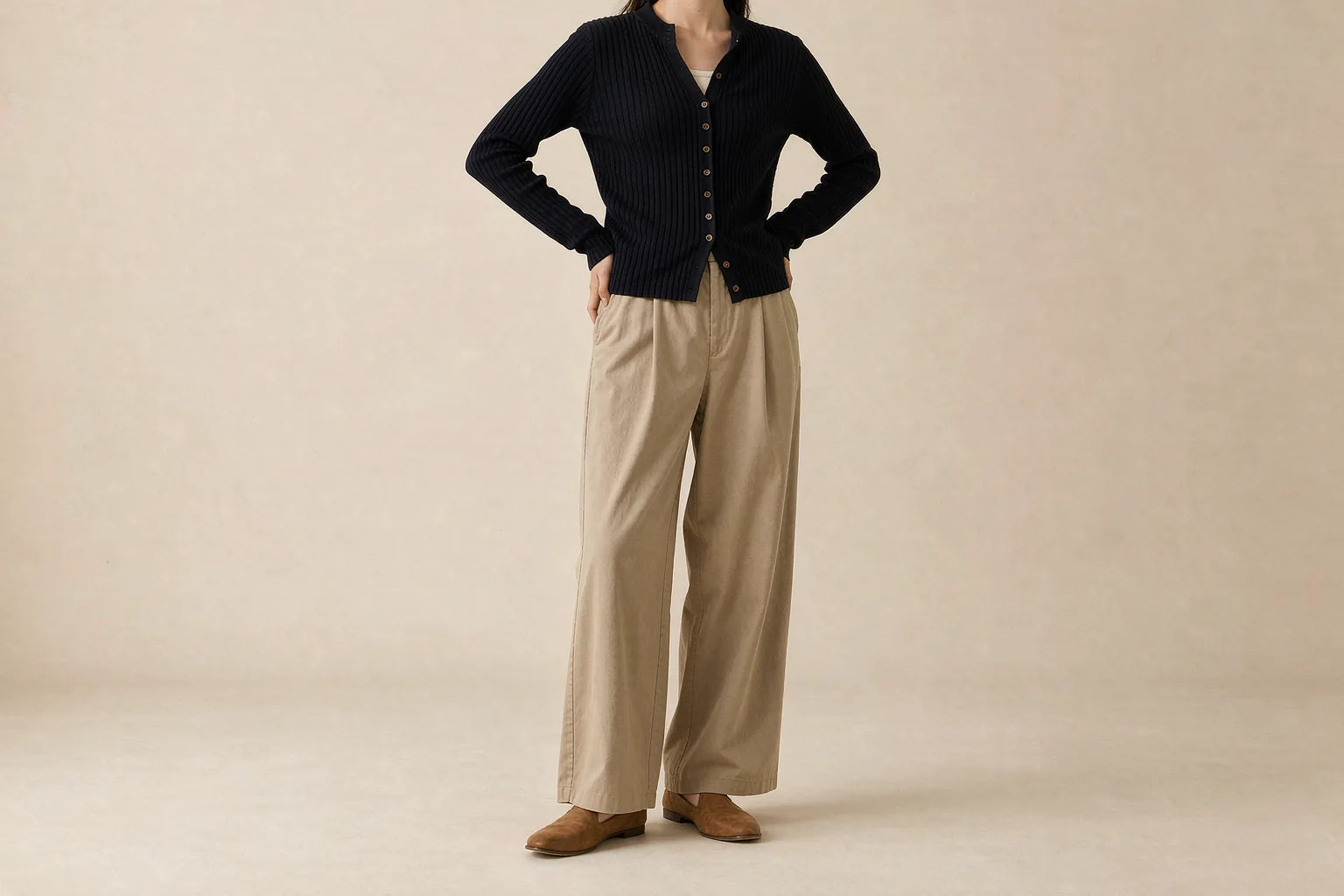
Formula 5 puts it directly: the fine-gauge knit cardigan for layering in navy blue over the high-waist wide-leg pants with fluid drape in khaki, on a white or cream base layer. Khaki and navy share a utilitarian history, so the pairing reads effortless rather than styled. In an overcooled office this is also the most practical formula: the cardigan is the layer you carry, not wear, and fine gauge means it folds to nothing in a tote. White sneakers keep it weekday-casual; brown flats swing it back toward office.
Formula Six: What Makes Terracotta the Warm Statement?
Terracotta is the loudest shade the Maillard palette allows itself, and it earns its place by doing one job: turning a quiet outfit into a memorable one without leaving the colour family. One terracotta piece per outfit is the rule — more than that and the look tips from warm to themed.
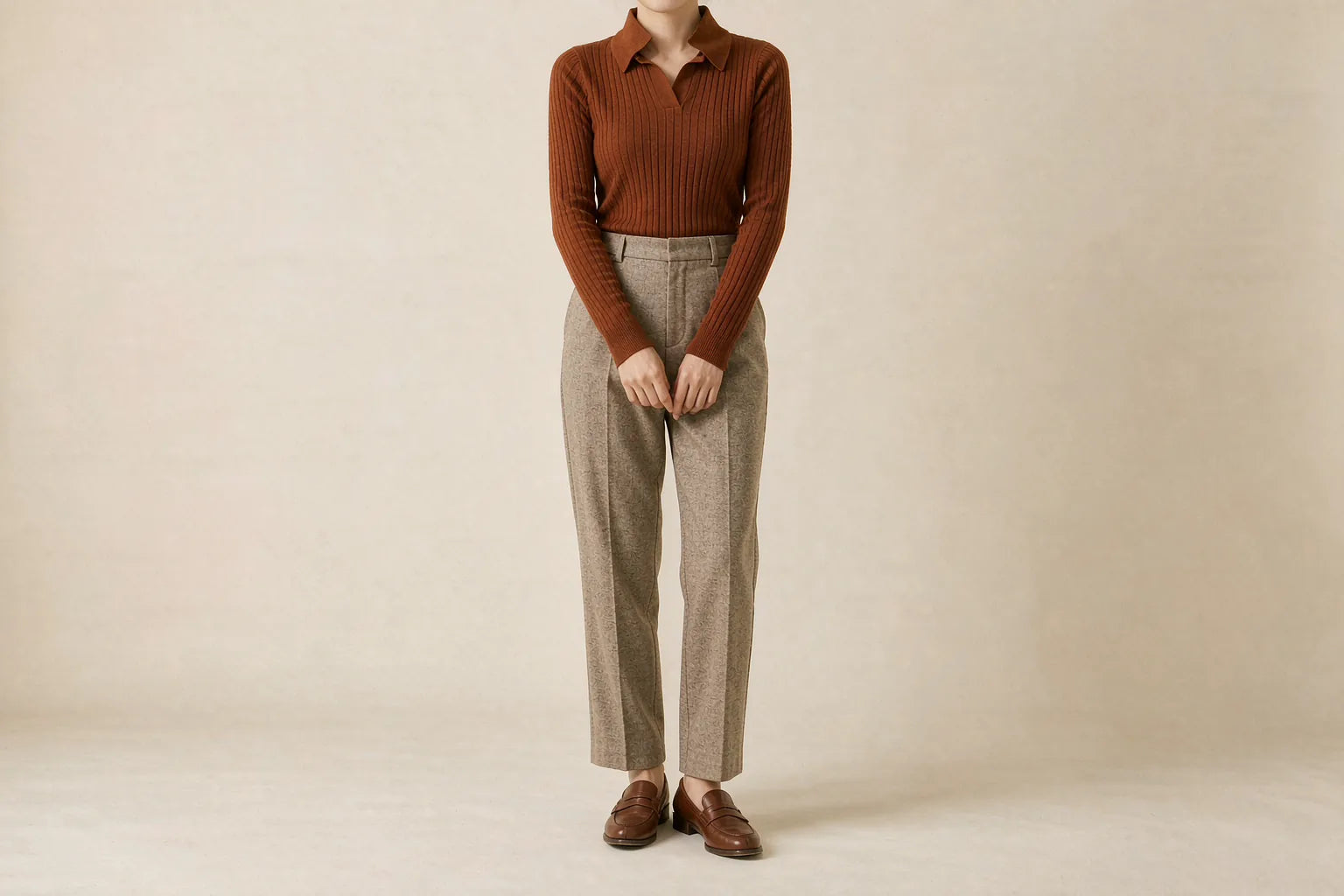
Formula 6 pairs the crew-neck sweater with patch collar detail in terracotta with the Italian-tailored high-waist trousers in oatmeal heather. The tailoring underneath is what keeps it grown-up: a fluid knit over a precise trouser is the central trick of the quiet-luxury register, and our old money style guide covers the principle in depth. Chestnut loafers and a tan shoulder bag finish it — my presentation-day formula, warm enough to be remembered, grounded enough to be believed.
How Do Shoes and Bags Finish an Earth Tone Outfit?
In a Maillard outfit, shoes and bag are not accessories; they are the dark anchor the formulas keep referring to. Three rules cover everything. Prefer brown leathers over black wherever the outfit doesn't already contain black — tan, chestnut and chocolate shoes extend the tonal line instead of interrupting it. Match depth, not exact shade: a tan bag with chestnut shoes looks natural, a perfectly matched set can look stiff. And if the outfit is all light tones (Formulas 1 and 3), the shoes may be the darkest point of the whole look, so choose them deliberately — a dark brown loafer grounds the outfit, a nude sandal dissolves the anchor entirely, and both are correct for different intentions. Metallics follow the same temperature logic: gold flatters the warm shades, silver reads cooler against navy and beech green.
Which Mistakes Flatten a Brown Outfit Combination?
Four failures come up again and again. Too many depths at once — a brown outfit combination works as a gradient, two or three clear depths, not four competing ones; if you squint and the outfit reads as one muddled shape, reduce to two tones. Black in the wrong place — black works with earth tones (Formula 2 is built on it) but as an accent at the extremities, not as a panel against a light brown; black beside camel fights, black beneath coffee supports. Pattern where texture should be — prints can work here, but they're a crutch; ribbed against smooth, matte against sheen, the interest comes from surface and it ages better. Ignoring the climate — deep tones in heavy fabrics look wintry here within minutes. The palette is shade-deep, not weight-deep: keep the fabrics light and breathing, per our fabric guide, and even coffee and black behave in 33°C.
How Does the Maillard Palette Fit a Small Tropical Wardrobe?
Better than almost any other palette, honestly, and for an unglamorous reason: everything mixes with everything. Six tops and six bottoms in this colour family give you thirty-six combinations before accessories — the arithmetic that makes a small wardrobe feel large. The skeleton of all six formulas costs only four purchases: one light bottom (oatmeal or off-white), one deep top (golden brown, coffee or mocha), one green or navy accent piece, and brown shoes.
It's also the palette I recommend after a style reset, because its combinations err toward looking considered rather than loud. The full method lives in our hot-weather capsule wardrobe guide, and the Maillard formulas slot into it unchanged.
Ready to Build Your First Maillard Capsule?
Start with one formula, not six. Formula 1 — golden brown top, oatmeal trousers, tan shoes — teaches the tonal engine, and everything else here is a variation on it. Wear it three times in one week, in three contexts, and you'll see which shades do the work for your skin and your days. Then add the anchor that's missing, usually a deeper brown or the navy layer. You can browse all RUIJIN pieces to see the current shade range in one place — and if a formula calls a shade you can't find, that's our honesty problem, not your styling problem; the mapping table says exactly what's on the floor today.
FAQ
What is the Maillard colour palette?
The earth-tone spectrum borrowed from the browning reaction in cooking: apricot, oatmeal, caramel, golden brown, coffee, chestnut and khaki, with black, navy and deep green as anchors. In dressing it means building outfits entirely within this warm, low-saturation family.
What colours go with earth tones?
Other earth tones first — light shades lift deep ones, and neighbouring shades layer naturally. Off-white sharpens the palette, beech green and khaki sit beside every brown, and navy or black work as accents at the shoes, bag or outer layer.
Can you wear black with earth tones?
Yes, with placement. Black works as an anchor — trousers under a coffee top, shoes, a bag — but a black panel against light browns fights the warmth. Keep black at the extremities and let the browns carry the middle.
Is the Maillard palette too warm for tropical weather?
Not if the fabrics are chosen for the climate. The palette is about colour, not weight; the same formulas work in fine-gauge knits and fluid trousers that breathe, per our fabric guide.
How many earth tones should one outfit have?
Two or three clear depths is the sweet spot — enough for a gradient, not so many that the outfit loses its shape. Add the dark anchor in accessories rather than a fourth clothing tone.
Do earth tones suit every skin tone?
Largely yes, because the palette is low-contrast and warm-leaning. If a shade feels off near your face, adjust the depth rather than abandoning the family — swap a very light caramel for a mid coffee, or keep the lightest tones below the waist.