

Yes — old money style works in 32°C heat, because its core disciplines — natural fibres, matte textures, restrained colours and light garment weights — were heat-adapted by design a century before air-conditioning existed. The polished images you scroll past are usually photographed at 20°C, yet the wardrobe logic behind them was built for Mediterranean summers, not mild ones. This piece explains where the hot-weather tradition came from, why each of the four disciplines holds up between 32°C streets and 18°C interiors, and how to audit a wardrobe against them. The short version: does old money style work in hot weather? Yes — every rule that makes it look quiet also happens to make it wear cool.
What makes old money style naturally heat-tolerant?
Old money style is usually described through its surfaces — quiet colours, no visible logos, understated tailoring — but its staying power in heat comes from structure, not styling. Four disciplines run through every genuinely quiet-luxury garment, and each one doubles as a heat-management decision:
| Discipline | What it demands | Why it helps at 32°C |
|---|---|---|
| Natural fibres | linen, ramie, cotton, lyocell over synthetics | air moves through the weave; absorbed moisture evaporates instead of pooling |
| Matte texture | light-absorbing surfaces over shine | reads composed up close and never looks damp under hard sun |
| Restrained colour | oatmeal, taupe, olive, khaki, navy | pale tones reflect heat; deeper neutrals hide the traces of a hot day |
| Weight discipline | fine gauges, unlined cuts, light layers | less fabric mass to trap heat; easier transitions into air-conditioning |
None of these rules was invented for the tropics. They accumulated over a century of dressing for coastal summers, which is why the style feels effortless in heat rather than adapted to it. That history is the next question.
Where did the hot-weather old money tradition come from?
The association between this style and heat is not a marketing accident — it is geography. In the early twentieth century, families who summered on the Riviera moved their wardrobes to the coast for whole seasons, and formal city clothes simply failed there. Tailors and shirtmakers answered with what the region already offered: linen suiting that creased gracefully, wool spun fine enough for a dinner jacket in August, washable cottons for the shore. Dress codes stayed formal; only the fabrics and weights changed.
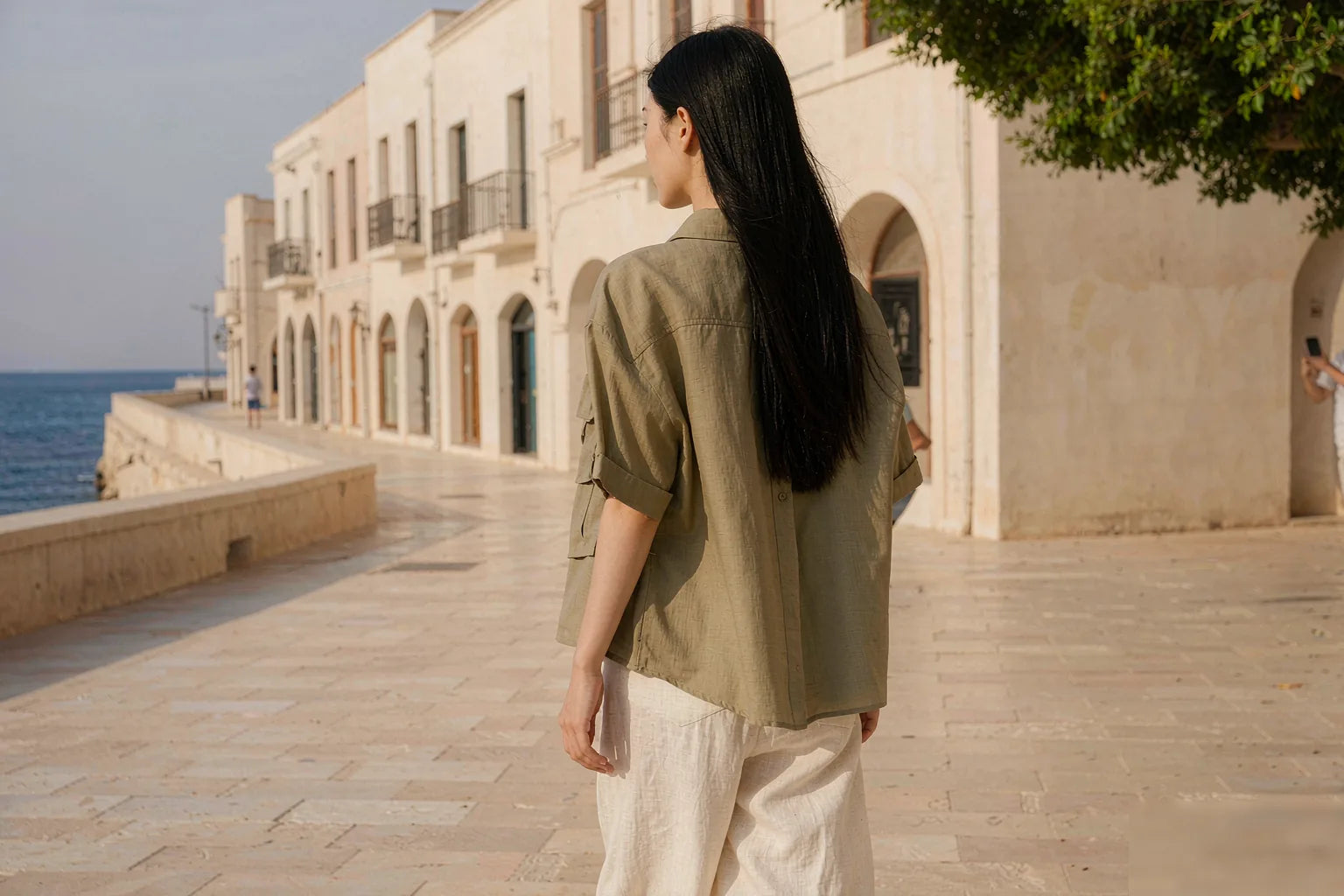
That is why "old money style summer" is not a separate aesthetic invented by social media — it is the original setting. Summer old money was linen old money: the same silhouettes, the same muted palette, executed in fibres that could survive a hot afternoon. A relaxed relaxed ramie shirt is the contemporary read of that tradition — collar and buttons in a crisp plant fibre, with sleeves that roll when the day demands it.
Why do natural fibres read as quiet luxury in the heat?
Natural fibres carry two advantages at once in heat — one physical, one visual.
Physically, plant fibres are hygroscopic: they draw moisture into the fibre itself and give it back as air moves, which is why linen and cotton feel dry to the touch even on a humid afternoon. Our guide to fabrics for hot, humid weather ranks the options for tropical wear, and the comparison of cotton vs linen vs lyocell explains how the three behave differently inside one wardrobe. Ramie — a nettle fibre woven like linen — holds a creisper hand than linen and keeps a shirt looking intentional through a long day.
Visually, natural fibres refuse to gleam. Synthetics tend to reflect light in a thin, uniform sheet; natural weaves break light up across their irregular surfaces. That softened look is the material basis of quiet luxury: richness announced by texture, not shine. The wardrobe translates this directly — 100% linen straight-leg trousers ($84.99) carry the formal-trouser tradition in a fully breathable weave, while the ramie shirt above shows how a workwear staple becomes summer-appropriate purely through fibre choice. One fit boundary worth stating: the trousers are drafted on regular proportions — recommend 160 cm and up, and under that expect to tailor, especially pants.
Does matte texture matter more than the fabric label?
Labels matter less than light behaviour. Two garments can both claim a natural composition and still behave completely differently under a noon sun; what the eye registers is how the surface treats light. Matte surfaces absorb and scatter it, so a garment reads as depth and texture. Shiny surfaces reflect it — flattening colour, spotlighting every crease and, in heat, magnifying the visual evidence of a long afternoon. Shine is also the fastest shorthand for cheap. The old money code is to disappear into texture, and matte knitwork is where that code is most testable: washi paper yarn, wool blends and dense cotton knits all hold a dry, light-absorbing surface.
| Fabric | Light behaviour | 32°C performance | Wardrobe role | In-store example |
|---|---|---|---|---|
| Linen | soft sheen that softens further with wear | creases are part of the look; airflow is excellent | trousers, shirting | 100% linen straight-leg trousers |
| Ramie | dry, crisp, low-gloss | holds structure through humidity | relaxed shirting | roll-cuff ramie shirt |
| Cotton + washi paper yarn | fully matte, slightly dry hand | stays visually dry; breathes through the knit | fine-knit tops | matte-texture knit top ($30.99) |
| Wool blend, fine gauge | muted, deep matte | a cold-interior layer, not a noon layer | cardigans, vests | fine-gauge wool-blend cardigan |
The matte-texture cotton and washi knit top is the discipline in its purest form: 45% cotton, 29% rayon and 26% washi paper yarn knitted into a surface that absorbs light rather than returning it — which is why it reads composed in exactly the lighting that makes shiny fabrics look dishevelled.
Which colours hold their composure at 32°C?
Colour discipline in this style has a physical logic and a behavioural one.
The physics: pale colours reflect more of the sun's energy, so oatmeal and ivory genuinely wear cooler at 32°C. Deeper neutrals absorb heat — but they earn their place by hiding the day's traces: damp patches, water marks, creasing. A navy or Timber Green knit looks the same at 6 p.m. as it did at 9 a.m., and that steadiness is its own form of composure.
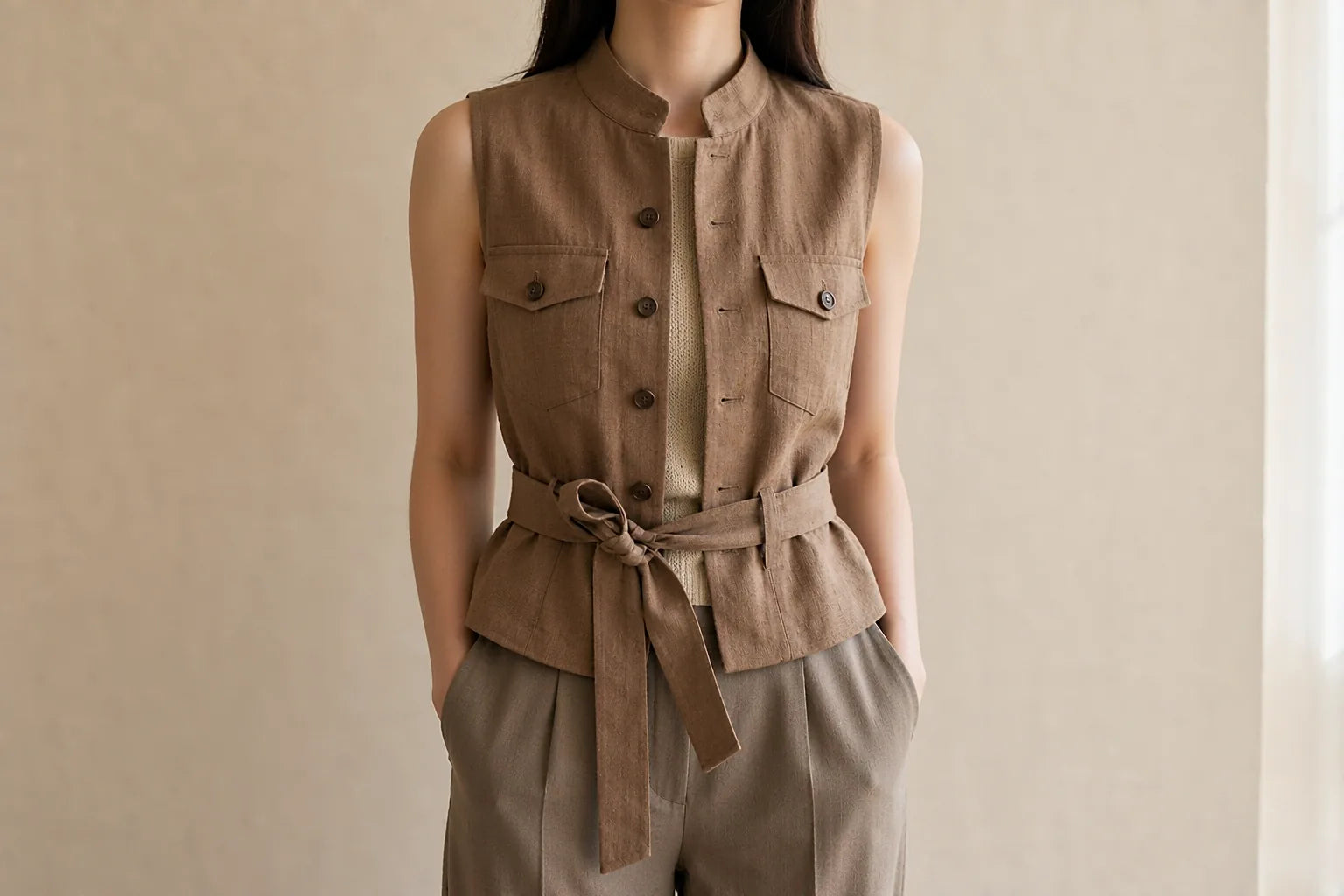
The behaviour: the classic old money colour combination stops a wardrobe from chasing seasons. Oatmeal, Taupe Brown, Olive Brown, Khaki and navy coordinate without effort, so garments combine across years instead of within one trend cycle — the same reason the maillard colour palette anchors so much of this boutique's range. The pieces shown across this article sit inside the band deliberately: an Olive Brown ramie shirt, a Timber Green matte knit, Taupe Brown linen trousers — three different garments, one continuous colour logic.
How heavy should an old money wardrobe be for 32°C streets and 18°C rooms?
Weight is the discipline most often missed in the tropics, because the real environment is not 32°C — it is 32°C outside and 18°C inside, several times a day, and the wardrobe has to serve both without bulking up.
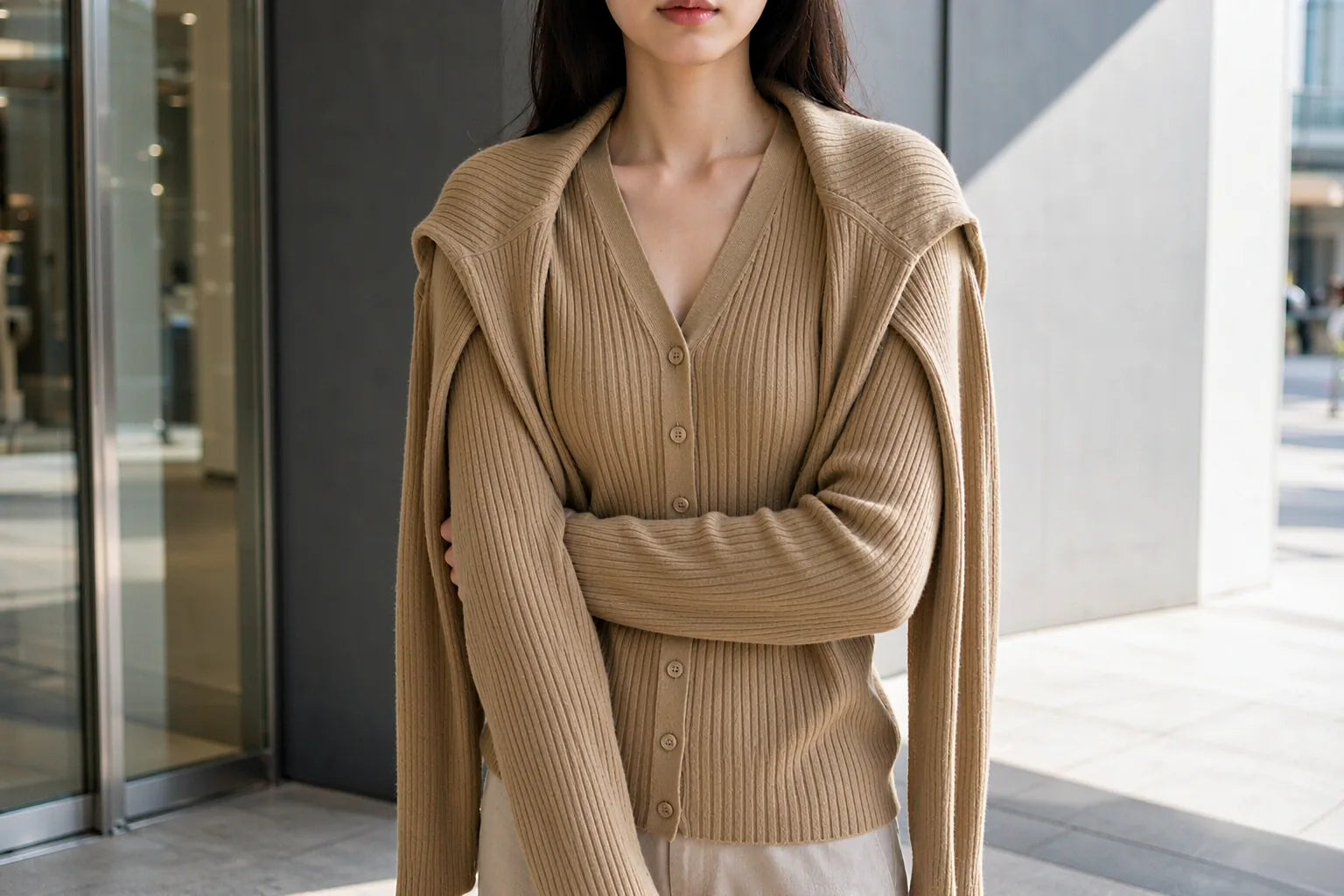
The street layer answers to everything above: unlined, light-gauge, breathable. The interior layer is where the tradition offers something genuinely useful — the third piece. A tailored vest restores formality to a shirt without adding sleeves; the tailored linen-lyocell vest (30% linen, 70% lyocell, $62.99) is that tradition cut to a tropical weight. For colder interiors, a fine-gauge knit layers flat over or under everything: the fine-gauge wool-blend cardigan (30% wool, $49.99) is, honestly, a blend rather than pure wool — and that is the point: a thin knit with some wool content holds its shape and warmth at a weight you can carry all day. Sequencing these layers across a working day is covered in our guide to dressing for air-conditioned offices in the tropics.
Can a knit-led wardrobe read old money in the tropics?
It is a fair doubt: knitwear sounds like cold-weather inventory. As a curated multi-brand boutique working in this climate, we treat knits as evidence of the four disciplines rather than exceptions to them. A fine-gauge knit in a matte yarn passes the texture, weight and colour tests simultaneously; combined with a full-length linen weave on the lower half, the smallest possible loop closes — texture above, drape below, nothing shiny anywhere. The workwear collection gathers the pieces that pass this audit; each one is there because of how it handles light, heat and colour, not because of how it photographs. That is the difference between a wardrobe that reads old money and a look assembled for a single afternoon.
How do you audit your existing wardrobe with the four disciplines?
The four disciplines convert into four audit questions. Asked in order, they take a wardrobe apart in an afternoon:
- Fibre. Is this mostly natural fibre — linen, ramie, cotton, lyocell, wool? A fully synthetic, glossy piece fails twice at once.
- Texture. Under a lamp or at noon, does the surface absorb light or throw it back? Matte stays; gloss waits for evening.
- Colour. Does it sit inside the restrained band — oatmeal, taupe, olive, khaki, navy — or does it tie the garment to one trend season?
- Weight. Could you wear it into an 18°C room and carry it through a 32°C street on the way home?
Anything that passes three of the four stays; anything that fails fibre and texture together goes. The audit rebuilds nothing — it only ranks. When the survivors feel too few, the next step is deliberate reconstruction, which we cover in how to build a hot-weather capsule wardrobe.
Does old money style survive humidity's tests — wrinkles, cling and sweat marks?
Honestly: partially, and some of the failures are traditional. Linen creases — the Riviera wardrobe was built around fabrics that crease gracefully, so a rumpled linen leg is part of the tradition, not a lapse in grooming. Rescuing wrinkles with stiff resin finishes is how a natural garment starts behaving like a synthetic one; we do not recommend it and do not stock it.
Cling is a cut problem before it is a fabric problem: drape — the way a relaxed weave falls from the body — keeps fabric moving air instead of gripping skin, which is why relaxed shirting outperforms fitted synthetics on a wet afternoon. Sweat marks are a colour-and-texture question: pale matte surfaces show dampness far less than dark glossy ones, so the restrained palette doubles as discretion. What humidity does attack is knit fibre itself — pilling, chiefly — and that is maintenance rather than style, covered in how to stop knitwear from pilling.
Conclusion — so, does old money style work in 32°C heat?
Yes — and not as a tropical afterthought. The four disciplines that define the style are the same ones that make it liveable in heat: natural fibres move air, matte textures stay composed under hard light, restrained colours refuse the trend cycle and keep the day's wear invisible, and light weights bridge the gap between a hot street and a cold room. The style was summer before it was anything else.
From here: for outfit-level execution in this climate, see our style guide to wearing old money style in Singapore heat; for the broader psychology of polish in warm weather, read how to look expensive in hot weather; and for the definition itself, start with what old money style actually means. The wardrobe side begins at the essentials collection — every piece there answers the same four audit questions.
Frequently Asked Questions
How do you dress old money in hot weather?
A: Rank the disciplines. Fabric first — linen, ramie, cotton or lyocell against the skin. Colour second — the restrained band from oatmeal to navy, nothing glossy. Weight third — fine gauges and unlined cuts. Cut last — relaxed enough that air moves. Accessories and grooming come after all four; they cannot rescue a garment that fails the fabric test.
What fabrics are considered old money in summer?
A: The old money style fabrics remain the ones the tradition was built on: linen for structure that creases gracefully, ramie for a crisper version of the same idea, cotton for everyday knits and shirting, lyocell for fluid drape, and fine-gauge wool for cold interiors. Women's summer wardrobes lean on the first four; the fifth earns its keep in air-conditioning.
What colours read as old money in hot weather?
A: The restrained band: ivory and oatmeal, taupe and khaki, olive and timber greens, deep navy. Pale tones wear cooler and soften hard light; deeper neutrals hide the traces of a humid day. What the band avoids is saturation and gloss — a matte taupe reads richer under midday sun than a bright tone in any fabric.
Are knit tops too hot for tropical weather?
A: Outdoors at noon, usually yes — a knit is not the answer to a 32°C street. But a tropical day is two climates: offices, malls and restaurants run cold. A fine-gauge knit is the 18°C answer, not the 32°C one — light enough to carry through the heat, structured enough to read intentional indoors.
Does old money style work in humid climates like Singapore?
A: It works, with two honest conditions. Matte, pale surfaces keep humidity from showing, and weights must stay low enough that drape does the work of airflow. The failure mode is never the style itself — it is the violations: shiny synthetics, heavy linings, tight cuts. Held to the four disciplines, the aesthetic carries across Singapore's climate as comfortably as the Riviera's.
The wardrobe logic, on the shelf
Old money style survives heat because it was never a costume — it is a set of working rules about fibre, light, colour and weight. If you want the rules already applied, start at the essentials collection and read the definition of old money style alongside it; every piece answers to the same four disciplines this article audits.
0 comments