

The honest answer to how to stop knitwear from pilling: attack its only cause — friction — from three directions at once. Wash knits inside out in a mesh bag on a cold, gentle cycle; dry them flat in the shade instead of tumble-drying; and shave off the first tiny pills with a fabric shaver before they mat into clumps. Cotton and lyocell knits pill far less than wool or loose acrylics, but Singapore's humidity raises wash frequency, and every extra wash is extra rubbing — so the routine matters more here, not less.
Key Takeaways
- Pilling is friction damage, not dirt: loose fibers tangle into balls wherever your bag, desk, and washing machine rub the fabric most.
- Combed cotton and lyocell pill noticeably less than wool or standard acrylic — but no knit is pill-proof, and frequent humid-weather washing raises the risk.
- The core routine: inside out + mesh laundry bag + cold water + gentle cycle, then dry flat in the shade, never in a dryer.
- An electric fabric shaver is the safest de-pilling tool for cotton and lyocell; razors only suit dense, flat-knit fabrics — never openwork pointelle.
- Fine pills at friction points are normal wear, not a quality verdict — fiber length, twist, and care habits decide.
What Actually Causes Pilling on Knitwear?
Pilling is the formation of tiny fiber balls on the surface of a knit, and it starts with broken fibers, not dirt. Why do sweaters pill at all? Every time a knit rubs against something — a bag strap, a desk edge, another garment in the wash — the shortest fibers near the surface work loose, and continued rubbing tangles them into the small fuzzy spheres we call pills.
Three factors decide how fast this happens:
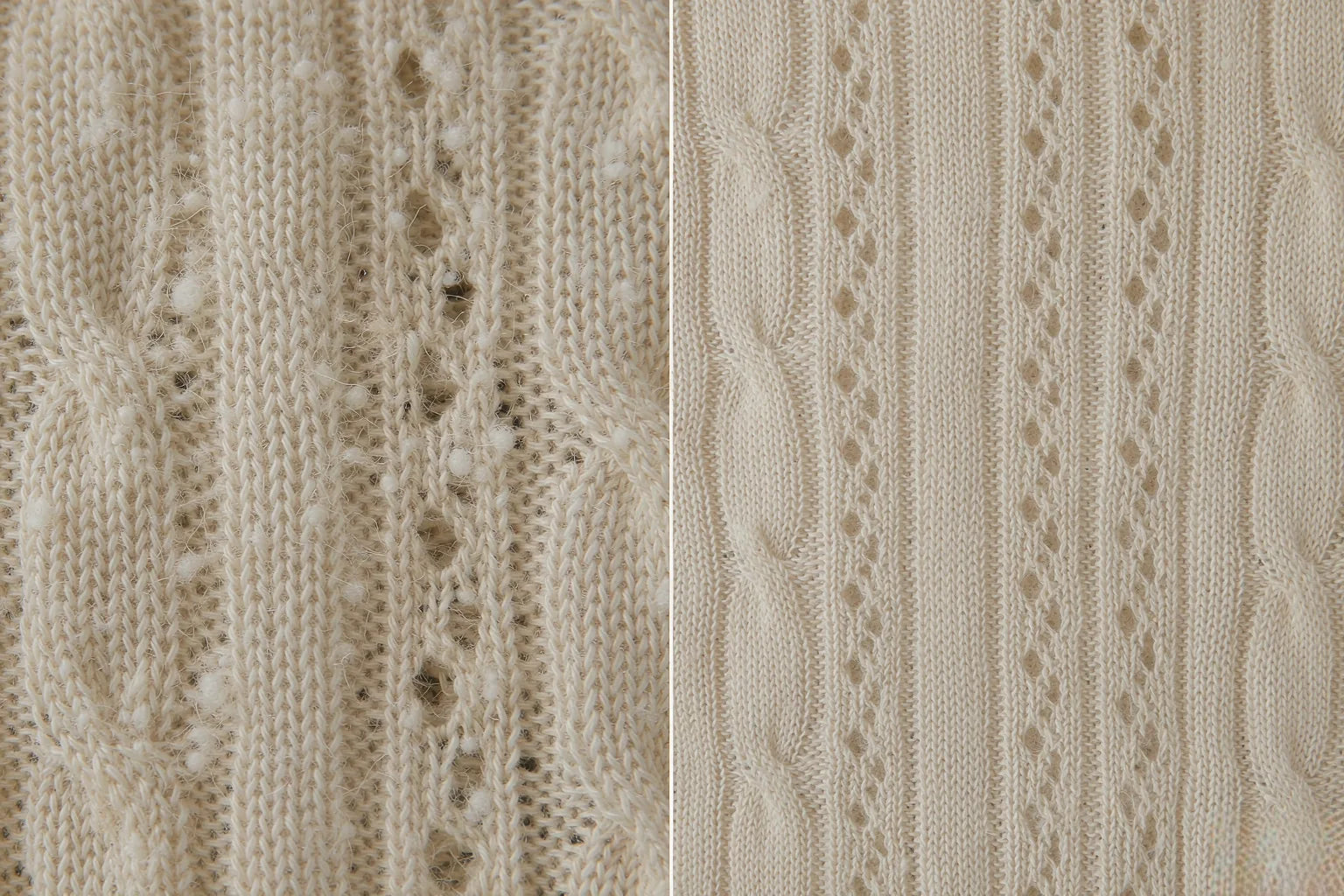
- Fiber length. Long, smooth fibers (like the long-staple fibers in combed cotton or the manufactured filaments in lyocell) anchor deeply into the yarn. Short fibers break free faster.
- Yarn twist. Tightly twisted yarn holds fibers in place; loosely spun, fluffy yarn lets them escape.
- Friction load. Underarm panels, sleeve cuffs, the side where a tote bag rides — pills cluster exactly where rubbing repeats. It's never random, and a cause you can locate is a cause you can manage.
Why Does My Cotton Knit Pill Less Than Wool — But Still Pills?
The honest answer to the question of cotton knit pilling has two halves. The good half first: cotton knit pilling is genuinely slower than wool pilling when the yarn is well made. Combed cotton goes through an extra step that brushes out short fibers before spinning, leaving longer, smoother strands — which is exactly why a 100% combed cotton pointelle knit top stays smooth far longer than a fuzzy wool sweater. Lyocell goes one better: its filaments are manufactured long and uniform, with a sleek surface that fiber balls struggle to grip.
Now the honest half: "less" is not "never." Cotton fiber is still shorter than lyocell's continuous filaments, and any spun yarn sheds its shortest fibers eventually. Blends complicate things further — a 70% lyocell and 30% linen tailored vest mixes two plant fibers of different lengths, which is what makes pilling possible even in a largely smooth fabric. Add repeated wet rubbing — which is what washing is — and even a well-made cotton or lyocell knit shows its first pills at friction points within a season of heavy wear. On these fabrics, though, pilling arrives later, stays finer, and responds beautifully to a five-minute cleanup.
Which Knit Fabrics Pill the Most — and Which Resist It?
Not all knits fight pilling equally. Here's how five fabrics you're most likely to own compare — see also our cotton vs linen vs lyocell comparison.
| Fabric | Pilling tendency | Why | Humid-weather care note |
|---|---|---|---|
| Combed cotton | Low–moderate | Extra combing removes short fibers; long staples anchor well | Handles frequent cool washes well; always dry flat in shade |
| Lyocell | Low | Long, smooth manufactured filaments with a sleek surface | Very washer-friendly, but blends with shorter fibers raise the risk |
| Linen | Low | One of the longest natural fibers; smooth and stiff | Extremely durable in wash; wrinkles rather than pills |
| Wool | High | Short, scaly fibers tangle easily under friction and moisture | Needs the gentlest cycle, cold water, and minimal washing |
| Acrylic | High (varies) | Spun from short synthetic strands that break and ball fast; some modern acrylics are engineered to resist pilling better | Watch dryer heat — it can permanently set pills and shine |
One practical note on acrylic: you'll sometimes see acrylic knits labeled as pilling-resistant, as on our striped crew-neck tee with contrast trim. That's a reduced tendency, not an immunity — fabric choice buys time, it doesn't replace the wash routine below.
How Does Singapore's Humidity Change the Pilling Equation?
In a temperate climate, a knit might be washed once a week. In Singapore or Kuala Lumpur, the math is brutal: a knit top worn through a humid commute is damp with sweat by 11 a.m., and nobody re-wears damp knitwear. The realistic rotation becomes wear, wash, repeat — sometimes three or four cycles a week. Every cycle adds drum friction, wet fiber swelling, and agitation, which is why humid-weather wardrobes see pilling on knits that would stay smooth for months elsewhere.
Damp fibers are also weaker and shed more easily, and a knit that stays damp too long abrades faster. This is why which fabrics breathe best matters beyond comfort: a breathable cotton or lyocell knit dries faster on the body and off it, shortening both the damp window and the wash frequency that come with it. You can't lower Singapore's humidity. You can lower how hard each wash cycle hits your knits — and that's the next section.
How Should You Wash Knits to Prevent Pilling?
Washing is where most pilling damage is done — and where most of it can be prevented. The full system is in our cotton, linen and lyocell knit care guide; the pilling-specific version is five rules:
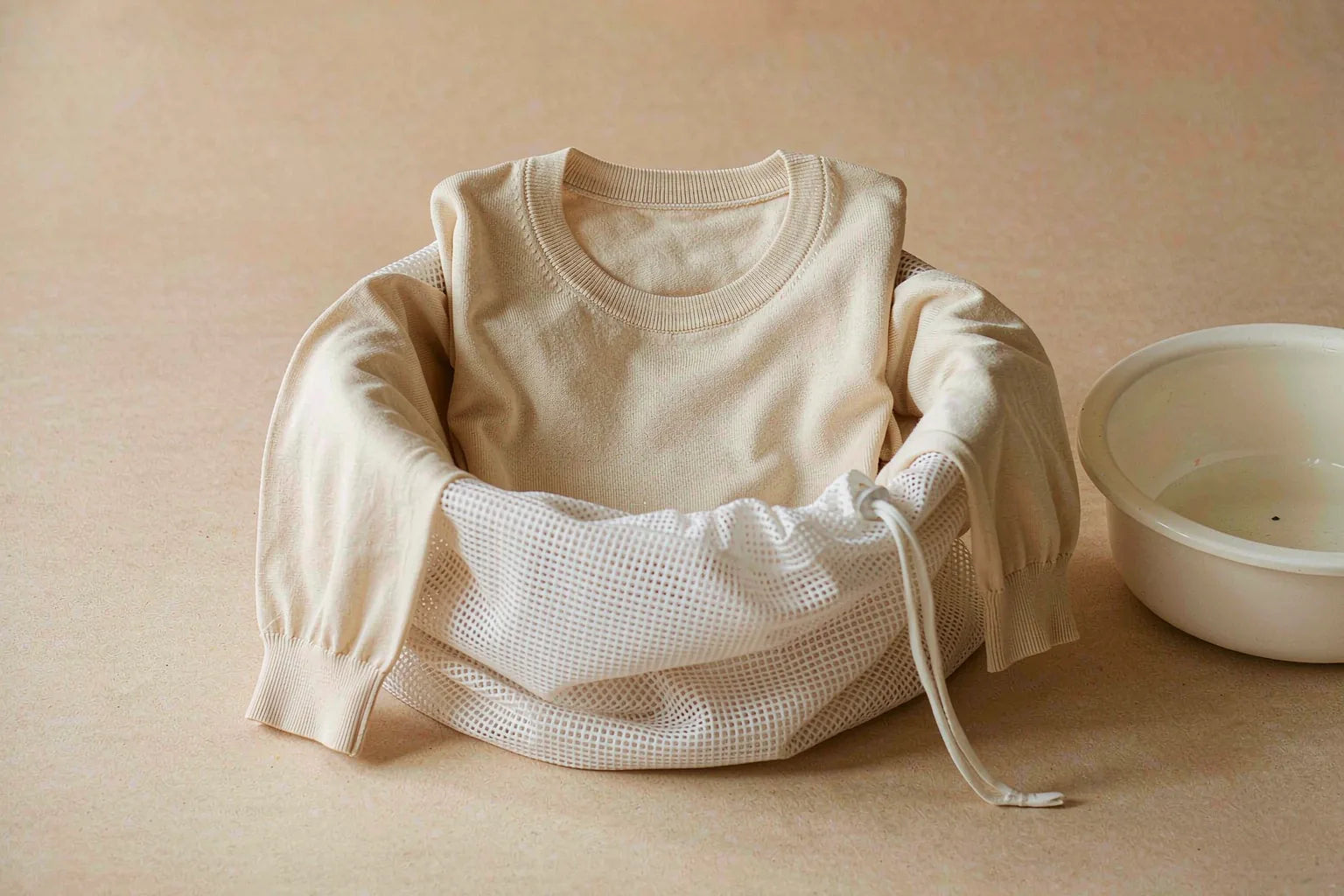
- Turn the knit inside out. The surface that pills should never touch other garments or the drum wall directly.
- Use a mesh laundry bag, every time. A physical friction shield — the highest-value habit here.
- Cold water, gentle cycle, slow spin. Heat swells fibers and makes them shed; a fast spin presses fabric against the drum.
- Wash knits with knits. A knit sharing a load with jeans, zippers, or hooks is being sanded.
- Dry flat in the shade. A wet knit is heavy; hanging it stretches the yarn. Lay it on a towel, reshape, keep it out of direct sun.
One honest ruling on detergent: enzyme-based "cellulase" formulas are often recommended for cotton pilling, because cellulase nibbles away tiny surface fuzz before it tangles. That advice is sound for pure cotton — but lyocell is also a cellulose fiber, and repeated enzyme exposure is not what its care line calls for. For cotton-lyocell blends, a mild liquid detergent on a gentle cycle is the safer default.
How Do You Remove Pilling From a Sweater Without Damaging the Knit?
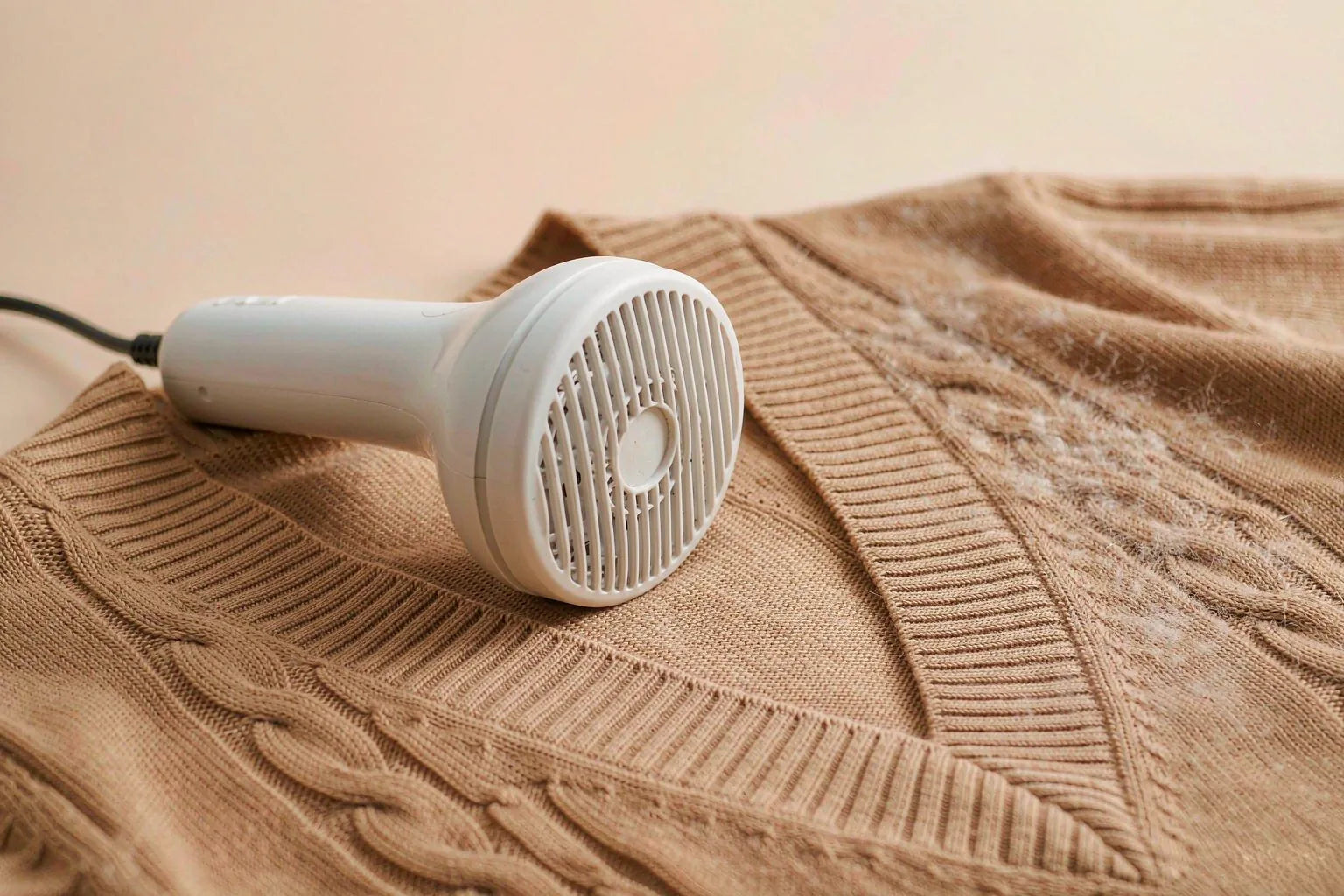
When pills appear, removing them properly takes about five minutes, and the rule is simple: cut or lift the pill, never pull it — pulling yanks the anchor fibers out of the yarn and opens a hole. Here is how to remove pilling from a sweater safely, on cotton and lyocell knits:
- Lay the knit flat and stretch the working area taut. Pills sit proud of the fabric; tension exposes them and keeps the shaver from catching folds.
- Choose your tool for the fabric — for most cotton and lyocell knits, an electric fabric shaver (next section matches tools to knits).
- Shave in one direction, with the lightest pressure that works. Short, overlapping passes. Let the blade lift the pills; pressing hard cuts yarns.
- Clear the lint chamber and the fabric as you go so loose fuzz doesn't re-tangle into fresh pills.
- Finish with a quick rinse-or-steam and dry flat. Moisture settles the freshly cleared surface; the flat-dry resets the knit's shape.
Do this at the first sign of fuzz, not after the pills have matured — early pills are a two-minute job, while established clumps sit deeper and roughen the surface even after a careful cleanup.
Fabric Shaver vs Sweater Comb vs Razor: Which One Is Safe for Your Knit?
The tool aisle gives you three options, and the competitors' advice contradicts itself — here is the ruling, by fabric rather than by folklore:
- Electric fabric shaver — the default for cotton and lyocell knits. An adjustable-height guard, a blade that trims at the surface, and a lint chamber make it the most controlled option — the safe choice for dense fine-gauge knits like a skin-soft v-neck knit top. Light passes trim pills without touching the knit structure.
- Sweater comb — gentlest, slowest. Fine for light fuzz on sturdy flat knits, but it pulls as much as it cuts. Seldom worth it.
- Manual razor — conditional, and easily the most dangerous. A razor gives an uncannily smooth finish on thick, dense, flat-knit fabrics — but it has no guard, and one crease caught under the blade is a slice through the yarn. If you use one, use it only on thick, flat, taut fabric with zero openwork. It must never go near a pointelle or cable-openwork knit like our pointelle short-sleeve knit top — the openwork loops sit exactly at blade height. For anything textured, lacy, or open-knit, the shaver is the only reasonable choice.
What Daily Habits Stop Pills From Coming Back?
De-pilling treats the symptom; habits treat the cause. Five do most of the work:
- Rotate your knits. A knit worn two days running never settles. Give each piece roughly 24 hours of rest between wears, building the rotation around easy mid-weight pieces like a mid-sleeve crew knit top.
- Map your friction points and defend them. Bag straps cross exactly where sleeves rub; a crossbody rides the same hip panel every day. Alternate the bag shoulder, take the bag off in transit, and avoid rough outer layers.
- Watch what sits above and beneath. A knit under a rough wool coat or textured scarf is being sanded all day; smooth inner layers — the job a slim v-neck base layer top is engineered for — help. Raised textures are friction magnets, so layer the cable detail of a shawl-collar knit cardigan under something smooth, and give the ribbed cuffs of a v-neck knit cardigan with ribbed trim the same thought.
- Mind the layered-look details. The fake two-piece effect of a stand-collar knit top is built into the knit, so its inner layer needs the same inside-out, mesh-bag washing as everything else.
- De-pill early, and store folded. Fold knits on a shelf rather than hanging them, and check cuffs, bag-side panels, and underarms once a week.
Structure matters too: a knit knitted to shape has fewer seams and stitched edges to abrade, while a cut-and-sew panel adds joined edges at exactly the places garments rub — see seamless knit vs cut-and-sew.
Is Pilling a Sign of Poor Quality — or Normal Wear?
Neither extreme is true. Pilling can indicate a quality problem: very short fibers, loose twist, and multi-fiber blends with three or more components all pill faster, because more fiber ends are free to escape and tangle. A brand-new knit that covers its whole surface in pills after two washes is sending a yarn-quality signal.
But pilling is also simply what knitted fabric does under friction — including expensive, well-made knits. Any spun-yarn knit, from a silk-wool blend like our soft crew-neck knit top with gentle drape to a dense combed cotton, shows fine pills at its highest-friction zones with enough wear and washing. The realistic standard is not "never pills"; it's pills late, pills lightly, and recovers cleanly when de-pilled.
The same standard answers the retirement question. Replace a knit when pilling stops being a surface event: when de-pilling roughens the fabric, when the yarn around friction zones has visibly thinned, or when cleanup creates holes faster than the shaver can clear them. Until then, a knit that pills at the cuff and smooths right back is a healthy knit.
Wash inside out in a mesh bag, cold and gentle; dry flat in the shade; shave early pills in one light pass; rotate wears and defend friction points. Do those four things and your cotton and lyocell knits — already the most pilling-resistant knits you can own — stay smooth through season after season of humid weather. The point was never zero pills; it's a knit that comes back from every wash looking like itself.
Knits that fight back
Building a pilling-resistant wardrobe starts with fabrics that fight back. Browse the RUIJIN knit collection — combed cotton pointelle and lyocell-linen tailoring for exactly this weather — start with a routine, not a rescue.
Does pilling mean my knit is low quality?
Not by itself. Pilling speed does reflect yarn quality — very short fibers, loose twist, and multi-fiber blends pill faster — but every spun-yarn knit pills eventually at high-friction points, regardless of price. Watch where and how much: all-over pilling on a new knit after two washes is suspect; fine pills confined to the bag-strap zone and cuffs are normal wear.
Can I use a razor to remove pills from cotton knitwear?
Only on thick, dense, flat-knit cotton — and carefully. Stretch the fabric taut, use a fresh blade with the lightest pressure, and work in straight lines. A razor has no height guard, so any crease, seam, or raised texture caught under the blade gets cut. Never on pointelle or any lacy knit — the open loops sit right at blade height. For most cotton and lyocell knits, an electric shaver with a guard is safer.
Why does my black knit get white pills?
Because pills are made of the knit's own fibers, tangled and swollen with air. Light scatters off that fuzzy tangle far more than off a flat surface, so on a dark fabric pills read as pale grey even though they're the same color as the yarn. It's an optical effect, not dye transfer — and the fix is the same: shave early, wash inside out, reduce friction.
Does fabric softener prevent pilling?
The advice out there genuinely conflicts, so here's the by-fabric ruling. Softener deposits a lubricating film that reduces surface friction, and on sturdy 100% cotton an occasional small dose can slightly reduce wash friction. But that same film builds up on fine knits, dulls drape and breathability, and does nothing about all-day body friction, where most pills actually form. For lyocell and cotton-lyocell blends, skip it — mild detergent and a mesh bag do more.
How often should I de-pill my knit tops?
In a humid-weather rotation, check friction zones weekly and de-pill at the first sign of fuzz, not on a fixed calendar. Early fuzz clears in a couple of light passes; matured clumps sit deeper and roughen the surface even after cleanup. Practical rhythm: a cuff-and-bag-zone check every weekend, a full session whenever fuzz shows at arm's length.
0 comments