

Same fibre, two different garments. Fine-gauge means thin yarn knitted on closely spaced needles, so the fabric hangs close, layers flat and reads quiet; chunky means thick yarn on widely spaced needles, so the fabric stands off the body, holds dimension and reads bold. In Singapore and Malaysia, though, gauge answers only half the question — the fibre and how open the knit structure is decide the other half. This guide explains what the G number on a label measures, compares the two weights across six axes, and shows where each earns its place: fine-gauge for humid streets and air-conditioned commutes, chunky for brutal AC, long flights and overseas winters.
Key Takeaways
- Gauge is needle density: a higher G number means finer needles, thinner yarn and a denser fabric.
- Fine-gauge drapes and layers; chunky stands off the body and insulates — yarn diameter and stitch density, not quality.
- Fine-gauge does not automatically mean cooler: fibre, weight and openness together decide how a knit feels in heat.
- Texture is not weight: cable and pointelle are structure choices fine-gauge yarns can carry; in the tropics, chunky is for deep AC, long flights and overseas winters only.
What does "gauge" actually mean on a knitwear label?
Gauge is the density of needles on the knitting machine, counted per inch — a 12-gauge (12G) machine packs twelve needles into every inch, a 5G machine five. More needles per inch means smaller stitches and thinner yarn; fewer means big stitches and fat yarn. The fibre says what the knit is made of; the gauge says how tightly it is packed together. Manufacturer guides work in rough bands:
| Gauge | Yarn | Fabric feel | Typical use |
|---|---|---|---|
| 3G–5G | Very thick yarn | Airy, dimensional, holds shape well away from the body | Chunky statement sweaters, deep-winter knits |
| 7G | Mid-weight yarn | Substantial but wearable, visible stitch definition | Classic sweaters, everyday cardigans |
| 12G | Fine yarn | Smooth, close to the body, layers flat | Fine-gauge sweaters, layering cardigans |
| 14G | Finer yarn | Sleek and thin with a neat surface | Office knits, shirting-style tops |
| 16G and up | Very fine yarn | Thin, fluid, almost woven in feel | Warm-season knits, polos, dress knits |
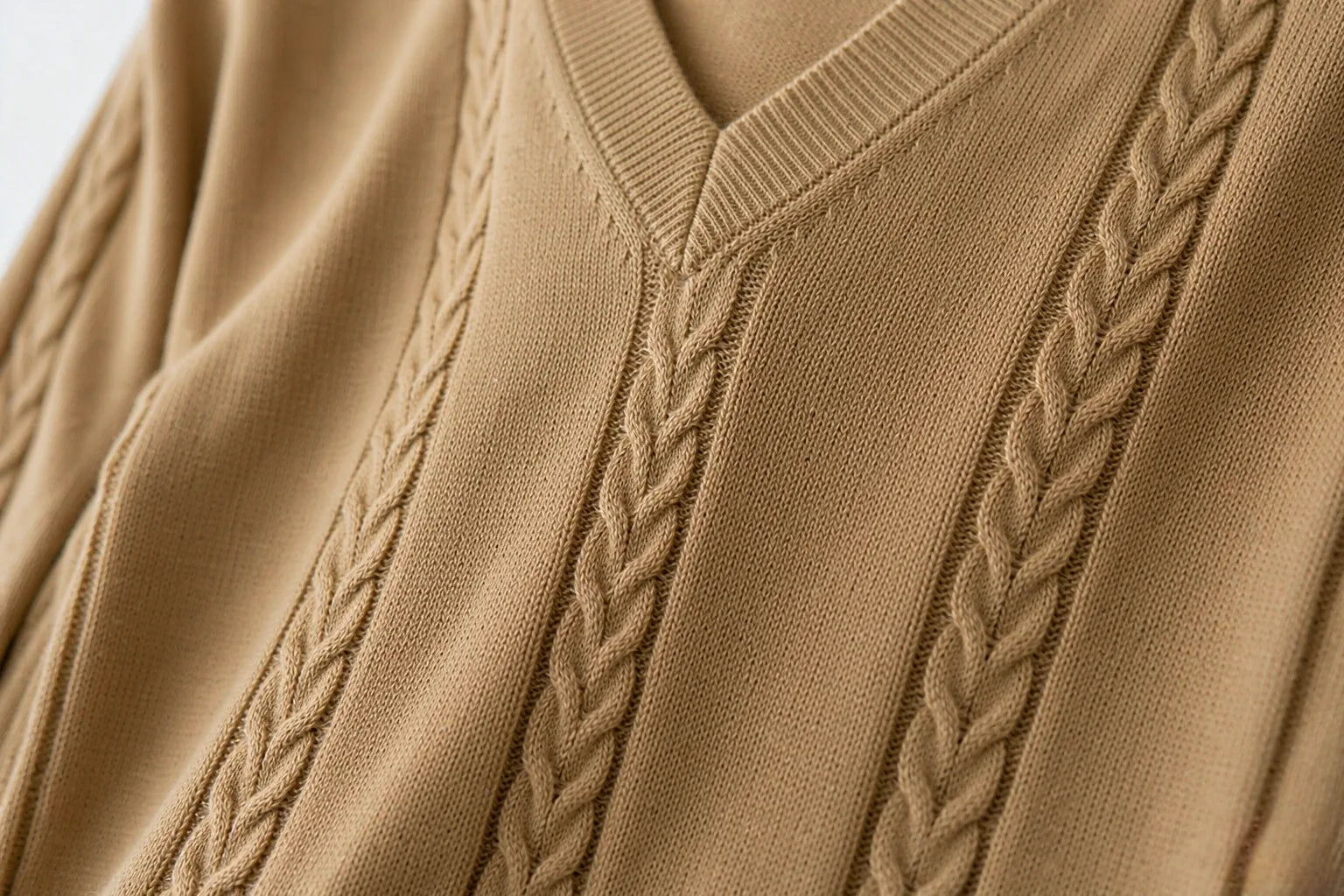
Read the label accordingly: a 14G knit is not a better knit than a 5G one — it is differently built, and everything about how a knit feels in humid heat flows from that fact.
Fine-gauge vs chunky knit — what is the real difference?
Fine-gauge knitwear is thin yarn knitted densely: it drapes close, layers without bulk and reads quietly tailored. Chunky knitwear is thick yarn knitted loosely: it stands off the body, holds dimension, insulates. In hot, humid weather, gauge answers only half the question — the fibre and the openness of the structure decide the rest.
| Axis | Fine-gauge | Chunky |
|---|---|---|
| Yarn diameter | Thin yarn, often plied tight for strength | Thick yarn, often single-ended and soft |
| Stitch density | High — small, tight, even stitches | Low — large, visible, open stitches |
| Drape | Falls close and follows the body | Stands off and holds its own shape |
| Weight on the body | Light; you forget you are wearing it | Heavy; the knit is a presence |
| Warmth | Low to moderate — depends heavily on fibre | High — trapped air plus more yarn mass |
| Care and handling | Thin yarns snag more easily; gentler handling | Loops catch less often, but bulk makes washing and drying slower |
Does fine-gauge automatically mean cooler in hot weather?
No — and this is where most comparisons quietly mislead. How a knit feels in hot, humid weather is a three-factor equation: the fibre, the weight, and how open the structure is. Fine gauge improves one and leaves the other two untouched.
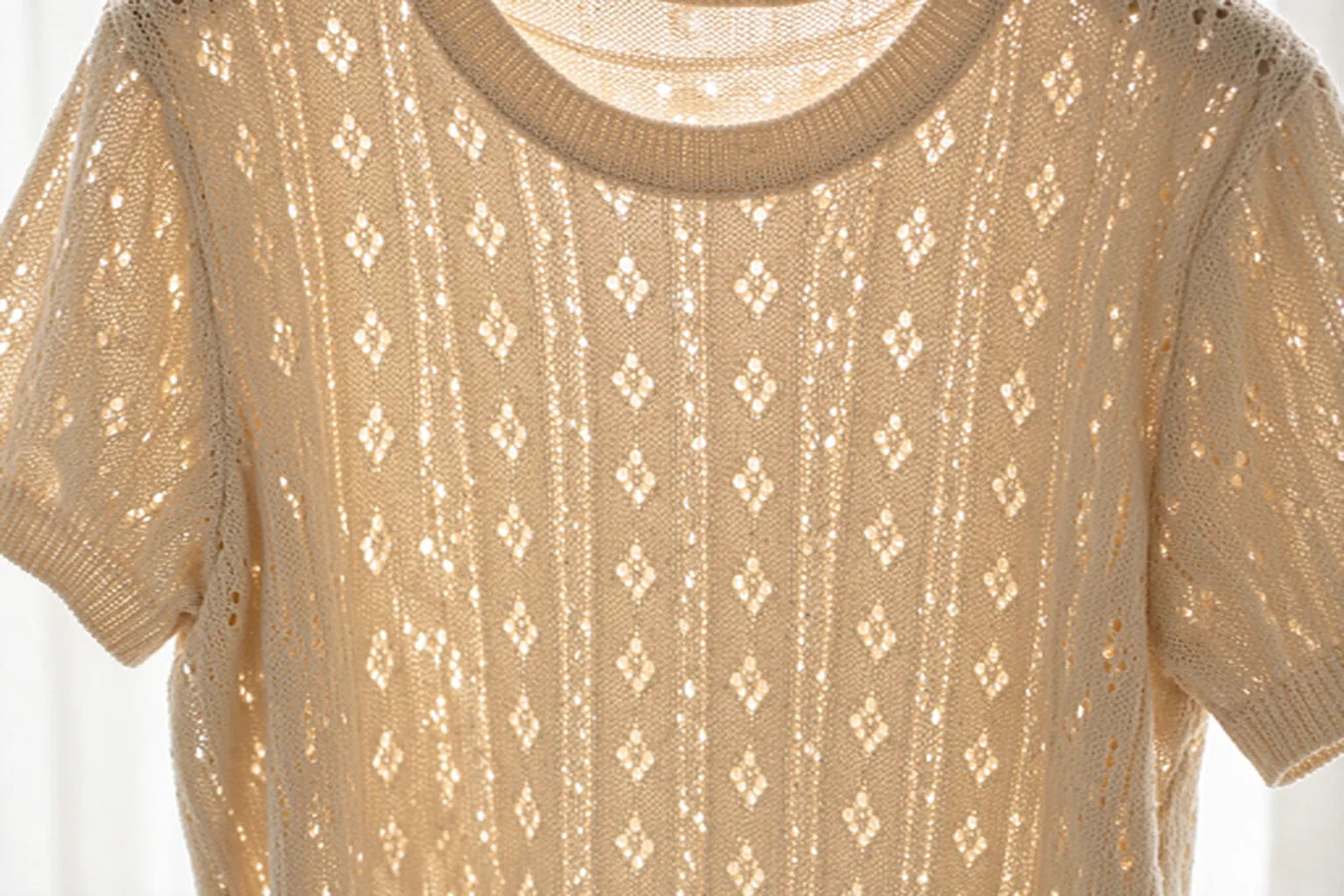
The fibre factor dominates: how a material takes up sweat and gives moisture back is fibre chemistry, not needle count — the mechanism is covered in which fabrics breathe best. Structure matters just as much: decorative openwork lets measurably more air through. Our pointelle openwork cotton knit top — 100% combed cotton — exists because openness does what gauge cannot.
The fibre counter-example is already in our lineup. The fine-gauge wool-blend layering cardigan is knitted at a fine gauge in 30% wool, 50% polyester and 20% acrylic — and wool is warm at any gauge, so it is positioned as an indoor air-conditioning layer. If the problem is heat rather than cold AC, a cellulose-rich fine-gauge knit is the better instrument — the lightweight cap-sleeve knit top, in a viscose- and lyocell-heavy blend with a cool hand, is built for that job (its sizing runs small, so size up between sizes). The three factors add up; they do not substitute.
When does fine-gauge knit earn its place in the tropics?
Daily, in one specific place: the air-conditioned indoors. Singapore style writers have long framed the cardigan as "aircon armour", and consumer guides reach for the same formula — a fine-knit layer over breathable fibres for freezing offices, because heavier wool blends overwhelm outdoors. The full styling logic lives in our guide to dressing for air-conditioned offices in the tropics.
A fine-gauge layer earns its slot through threshold behaviour. On the street in 33°C and 80% humidity it adds the least fabric mass; indoors at 22°C it traps just enough still air to take the edge off; back outside it folds into a tote. Chunky cannot do this — the property that insulates indoors punishes outdoors.
Two pieces anchor the use case. The fine-gauge V-neck knit top blends wool, mulberry silk and synthetics into a close-fitting knit that works under tailoring. The wool-blend cardigan above does the outer half — as its product page puts it, the fine-gauge knit keeps the profile clean, what makes a warm-fibre layer tolerable for a commute.
Does chunky knit have any place in a tropical wardrobe?
A narrow one — and we would rather state it plainly. Singapore shopping guides land where the climate does: chunky wool is overseas-winter-travel material, too warm for local outdoors, and regional packing lists file thick knits under "leave at home".
The honest exceptions: first, brutally air-conditioned spaces — long-haul budget flights, cinemas, some offices — where sustained cold rewards a substantial knit. Second, the flights themselves: a chunky knit doubles as pillow and blanket. Third, overseas winter travel, where it becomes equipment, not costume.
One transparency note: RQFashion carries fine-gauge and lightweight knits — including dimensional-texture pieces that can photograph like chunky — and no true heavy-gauge pieces. We will not dress a cable texture up as chunky to complete a comparison. If your life is heavy on the exceptions, buy a proper chunky knit from a specialist maker; if not, the fine-gauge drawer works.
Cable knit vs chunky knit — is texture the same as weight?
No, and keeping the two apart is the most useful single skill in knitwear shopping. Cable describes a structure — stitches crossed over others to make rope-like raised lines. Chunky describes a weight — thick yarn at a low gauge. They often appear together, which is why the terms blur; a fisherman's sweater is both. Either can exist alone.
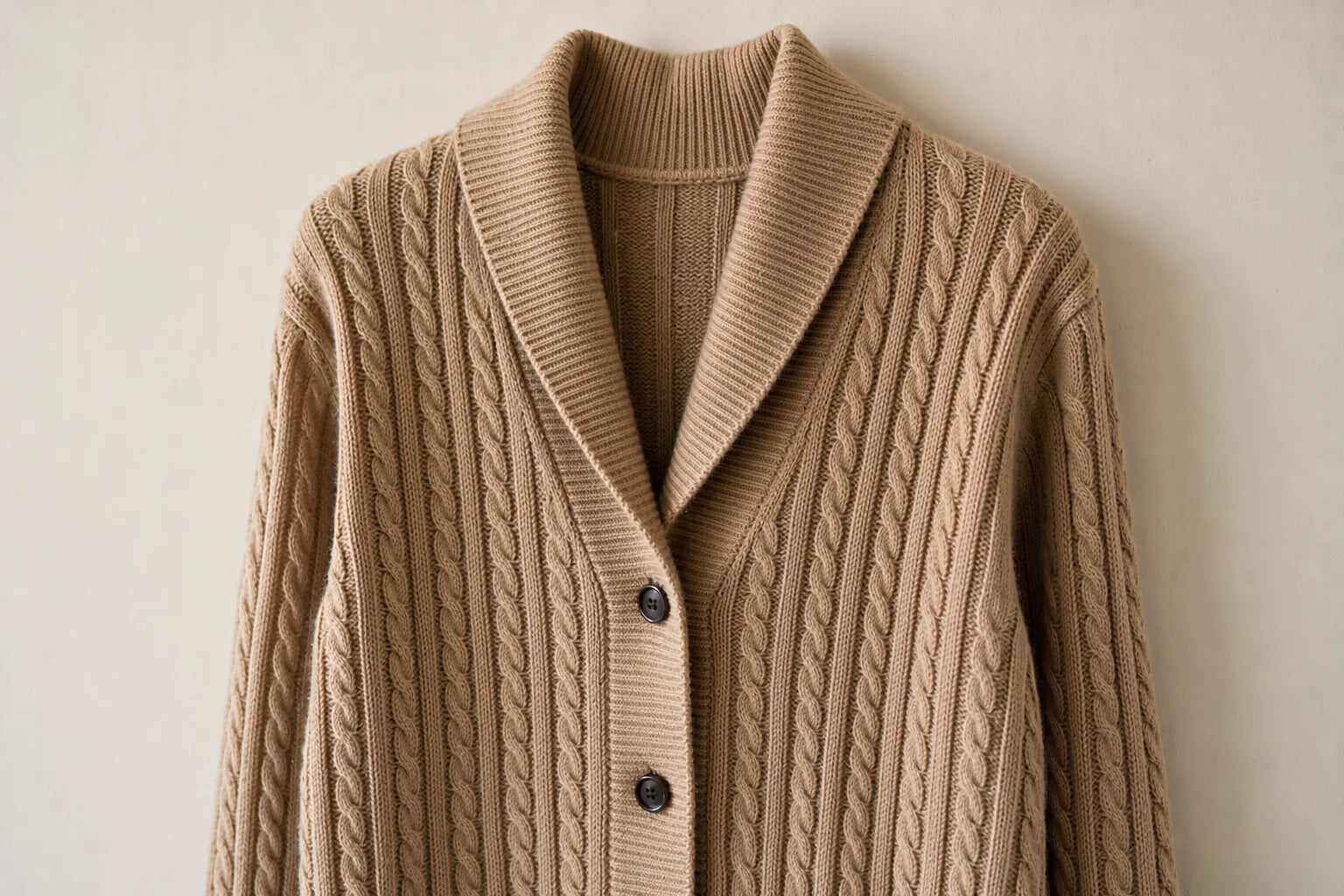
Our cable-knit shawl-collar cardigan is the working proof. Full cable texture, proper shawl collar — and a description that reads "knitted in a fine-gauge yarn with gentle stretch": the cable-look texture in a fine-gauge knit gives the visual dimension of a heavier sweater while the thin yarn keeps the piece light. Texture is a design decision; weight is a construction one. Labels that use "cable" to imply "warm and chunky" borrow weight their yarn may not have.
How does knit weight change drape and proportion?
Weight decides who the fabric listens to — you, or gravity. A fine-gauge knit is mostly drape: little stiffness, so it falls close, skims the body and layers flat under jackets. A chunky knit is mostly structure: thick yarn stands on its own, holding the garment's shape, not the shape beneath.
Volume, not fibre, overwhelms a smaller frame. Style guidance for petite readers makes the same point — a voluminous chunky knit can swallow a smaller silhouette, while a fine knit with a streamlined line sits better — and the reasoning is geometric: fabric that stands away from the body adds visual mass. Cut matters as much as weight.
On fit specifics: our knits are drafted on regular proportions — knits sit closer than trousers, so we recommend 160 cm and up; under that expect to tailor, especially pants. Shoulder-drop and hem questions live in our guide to how a knit top should fit; here the same body wears two silhouettes at 5G and 14G.
Fine knits pill and snag more — is that true?
Partly, and the honest version has two halves. The snag half is real: a fine loop is more likely to catch on a bag zip, a ring, a rough shelf, and when a thin yarn catches, damage shows sooner because the yarn itself is narrow.
The pilling half is conditional. Pilling comes from short or loose fibres working free under friction, and yarn thickness is not the deciding variable — a delicate yarn at a loose tension can still pill. Fibre processing matters more: combed cotton removes short fibres, so the remaining long fibres are less prone to pilling — part of why the pointelle top holds its surface. The fair framing is "different failure modes", not "fine knits fall apart".
Both are care subjects: wash-bag habits, friction sources and the de-pilling routine live in our guide to how to stop knitwear from pilling. The construction takeaway: fine gauge trades durability of appearance for drape and lightness — a trade most tropical wardrobes should take.
How do you judge knit weight when buying online?
Product pages carry the signal in four places — gauge words, the G number if given, fibre percentages, and the fit description. Read them as a set:
| Label word | What it tells you | What to check next |
|---|---|---|
| Fine-gauge / 12G–16G | Thin yarn, dense stitches, close fit and drape | Fibre percentages — fine wool still insulates |
| Chunky / 3G–5G | Thick yarn, low density, volume and warmth | Where you will actually wear it — travel and deep AC, for most tropical buyers |
| Pointelle / openwork | Decorative holes = structural openness, more airflow | The fibre — openness helps most over a breathable one |
| Cable | Texture pattern only — not a weight claim | The yarn line: "fine-gauge yarn" can sit right next to "cable" |
| "Lightweight" | A marketing range with no fixed standard | Fibre percentages and the fit description carry the real signal |
Trust construction words over marketing words — "12G" and "100% combed cotton" are checkable; "cosy" is not. Read the fit line too, because cut stacks on gauge: an oversized fine-gauge knit wears bulkier than its yarn suggests. Since weight is hardest to judge from a photo, the 30-day return window is part of honest buying math.
Fine-gauge or chunky — which should you buy first?
For a wardrobe lived in Singapore or Malaysia, fine-gauge goes first, and the order tracks the rooms you live in:
- Daily commute and humid streets: a fine-gauge knit top — the V-neck above for tailoring days, a crew-neck for everything else.
- Air-conditioned offices and malls: a fine-gauge cardigan layer — wool blends for cold rooms, cellulose-rich blends for in-and-out days.
- Humid-season outdoors: light weight plus openness — the pointelle cotton top's territory, where structure helps the fibre work.
- Travel and deep-cold exceptions: warmth from fibre, not gauge — the lambswool button-front cardigan from RUIJIN, the founding brand in residence at RQFashion, carries autumn 2026 duty with a fine-gauge profile: fibre warmth without bulk.
Chunky stays a specialist purchase. For the fine-gauge drawer, our ranking of the best fabrics for hot, humid weather narrows the fibre before the weight. Logistics stay simple: Standard delivery is $6 across Singapore and Malaysia, free over $80; Expedited is a flat $46; parcels move DDU, so import duty is the customer's to settle; returns run 30 days; checkout takes PayPal. Or browse new-in knitwear and pick the weight from the body.
Frequently Asked Questions
What does gauge mean on a sweater label?
A: Gauge is needles per inch on the machine that made it. A 12G sweater has twelve needles per inch — small stitches, thin yarn; a 5G sweater has five, big stitches and thick yarn. Higher numbers mean finer, denser knits, whatever the fibre.
Is fine-gauge knit better for hot, humid weather?
A: Usually easier to live with, but "better" overstates it. Gauge fixes only the weight factor; fibre and openness decide the rest. A fine-gauge wool blend is still the warmest thing you own; a pointelle pattern in combed cotton breathes harder than any dense knit of the same fibre.
Can you wear chunky knits in Singapore or Malaysia?
A: Yes, in a narrow set of cases: severely air-conditioned spaces, long-haul flights where the knit works as blanket and pillow, and overseas winter travel. Everyday local wear, no — the climate makes a thick knit punishing outdoors.
Do fine-gauge knits pill and snag more easily?
A: They snag more easily — thin yarn catches on zips, jewellery and rough surfaces, and damage shows sooner. Pilling depends more on fibre length, spin tightness and fabric tension than on yarn thickness — a tightly spun long-fibre fine knit can outlast a loosely made thick one.
What weight of knit works for air-conditioned offices?
A: The 12G-and-finer band — thin enough to layer without bulk, in a fibre matched to how cold the room runs. Singapore guides converge: a fine-knit cardigan or top as the "aircon layer" — wool blends for the coldest rooms, cellulose-rich blends for in-and-out days.
The fabric picks the material — the gauge picks the feel
Fibre decides what a knit is made of and how it handles moisture; our comparison of cotton vs linen vs lyocell covers that axis while gauge decides how that fibre is packed — and with it the drape, weight and proportion of everything built on top. Read the G number, check the fibre, weigh the openness — the label puzzle becomes a ten-second decision.
Build the fine-gauge drawer first
Start where this guide landed: the fine-gauge wool-blend layering cardigan for the air-conditioned hours and the pointelle openwork cotton knit top for the humid ones — one reads the indoors, the other the street. To weigh fibres on top of weights, the fabric breathability guide finishes the equation, or browse new-in knitwear and read each G number with the ladder above.
0 comments