

How should a blazer fit? Five checkpoints settle it: the shoulder seam rests on or just past the point of your shoulder bone, the sleeve ends at the wrist bone, the top button closes without pulling, the hem covers the hip, and the back hangs smooth with no horizontal creases. On a relaxed, unlined linen blazer — cut to drape rather than to structure — those checks score against a wider target, not a lower standard. In Singapore and Malaysia a blazer lives two lives: buttoned through a 17°C boardroom, folded into a tote before the 33°C walk to lunch. That double duty is exactly what the relaxed linen cut is built for, provided you can tell designed ease from a size you simply got wrong. Below: each checkpoint in order, where a dropped shoulder may fall, petite proportion rules, and the no-tailor fixes for a too-big jacket.
Key takeaways:
- - Five checkpoints decide blazer fit: shoulder seam at the bone, sleeve at the wrist bone, one button that closes without pulling, a hem that covers the hip, and a back free of horizontal creases.
- - A dropped shoulder is designed when it falls about 1–3 cm past the shoulder point and the sleeve head stays rounded; a seam past roughly 4 cm cannot be styled back.
- - Linen needs about half a size more ease than wool, wrinkles by design, and rewards unlined construction in the tropics.
- - On petite frames the shoulder seam is the north star; sleeve scrunch, an open front and a slim base layer work around it.
- - For 30°C+ streets and cold offices: unlined linen jacket in a light color, slim fine-knit base, blazer indoors and bagged outdoors.
How Should a Blazer Fit When the Fit Is Meant to Be Relaxed?
A structured wool blazer and a relaxed linen one answer the same question in different grammar. The structured jacket uses canvas, padding and lining to hold a shape close to your body, so its fit is judged by how nearly it approaches you. A relaxed blazer — unlined or half-lined, in linen or a linen blend — carries almost none of that armor, and its fit is judged by how the fabric falls. Same five checkpoints, wider tolerance.
The baselines do not move: shoulder at or just past the bone, sleeve at the wrist bone, one button that closes without pulling, a hem that covers the hip, a back without horizontal creases. What changes is the allowance — relaxed ease runs a few centimetres looser through the chest and waist on purpose.
The judging conditions differ from the other soft pieces in this series. A cardigan is scored buttoned and open, per how a cardigan should fit; a knit top sits second-skin against you, per how a knit top should fit. A relaxed blazer lives mostly open — buttoning is a test you run, not the posture you keep.
| Checkpoint | Too big looks like | Too small looks like |
|---|---|---|
| Shoulder | Seam slides toward the bicep; the sleeve head caves flat | Seam creeps up the neck; chest pulls under the arm |
| Sleeve | Cuff swallows the hand even when pushed up | Wrist bone shows below the cuff |
| Button | Front edges hang a wide, floppy distance apart | Pull lines radiate from the button; the placket splits |
| Hem | Falls toward mid-thigh and swallows the waistband | Sits at the hipbone and rides up when you sit |
| Back | Deep vertical folds pooling at the armhole | Horizontal creases across the shoulder blades |
One clarifying idea: relaxed is vertical, wrong is horizontal. Designed ease makes long vertical folds; a wrong size drags sideways — across the back, across the buttons, along the sleeve.
Where Should the Shoulder Seam Sit on a Relaxed or Dropped-Shoulder Blazer?
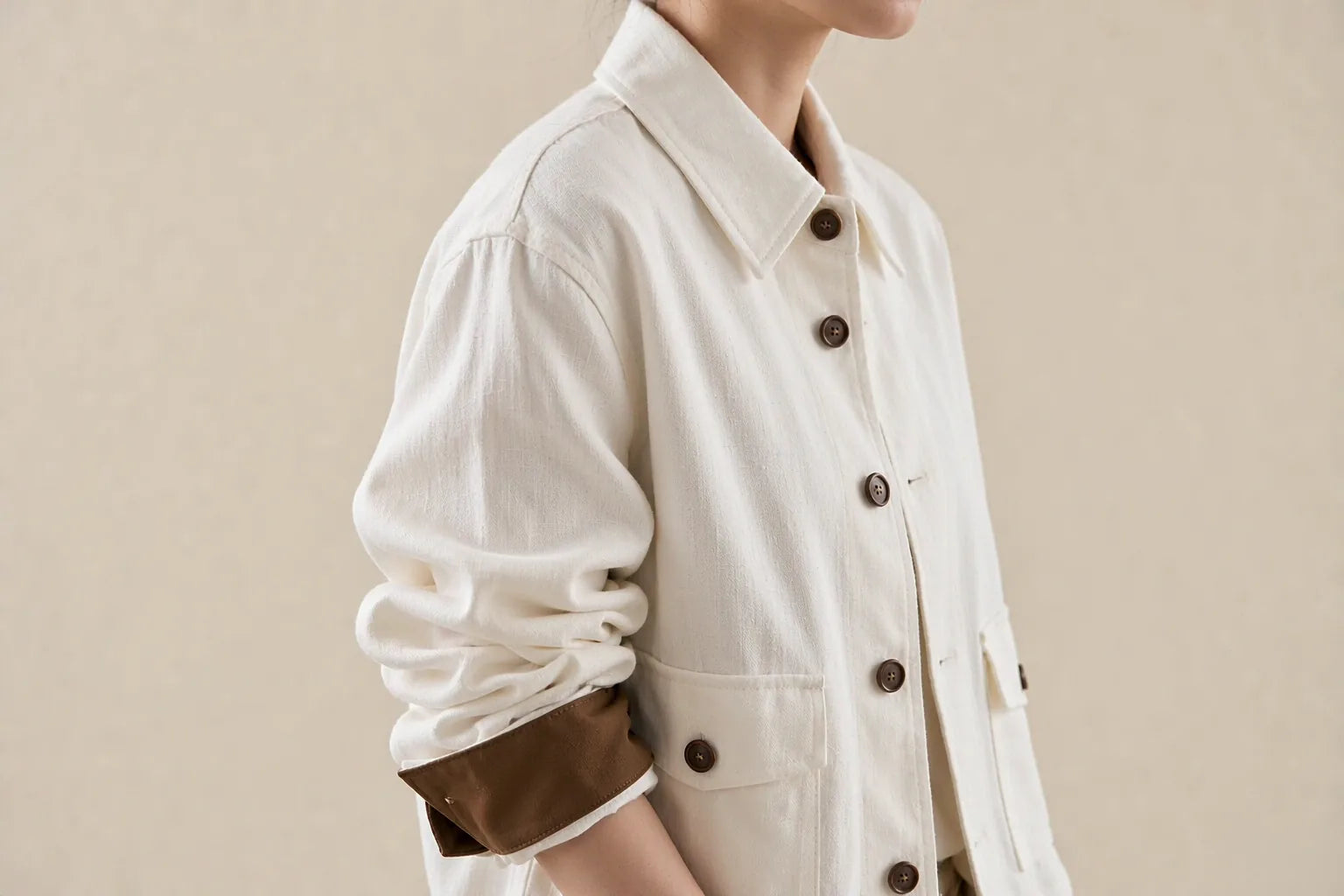
On a classic blazer the seam must end at the point of your shoulder bone — the one checkpoint no tailor can cheaply move. A relaxed or dropped-shoulder cut bends the rule on purpose: the seam may fall a controlled one to three centimetres past the bone, as long as the sleeve head still rounds over the shoulder instead of caving flat.
So the seam, not the bicep, is the anchor. A drop of up to roughly four centimetres can still work when other proportions compensate — sleeves pushed up, a defined waist below. A seam halfway down the upper arm is not a style; it is someone else's size.
My colleague Priya, 163 cm, ordered a relaxed blazer in M "for the drape". In the mirror the seam sat halfway down her arm and the sleeve head had collapsed. The same jacket in S dropped the seam about two centimetres past her bone — and the same oversized design suddenly read as intentional.
That is also how to read product pages. The relaxed-fit linen blazer with easy shoulders lists relaxed shoulders as a design feature — the drop is in the pattern, offered in White and Khaki, not an accident of sizing. Before ordering, measure your shoulder and sleeve length so the checkpoints have numbers to compare against.
How Should a Linen Blazer Fit Differently From a Wool One?
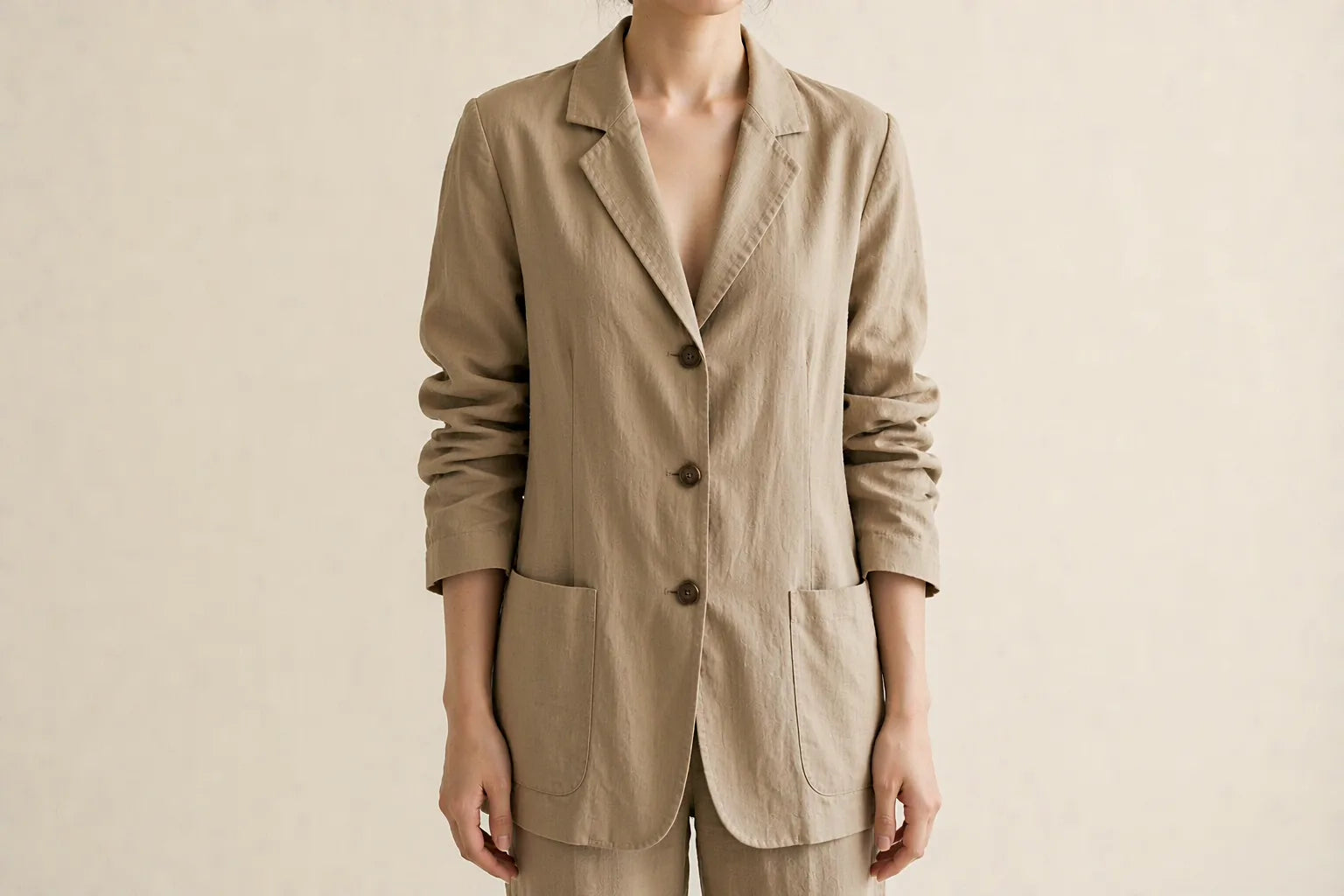
Wool has give and memory; linen has neither. A wool jacket stretches back after a long day, while a tight linen announces its strain within the hour — which is why a linen blazer wants roughly half a size more ease than the wool equivalent, built into the cut rather than improvised.
Wrinkles are the second difference, and they point the other way. Creases are linen's signature, not a fit fault, so judge the drape instead of the crease count: the front edges should fall in clean vertical lines from the shoulder.
Construction is the third. An unlined or half-lined back forgives more than a fully lined one — there is no lining tension dragging across the shoulder blades — and in the tropics that same absence of lining is what keeps the jacket wearable. Fabric blends shift the drape too: the stand-collar jacket in a linen–lyocell blend falls closer and more fluidly than pure linen, while the minimal linen lapel jacket keeps the airier box that 100% linen gives.
| Structured wool blazer | Relaxed linen blazer | |
|---|---|---|
| Shoulder test | Seam must end at the bone; only a tailor moves it | Designed drop of 1–3 cm is fine; past about 4 cm is not |
| Button standard | Usually worn closed; must close without pull | Often designed open-first; one button must still close cleanly |
| Ease allowance | Close to the body; altered to fit | About half a size looser by design |
| Wrinkles | A flaw — press before wearing | The fabric's signature — judge the drape |
| Petite friendliness | Petite sizing or alterations usually needed | Relaxed S/M cuts can work: seam, scrunch and proportion do the rest |
| Tropical suitability | Full lining turns heavy in 30°C+ | Unlined linen moves air; the cold office is its habitat |
How Should a Blazer Fit if You're Petite?
An oversized blazer on a petite frame is a proportion exercise, not a forbidden combination — and it still starts at the shoulder seam. If the seam passes the checkpoint above, everything else is adjustable; if it does not, nothing else saves it.
Length is the next lever. The hem should just cover the hip; every centimetre it creeps toward the knee eats visible leg. A hem landing between the hipbone and mid-hip keeps the torso read short and the legs read long.
Then the ratio: aim for the jacket to end around the one-third mark of your outfit, leaving the lower two-thirds to the leg line. The scrunched sleeve helps here too — pushed to the forearm, it uncovers the wrist and keeps the sleeve from shortening your arms.
Underneath, keep the base layer slim and the waistline high so the volume above has something to contrast. On sizing: the product pages note these cuts run petite and suggest sizing up between sizes — take that as the starting point, then let the seam checkpoint overrule it, because the rules in between sizes: size up or down bend once the pattern carries its own ease.
My Blazer Is Too Big — Can I Fix It Without a Tailor?
Often, yes. Push the sleeves to the forearm — a small elastic band or hair tie inside the cuff holds the scrunch all day. Wear it open; an open front reads slimmer than a strained closure and suits the relaxed design anyway. Slim the middle with a fitted base layer, keep the column under it one color, and add a belt over the jacket if you want the waist back.
What styling cannot fix is the seam. Past roughly four centimetres beyond the shoulder bone, no rolled sleeve or belt restores the line — that is a size problem, not a styling one, and the honest move is the return window rather than a lifetime of compensating.
Should a Blazer Button Closed Without Pulling?
Yes — one button, cleanly. Close the top button and slide a flat hand between button and body: it should pass without resistance, with no pull lines radiating outward and no lens-shaped gap straining at the fullest point.
Relaxed cuts are usually designed open-first, and a front that hangs apart below the buttoned point is styling room, not a defect. The failure signs run the other way: a button that fights your ribs, a placket that splits on its own, horizontal creases from each closure. A relaxed hem swinging open is design; a button working against you is a size.
How Do You Wear a Blazer in Hot, Humid Weather?
Construction decides before styling does. Unlined or half-lined wins — a full lining traps heat against the back — and lighter colors reflect more of the sun than dark ones. Linen's open weave lets air move while it shades you, which is why the "cotton or linen, unlined" formula keeps resurfacing in local style writing: the blazer here is cold-office equipment first, an outfit second.
The rotation is the same one that makes the cardigan earn its keep: indoors and outdoors sit around sixteen degrees apart, so the jacket does the 17°C boardroom and the tote does the street. An unlined relaxed jacket folds flat and recovers without pressing, which is what makes the commute rotation realistic at all.
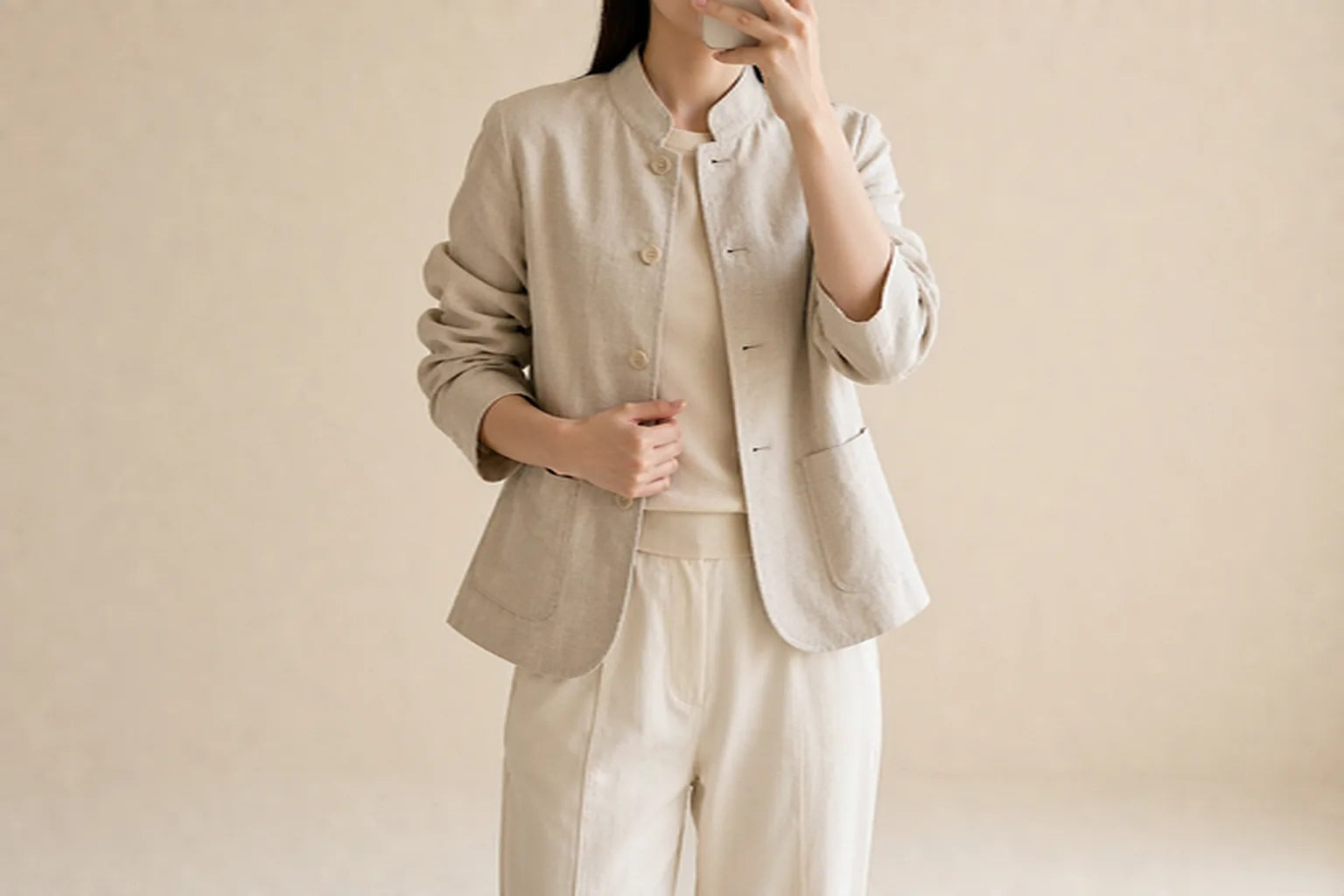
For that job, the stand-collar jacket in a linen–lyocell blend in Oatmeal is the natural pick — light enough to carry daily, collar standing or open. Worn open on the street and buttoned at the desk, it covers both climates in one garment.
What Should You Wear Under a Relaxed Blazer?
Start slim. A fine-gauge knit that follows the body — the skin-soft v-neck knit top is the template — keeps the layer under the jacket thin, and the fitting rules in how a knit top should fit apply unchanged. Chunky knits fill the designed ease of a relaxed chest and turn drape into bulk.
A button-front vest is the other honest answer: the tailored button-front vest adds the structure a third piece should give, without adding heat on your arms or bulk under the jacket. On humid commutes that trade — warm core, free arms — is worth more than any lining.
Ready to Run the Five-Point Check on Your Next Blazer?
Shoulder at or just past the bone, sleeve at the wrist bone, one button closing without a fight, hem covering the hip, back hanging smooth — five checkpoints, ninety seconds, and the difference between designed ease and a wrong size stops being a guess. Tonight, run them on the blazer you reach for and the one you avoid; the avoided one will trace back to a seam that slid or a hem that swallowed. And when the next one passes all five — seam where the pattern put it, drape falling in vertical lines — you will know it was cut the way the relaxed-fit linen blazer with easy shoulders and the minimal linen lapel jacket were: relaxed by design, not by accident. Start with the five checkpoints and let the checklist do the shopping: explore the RUIJIN collection.
FAQ
Should a blazer be tight or loose?
Neither extreme. The shoulder seam sits at or just past your shoulder bone, the sleeve ends at the wrist bone, one button closes without pulling, and the hem covers the hip. A relaxed cut adds vertical ease by design; tightness that pulls horizontally — across the back or the button placket — is a size problem, not a style.
How long should a women's blazer be?
Long enough to just cover the hip — anywhere from the hipbone to mid-hip. On petite frames take the shorter end of that range, because every centimetre toward the knee costs visible leg. A longer blazer works only over a slim, high-waisted column that keeps the leg line readable.
Can petites wear oversized blazers?
Yes, as a proportion exercise. Keep the shoulder seam within a couple of centimetres past the shoulder bone, scrunch the sleeves to the forearm, let the hem end near the one-third mark of the outfit, and keep the base layer slim with a high waistline. Break the seam rule and nothing else recovers it.
Should a linen blazer fit looser than a wool one?
By about half a size of ease, yes. Linen has no give or memory, so a tight linen shows its strain within an hour. The wrinkles are the fabric's signature rather than a fit fault — judge the vertical drape, and prefer unlined construction in hot weather.
Can you fix a blazer that's too big without tailoring?
Often: scrunch the sleeves to the forearm (an elastic band inside the cuff holds them), wear the jacket open, slim the middle with a fitted base layer, keep one color under it, or belt it. What styling cannot fix is a shoulder seam more than about four centimetres past the bone — that one goes back.
0 comments