

How should a cardigan fit? Four checkpoints settle it: the shoulder seam sits on your shoulder bone, the sleeve ends at the wrist bone, the buttons close at the bust without pulling or gaping, and the hem lands between your hipbone and the top of your hip — the shorter end of that range if you're petite. Everything else — boyfriend slouch, cropped boxy cut — is styling built on those four checks. In Singapore and Malaysia a cardigan is less a winter piece than aircon equipment: buttoned inside a 17°C office at nine, stuffed into a tote before lunch on a 33°C street. A piece that lives two lives has to pass all four checkpoints at once — below is each check in order, plus a height-by-length table for petite frames and the layering rules that make it work here.
Key takeaways:
- - Four checkpoints decide cardigan fit: shoulder seam at the bone, sleeve at the wrist bone, buttons that close without pulling, and a hem between hipbone and top of hip.
- - A cardigan is judged in two states — open and buttoned — and always over the base layer you'll actually wear.
- - On petite frames (roughly under 163 cm), aim for a flat-lay front length of about 50–63 cm so the hem finishes at or just past the hipbone.
- - Cropped beats long for petites in most pairings; a long cardigan works only when it stays slim and drapey over a high-waisted column.
- - In a tropical climate, choose fine-gauge knits that fold into a tote, and run the button test over your thinnest base layer.
What Does "a Cardigan Fits" Actually Mean — and How Is It Different From a Knit Top Fit?
A cardigan has to pass the same foundation checks as any knit — then pass them twice, because it lives in two states. Open, it drapes from the front edges. Buttoned, the panels join and the garment re-tensions: the chest gets a centimetre smaller, the shoulder seam tugs inward, the hem rides up. A cardigan that only fits open isn't a fitted cardigan; it's a cape with ambitions.
The second difference is what's underneath. A pullover sits on you, so you fit it to your body; a cardigan sits on a system — a camisole, a knit top, sometimes both — and you fit it to the system. The shoulder and hem logic carries over from our guide on how should a knit top fit; buttons and two-layer ease are cardigan-only territory.
The working definition: a cardigan fits when it passes shoulder, sleeve, button and hem checks in both states, over your real base layer. Four checks, two states, ninety seconds.
Where Should the Shoulder Seam Sit on a Cardigan?
Same rule as every knit, with one cardigan-specific twist: on a set-in cardigan, the seam finishes right at the bony point of your shoulder, so the sleeve hangs cleanly off the true edge.
The twist: buttoning changes the shoulder. Close the front and the plackets pull toward each other, dragging the back panel — and the shoulder seams with it — a few millimetres inward. So run the check in both states. If the seam sits at the bone open but creeps up your neck when buttoned, the body is cut too narrow through the chest.
Dropped shoulders are the legitimate exception. A designed drop falls a controlled two or three centimetres past the bone and keeps some structure in the sleeve. An accidental drop slides halfway down the upper arm while the body stays slim — the two don't agree. If your shoulders sit between sizes, the decision tree in between sizes: size up or down settles the seam question by garment type.
How Long Should a Cardigan Sleeve Be — to the Wrist Bone or Past It?
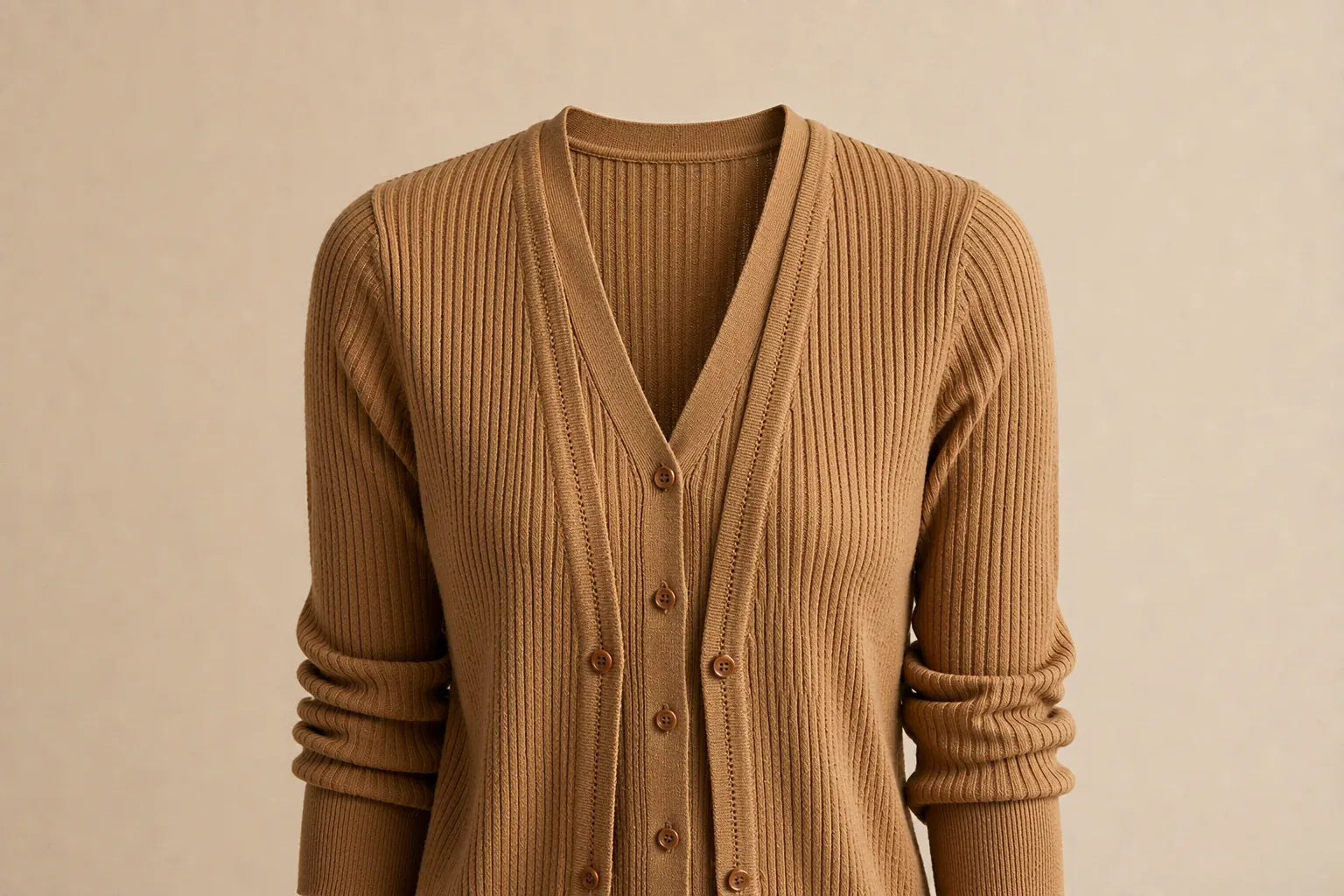
To the wrist bone — the same baseline as a shirt, with one knitted caveat. Drop your arms: the cuff should meet the bone at the base of your thumb without covering it — the length that stays put while you type.
The caveat is knit sag. A cardigan's sleeves grow over a day of wear, because gravity plus body heat relaxes the stitches. The correct length at 9 a.m. is a finger too long by 3 p.m. — so the fitting standard is wrist bone or a hair above it, never below. A cuff that already pools on your hand in the shop has done its growing before you paid for it.
Slightly long is workable; slightly wide usually isn't. A ribbed cuff that grips lets you push the sleeves to the forearm and keep them there — the standard move in a warm office — while a wide, slack cuff slides straight back down.
Where Should a Cardigan Hit on a Petite Frame?
Hem length is the checkpoint where petite frames are won or lost, and where should a cardigan hit deserves an answer in numbers, not vibes. On a taller frame extra length is styling nuance; on a 155 cm frame it decides whether your legs read as legs or an afterthought.
Petite — formally, women around 163 cm (5'4") and under — changes the arithmetic: the same garment length covers proportionally more of you. The benchmarks below are general flat-lay figures for the front length (shoulder to hem, measured on the garment):
| Your Height | Front Length to Look For (flat-lay) | Where the Hem Should Fall | Why |
|---|---|---|---|
| Under 150 cm | 50–55 cm (20–22") | At the hipbone | Longer cuts pool at the hip and shorten the leg line |
| 150–158 cm | 53–58 cm (21–23") | Hipbone to just below it | The classic petite window — coverage without stacking |
| 158–163 cm | 56–63 cm (22–25") | Just past the hipbone | Mid-hip works when the knit is slim and drapey |
| Over 163 cm | 60–66 cm (24–26") | Mid-hip | The range most general petite guides quote |
Brands vary — treat these as aim points and compare against a cardigan you already like, measured the same way; the method in our how to measure yourself for womenswear guide takes minutes. Second, hem position is a pairing decision: a hem at the hipbone reads clean over high-waist wide-leg relaxed pants because the eye gets a waistline, a hem, then legs. The proportion rules in our wide-leg pants styling guide for petite frames cover that geometry in full.
Cropped or Long Cardigan — Which One Works on Petite Frames?
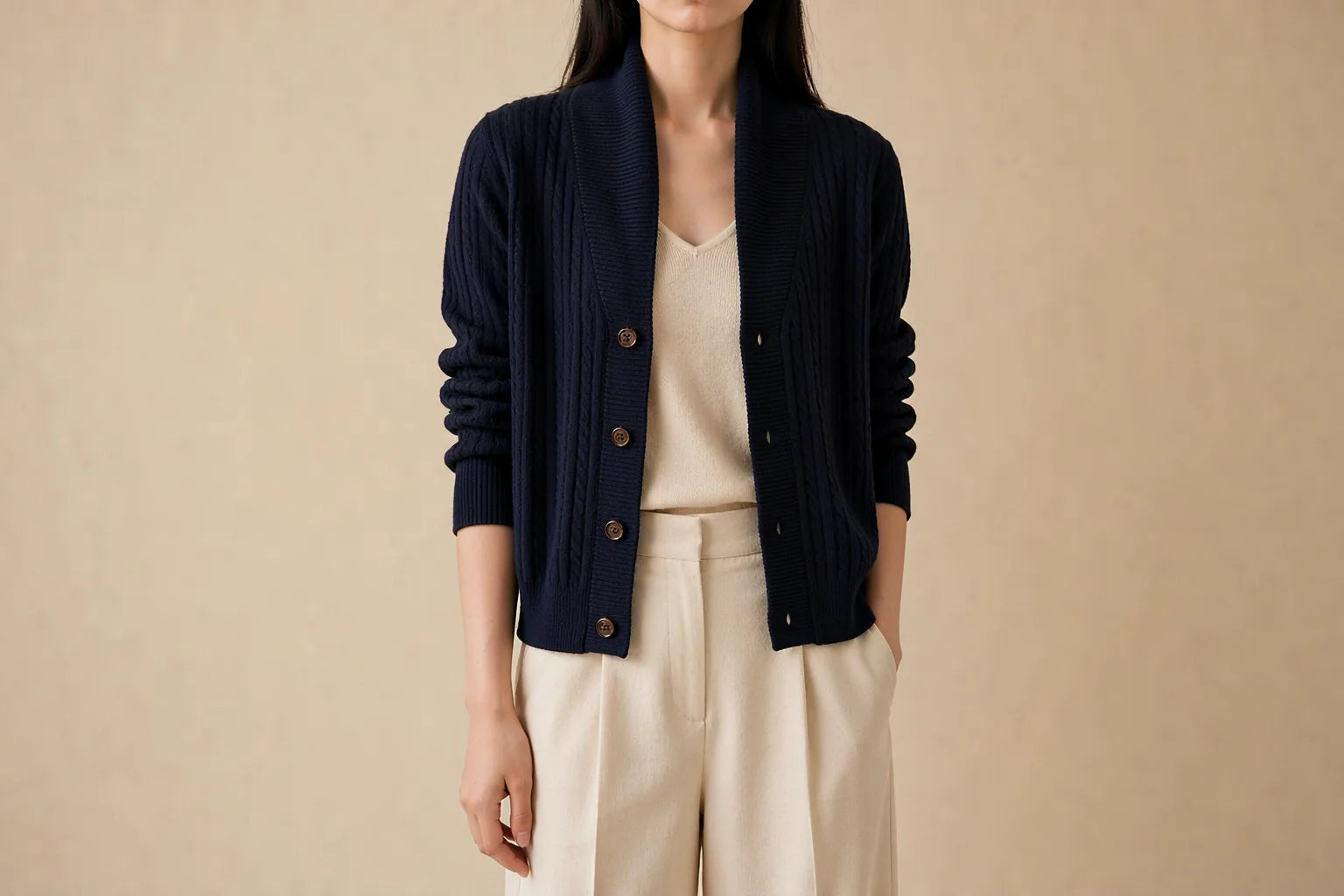
The honest answer: cropped wins more often for petites, hip-length is the daily default, and long is a conditional pass. This is the cropped vs long cardigan petite question: how much vertical space is the knit allowed to occupy?
| Cropped | Hip-Length | Long (mid-thigh and below) | |
|---|---|---|---|
| Hem position | At or above the top of the hip | At the hipbone | Mid-thigh or lower |
| Petite verdict | Works — especially over high waists | The everyday default | Conditional — see rules below |
| Best bottoms | High-waisted trousers, longline skirts | Straight pants, mid-rise everything | Slim columns, tone-on-tone layers |
| Aircon office | Covers the back seated, short at the sides | Full coverage seated and standing | Warmest, but bulkiest in a tote |
| Visual effect | Raises the waistline, lengthens the legs | Neutral and classic | Can cut your height unless kept slim |
A long cardigan on a petite frame survives exactly three conditions: the knit is fine-gauge and falls inward rather than standing away from the body, the colour stays close to the bottoms, and the shoulders still pass the seam test. Break one and the length stops reading as relaxed; a boxy long knit on a small frame is the fastest way to look like the coat rack.
The practical test when choosing cardigan length for petite frames: find your waistband in the mirror. If the hem ends at or above it, you're safe; if it swallows the waistband and keeps going, the outfit has two competing horizontal lines and no waist.
Should a Cardigan Button Closed Without Pulling?
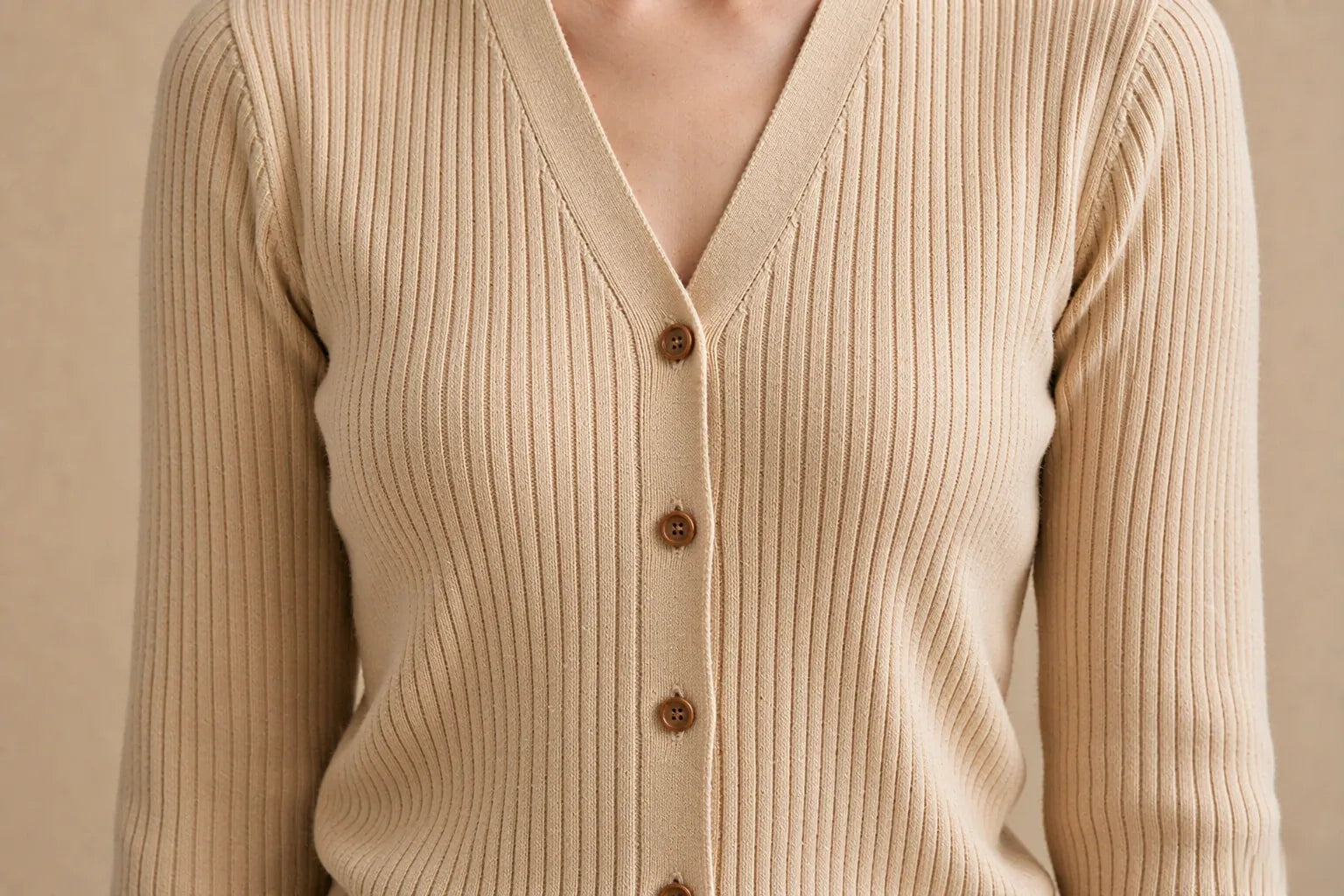
Yes — and this checkpoint kills more online cardigan purchases than any other, because product photos rarely show it. My colleague Mei bought a cardigan last quarter that photographed beautifully open, then buttoned it over a blouse on its first office outing: between the second and third buttons the placket split into a small V of visible camisole, and by lunch horizontal pull lines radiated from every button. She'd bought to her open-fit size, not her closed-fit size.
The check takes ten seconds. Button it fully over your base layer and look for three things:
- Gaping between buttons — a lens-shaped opening where the placket splits. A centimetre of gap at the fullest point of the bust means the chest is short.
- Horizontal pull lines — wrinkles running sideways from each button toward the armhole. The fabric is borrowing room from where there is none.
- The side view — the placket should hang plumb, not curl backward or flare outward.
Mei kept the one she re-tested over her thinnest top; over a chunkier knit it gapped. The one she reaches for daily now is our V-Neck Knit Cardigan with Ribbed Trim, cut relaxed and true to size, so it buttons smoothly over a skin-soft v-neck knit top without staging that drama. Always run the test over the layer you'll actually wear — your thinnest base for a tropical rotation, a stand-collar knit top if your office runs colder.
Can Petites Wear Oversized Cardigans?
Yes — with three conditions, all checkable in under a minute. The oversized cardigan is a proportion game: you're borrowing volume on top, so everything else has to hold the line.
- The drop must be designed, not accidental. A deliberate oversized cut drops the seam a controlled few centimetres past the bone and keeps the sleeve structured. Once the seam is nearer your bicep than your shoulder, the garment is wearing you.
- Manage the sleeves. If the cuff can be pushed to the forearm and stay, the volume reads intentional; if it swamps your hand, the whole silhouette droops.
- Keep one volume per outfit. Big top requires a slim, high-waisted bottom half. Wide cardigan over wide trousers on a 155 cm frame erases every vertical line you own.
Brand guidance is the shortcut: the Shawl-Collar Cable-Knit Cardigan is cut relaxed and true to size, and the listing itself says size up for a looser layer — one boundary for any cardigan order: we recommend the collection for 160 cm and up — the oversized look on a petite frame comes from the sizing, not from hunting a men's cut. The cable texture and shawl collar hold their shape when the fit loosens, which keeps a bigger size from reading as a shapeless one.
How Should a Cardigan Fit in a Tropical Climate?
How to wear a cardigan in tropical weather is really a question about gauge, weight and packability, because in Singapore or Malaysia the cardigan's job is the 16-to-18°C indoor stretch, not the street. Indoors and outdoors here can sit sixteen degrees apart, and a cardigan is the only layer that bridges that without commitment.
Fit changes in three ways when the climate does:
- Fine gauge for the commute rotation. A thin, fluid knit layers without bulk, folds into a tote, and comes out looking like it never left. Save the cable knits for heavily airconditioned rooms and dinners.
- The fold test. Crush the cardigan gently in your fist. A tropical-rotation cardigan springs back with minimal creasing; a dense one stays a crumpled ball. The base layer underneath matters too — a slim mid-sleeve crew knit top or a featherweight slim v-neck base-layer top stays smooth under a cardigan that goes on and off all day.
- The button test over the thinnest layer. A cardigan sized to button over your thinnest top leaves room to re-layer upward without re-buying.
One more local adjustment: expect to wear it open on the street and buttoned at your desk — the shoulder and hem checks matter more than the closed-chest check. A breathable soft crew-neck knit top with gentle drape underneath does the outdoor hours; the cardigan does the indoor ones.
Cardigan or Vest — When Does a Button-Front Vest Fit Better?
Some days the cardigan is the wrong tool, and the tell is your forearms. A cardigan gives you a removable layer but keeps fabric on your arms; a button-front vest gives you the warm core and the structured third piece while leaving your arms free for a humid commute or a packed train.
The vest also solves a fit problem the cardigan can't: sleeve-length arithmetic. Petite frames spend disproportionate time shortening sleeves; a vest has none. Our Tailored Button-Front Vest with Welt Pockets, cut from a linen-lyocell blend, passes the same four checkpoints — armholes high and close, buttons that close without pull, a hem at the hipbone that doesn't fight the bottoms.
Rule of thumb: cardigan when the office is the cold end of the day; vest when you're in and out of doors or the outfit already has enough sleeve interest. A vest over a slim knit and high-waisted trousers is about the cleanest vertical line a petite frame can build in this weather.
What Size Cardigan Should You Buy If You're Between Sizes?
Size for the shoulder, then let the rest negotiate — with one cardigan-specific amendment. In most knits a roomy chest is forgivable and a dropped seam is not, so the seam decides. In a cardigan, add the button check: if the smaller size buttons cleanly over your base layer and the seam sits at the bone, take it, because knit relaxes with wear and the garment will grow toward you. If the smaller size gaps at the bust when buttoned, the choice is made for you.
How much a size differs across labels is its own rabbit hole; our US, UK, EU and SG/MY size conversion guide maps the drift between markets. And before trusting any chart, get your own numbers — two minutes with a tape measure, per the how to measure yourself method, beats every letter on the tag.
Ready to Run the Four-Point Check on Your Next Cardigan?
Shoulder at the bone in both states, sleeve at the wrist bone, buttons that close without a fight, hem between hipbone and top of hip — four checkpoints, ninety seconds, and most of the cardigan regret in your wardrobe evaporates. Tonight, run the check on the cardigans you wear most — and the one you avoid; the avoided one traces back to one of the four. And when the next one earns its place — buttoned smoothly over your thinnest base layer, hem exactly where the table says — you'll know it passed the same test the V-Neck Knit Cardigan with Ribbed Trim and the Shawl-Collar Cable-Knit Cardigan were cut around. Start with the four checkpoints, and let the checklist do the shopping: explore the RUIJIN collection.
FAQ
How Much Should a Good Cardigan Cost?
Fit rules are free; the cardigan is not, so here is the honest price band. The cardigans currently stocked at RQFashion run from $35.99 for a fine-gauge layering piece to $119.99 for a lambswool button-front, with the core between $38.99 and $56.99 — including the shawl-collar cable-knit cardigan at $56.99. Converted for Singapore budgets (1 USD ≈ 1.34 SGD), seven of the eight sit under SGD 150.
What the price actually tracks is cloth and construction: a fine-gauge layering knit uses less yarn than a cable-knit shawl collar, and lambswool costs more than cotton blends. Match the number to the length before you pay — the RQFashion length guide lists the hem measurement of every stocked cardigan in centimetres, so the four-point check above starts with data instead of guesswork.
How much should a good cardigan cost?
- Stocked cardigans at RQFashion run from $35.99 to $119.99; the core range sits between $38.99 and $56.99 (about SGD 52–76).
- Price tracks cloth and construction: fine-gauge layering costs less than cable-knit, lambswool more than cotton blends.
- Seven of eight stocked cardigans come in under SGD 150 at current exchange rates.
How should a cardigan fit a woman?
The shoulder seam sits on your shoulder bone, the sleeve ends at the wrist bone, the buttons close at the fullest point of the bust without gaping or pulling, and the hem lands between your hipbone and the top of your hip. All four checks must pass both open and buttoned, over the base layer you actually wear.
What length cardigan is best for petite women?
Aim for the hem to finish at or just past the hipbone — a flat-lay front length of roughly 50–63 cm for frames between 150 and 163 cm. Longer cuts work only on slim, drapey knits over high-waisted bottoms; otherwise the extra length stacks at the hip and shortens the leg line.
Can petites wear oversized cardigans?
Yes, under three conditions: the shoulder drop is designed and limited rather than collapsed, the sleeves can be pushed up and stay, and the lower half of the outfit stays slim and high-waisted. Break one condition and the look survives; break two and the knit starts wearing you.
Should a cardigan be able to close over a shirt?
Yes — the buttons should close over your intended base layer without gaping between buttons or pulling in horizontal lines. If it only works open, size up or choose a cut with more chest room, because you'll want it buttoned on every cold-office day.
Are long or cropped cardigans better for petites?
Cropped and hip-length cardigans suit petite frames more reliably: a cropped hem raises the waistline and lengthens the leg line, and a hip-length hem is the versatile default. Long cardigans work on petites only when the knit is fine-gauge, falls close to the body, and stays close in colour to the bottoms.
0 comments