

You can dress quiet luxury on a budget by spending on three things that cost nothing extra at the till: matte natural fabrics, precise fit and a restrained neutral palette. Quiet luxury is not a price bracket — it is a dressing protocol built on unbranded, well-cut clothes in cotton, linen and lyocell that keep their composure in 32°C heat. If you have been wondering what is quiet luxury style, the short version is this: no logos, no shine, no noise — just fabric, fit and colour doing the talking. This guide turns that protocol into a practical playbook for Singapore and Malaysia: three fabric tests you can run in any store, two under-$60 outfit formulas built on real $38–47 knits, the colour and proportion rules that do the visual heavy lifting, and the mistakes that quietly undo the effect. For the definition behind the look, start with the full quiet luxury vs logo luxury breakdown, then come back and build yours.
What Does Quiet Luxury Actually Mean on a Budget?
Quiet luxury, stripped of its television associations, is simply a code of dress: unbranded clothes, muted colours, matte fabrics and fits that sit exactly where they should. The line stylists keep repeating — a protocol, not a price point — is accurate in a way that matters for your wallet. None of the core signals require money; they require judgement, and judgement is free.
Picture two women in the same lift at an Orchard Road office. One wears a shiny synthetic blouse with a large monogrammed tote; the other wears an unbranded oatmeal knit with quietly tailored trousers. Before either speaks, most people in that lift have already formed an impression — and the impression has nothing to do with the tote's receipt. That is the entire thesis of the budget approach: the signals that read as expensive — matte texture, restraint, fit — are the cheapest signals to acquire and the hardest to fake with spending alone.
The budget version also has a tropical advantage. Because the aesthetic was built on lightweight natural fabrics, its uniform translates to 32°C streets and 20°C trains far better than the logo-and-leather interpretation ever did.
Which Fabrics Deliver Quiet Luxury Without Designer Prices?
Fabric is where budget dressing is won or lost, because fabric is what the eye reads first, before silhouette, before colour. Expensive-looking clothes share one mechanical property: they absorb light. Matte combed cotton, linen and lyocell scatter light softly across the surface; cheap-looking synthetics bounce it straight back with a plasticky gleam. Run this checklist in the fitting room or on your own shelf:
- The light test: tilt the fabric toward a window or your phone torch. A soft, even surface passes; a glittery sheen fails on the spot.
- The drape test: hold a corner and let it fall. Fluid, weighty movement reads refined; stiff, crackly or static-clingy movement reads cheap.
- The surface test: after an hour of wear in the heat, combed cotton and linen keep a clean, unbothered surface. Pilling, clinging and sweat-shine are instant downgrades no label can rescue.
Combed cotton is the budget MVP here. The combing process removes short, fuzzy fibres from the yarn, which is how a $38 knit can carry the smooth, low-fluff surface of something twice its price. Linen brings texture and airflow. Lyocell — a smooth fibre made from wood pulp — adds the fluid drape that makes even the simplest silhouette look considered. This is also why the fabric-content label is the most useful tag on any affordable piece: fibre percentages predict how a garment will behave better than brand names ever will. Even mass-market retailers now stock good fibres at low prices, which is exactly why fabric behaviour over pedigree has become the working rule for dressing well on a budget.
How Do You Build a Quiet Luxury Outfit Under $60?
Here is the encouraging maths: the quiet luxury outfits women actually wear through the tropics need only one new piece per season, because the rest of the formula is discipline you already own. Spend under $60 on a single knit, borrow everything else from your wardrobe, and let restraint finish the job.
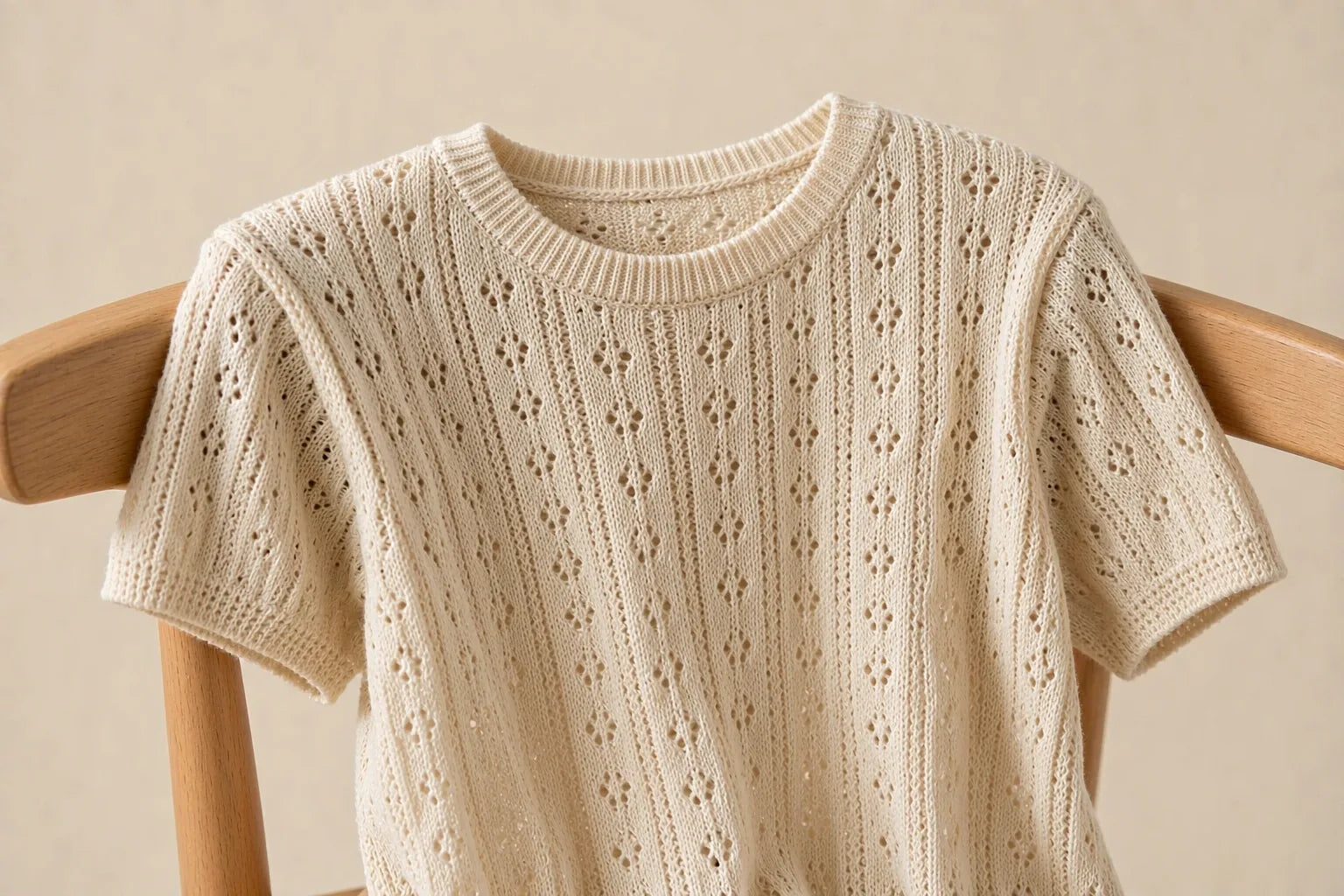
Formula 1 — The Matte Cable. The cotton cable-knit short-sleeve top ($38, 100% combed cotton) in cream or apricot, worn with beige wide-leg trousers you already own, leather loafers or clean sandals, and small gold hoops. The pointelle texture supplies all the visual interest; everything else stays deliberately quiet.
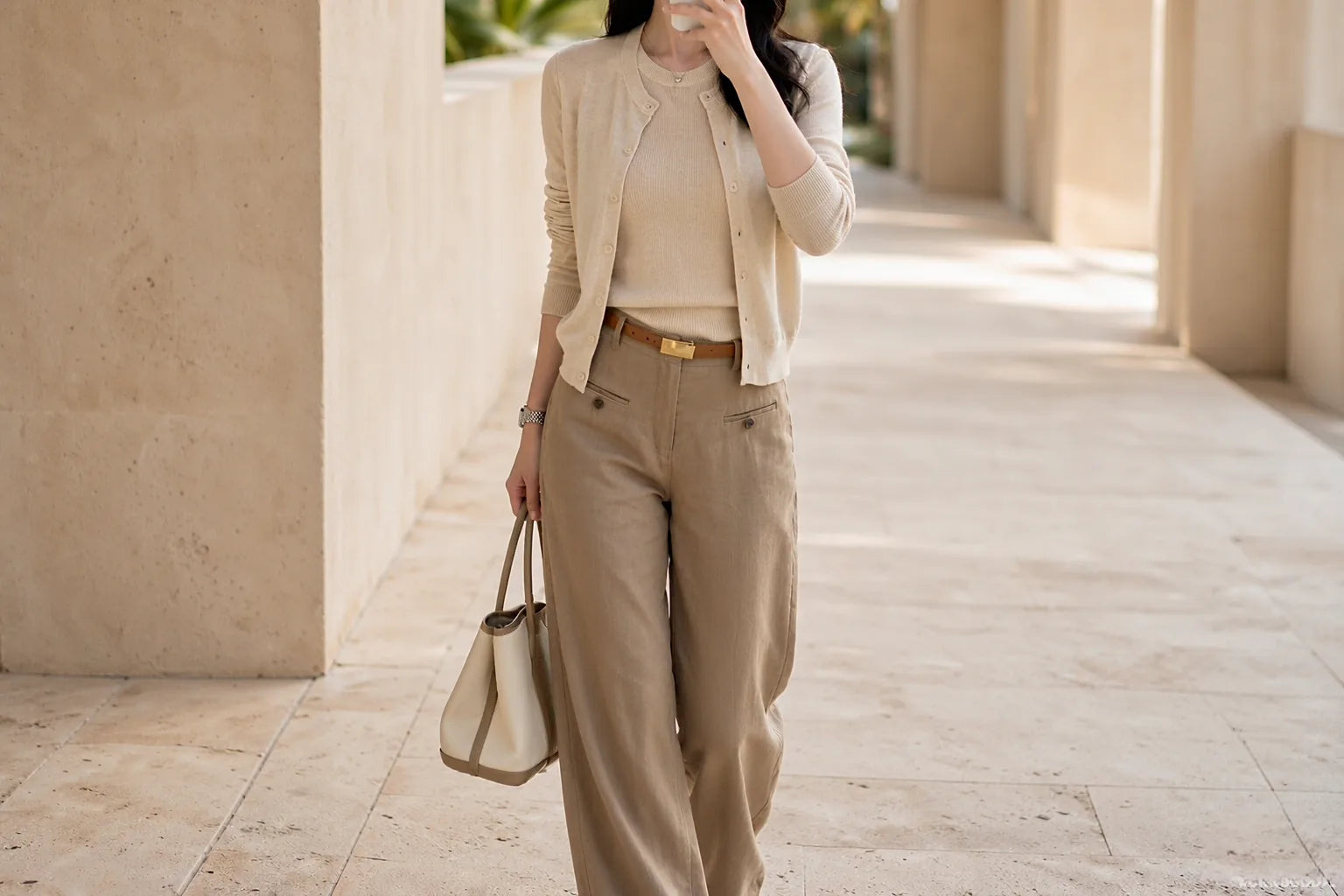
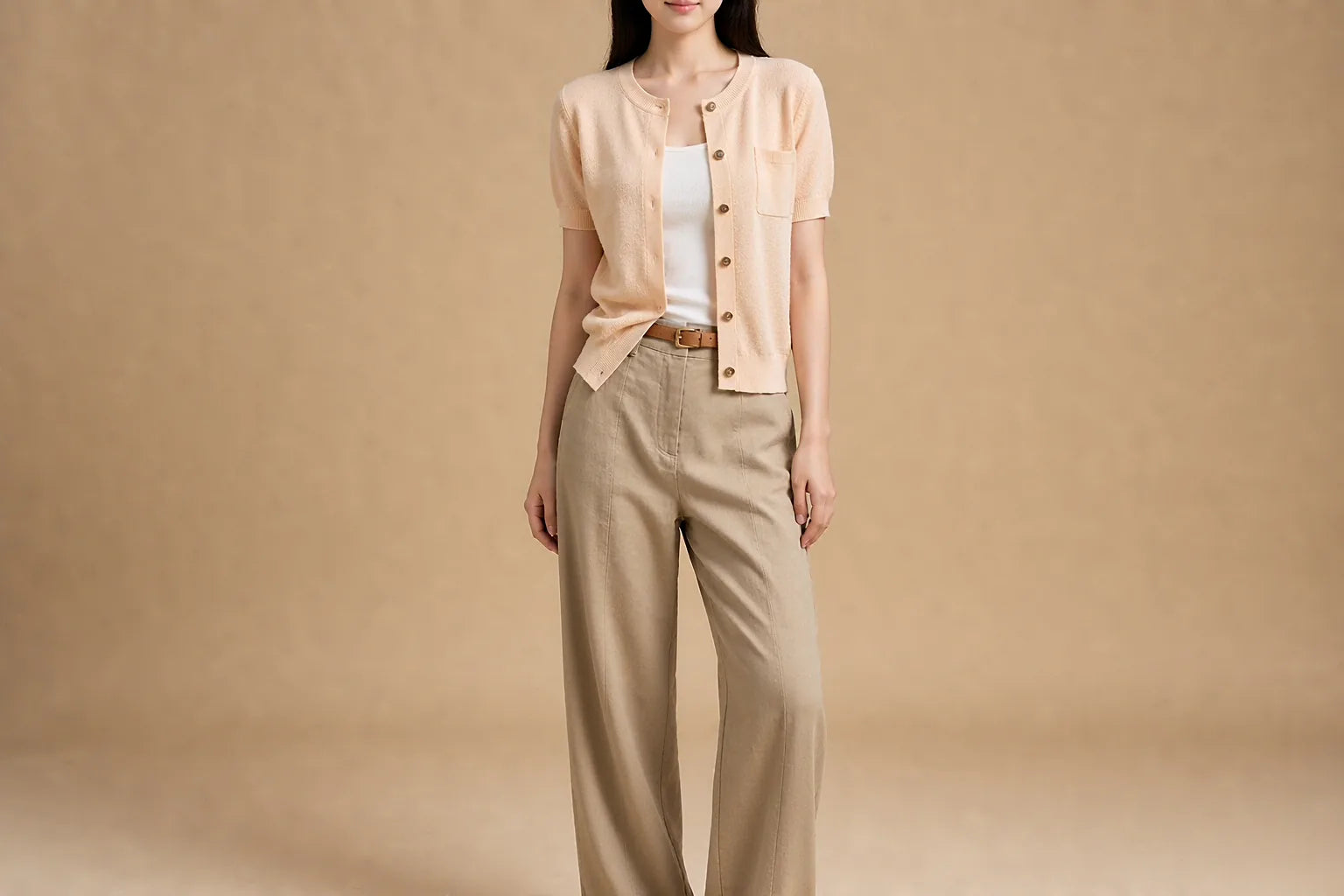
Formula 2 — The Softened Cardigan. The short-sleeve knit cardigan in apricot ($38.67) buttoned over a white tank and half-tucked into khaki trousers. One chest pocket, matte yarn, no announcements — it reads like something from a much higher price bracket.
For offices that run at Arctic settings, add one third piece you can remove at the door. The knit two-piece layering set earns its keep exactly here — and our guide to dressing for air-conditioned offices in the tropics covers the full layering system.
Can Affordable Knits Really Read Expensive?
Test the claim against real pieces rather than theory. Three knits in RQFashion's curated edit — designed by RUIJIN, the label in residence at the boutique — price between $38 and $47.33, and each passes the checklist above for specific, checkable reasons.
The cotton cable-knit top ($38) is the cleanest case: 100% combed cotton, a gently fitted cut and a pointelle-cable texture with no sheen at all. It is the piece that proves the combed-cotton argument in practice — matte in torchlight, fluid over the shoulder, unbothered after a commute.
The short-sleeve cardigan in Apricot ($38.67) blends 40% combed cotton and 5% linen with a polyester balance that keeps it under $40 — and because the yarn is fine-gauge and fully matte, the blend still behaves: soft hand, clean surface, no glitter under office lighting.
The two-piece set ($47.33) pairs an Oatmeal long-sleeve layer with a matching ribbed camisole; 12% linen and 28% lyocell supply the fluid drape, while the balance of the yarn holds the price under $50 without putting shine on the surface. Not every fibre has to be natural — it has to act natural.
Notice what is happening across all three: the signals that read as expensive — matte finish, drape, fit — arrive at $38–47 because the money went into yarn and cut instead of marketing. A friend of ours once paid $200 for a lustrous "luxury" blouse that creased like paper by lunchtime; the $38 matte knit she wore beside it won every comparison that month. Fabric behaviour beat price tag, publicly and repeatedly.
Which Colours and Proportions Signal Quiet Luxury for Less?
Palette discipline costs nothing and does half the visual work. Build your outfits around the warm neutrals — Apricot, Oatmeal, Khaki and Cream — then anchor them with Navy or Black. One outfit, two to three colours, all from the same muted family: that restraint is what reads as considered. What breaks the spell is contrast and saturation — a neon top, a primary-red bag, glossy black accessories all competing at once. When in doubt, remove the loudest thing you are wearing.
Proportion is the other free upgrade, and two rules cover most bodies:
- Anchor the waist. High-waisted trousers or skirts, with knits buttoned or front-tucked so the waistline stays visible. The half-tuck — front hem in, back hem out — is the single highest-return styling move in this entire aesthetic.
- Keep one volume. Wide legs with a fitted top, or a relaxed knit with a leaner bottom. Two loose volumes at once read sloppy at any price point.
Petite frames collect an extra dividend from the tuck: a visible waistline adds back the centimetres that long, untucked knits quietly subtract. Worth knowing before you order — these knits run petite, so size up if you sit between sizes, then let the tuck finish the proportion work — and the same boundary applies: we recommend the collection for 160 cm and up, with tailoring expected below that, especially for pants.
How Does Quiet Luxury Differ From the Old Money Aesthetic?
The two overlap so heavily that the terms get used interchangeably, but the accents differ. Old money style leans collegiate and inherited: structured blazers, loafers with history, tennis-club codes, a whiff of library polish. Quiet luxury leans modern and minimal: softer silhouettes, fewer elements, an almost gallery-like restraint. If old money is a library, quiet luxury is a white-cube gallery — same hush, different furniture.
For daily life in Singapore or Malaysia, quiet luxury is the more practical dialect. Its short sleeves, knits and breathable cottons were practically engineered for the commute between 32°C pavements and 20°C carriages, while the old money uniform keeps reaching for wool. If you want the full lineage — the codes, the icons, the history — our what is old money style guide covers it in depth. Borrow the palette from one and the ease from the other; the overlap zone is where most well-dressed people in the tropics actually live.
What Should You Skip When Shopping Quiet Luxury on a Budget?
The fastest ways to lose the effect while chasing it — each one common, each one avoidable:
- Visible logos. The aesthetic is the absence of announcement; a large monogram undoes every other correct decision in the outfit.
- Head-to-toe beige in the wrong fibres. Neutrals only look quiet when the fabric is matte. A shiny beige polyester set reads as sleepwear, not polish — run the light test first.
- Ignoring fit labels. Ordering your usual size in a petite-cut knit and drowning in it is the most common self-inflicted error. Size up, then tuck.
- Accessory stacking. One watch or small hoops. Four bracelets negotiating for attention re-introduce the noise this style exists to remove.
- Wrong-climate purchases. A "bargain" wool blazer worn twice a year is not a budget win. In the tropics, the capsule is knits, linen trousers and one removable third piece — nothing that needs a December to justify itself.
- Chasing every new drop. The aesthetic's power is repetition: the same five quiet pieces worn relentlessly beat fifteen almost-right ones every time.
Where Should You Actually Spend and Save?
When the budget is genuinely tight, rank by visual return: fabric first, fit second, colour third. A matte, well-fitting $38 knit outperforms a shiny, ill-fitting $100 piece in every setting that matters — the table below is the whole strategy in one screen.
| Priority | Spend on | Save on |
|---|---|---|
| Fabric | Combed cotton, linen and lyocell knits with a matte finish | Trend-driven synthetics with any sheen |
| Fit | Pieces cut close to your proportions (check the petite notes) | Alteration-heavy bargains that never quite sit right |
| Colour | Apricot, Oatmeal, Khaki, Navy — colours you will re-wear weekly | One-season statement shades |
| Accessories | One leather good or small gold pieces worn daily | Stacks of costume jewellery |
| Third layer | One structured knit layer for cold offices | Seasonal wool the tropics will never justify |
On the question of affordable quiet luxury brands: the useful filter is not the name but the label. Check the fibre content, run the three tests from the fabric section, and let the price band follow the evidence. Mass-market names like Uniqlo or COS surface in every version of this conversation and they are fine context — but the shortlist that actually matters is whatever passes the fabric tests in your size, at a price you stop noticing. My colleague Priya rebuilt her work wardrobe around exactly this table: one $38 cable knit, one $47 two-piece, trousers she already owned. Total new spend: under $60. Three months on, the pieces she still gets asked about are those two.
Frequently Asked Questions
Can you do quiet luxury without spending a lot?
Yes — the core signals are matte fabric, precise fit and a muted palette, none of which correlate strongly with price. A $38 combed-cotton knit styled with trousers you already own can out-read a $300 logo piece. Start with one piece from this guide rather than a full wardrobe rebuild, and let repetition compound the effect.
What is the difference between quiet luxury and old money style?
They share a muted palette and logo-free discipline, but old money leans collegiate and heritage — blazers, loafers, inherited codes — while quiet luxury is modern and minimal. The fabric-first version in this guide is the tropical-practical dialect; the full old money breakdown lives in our dedicated guide.
What fabrics make cheap clothes look expensive?
Matte, fluid natural and semi-natural fibres: combed cotton, linen and lyocell top the list. They absorb light, drape cleanly and hold their surface in heat — the three behaviours eyes read as expensive. Shiny, stiff or clinging fabrics do the opposite at any price point.
What should you avoid for a quiet luxury look?
Visible logos, shiny synthetics, poor fit, stacked accessories and climate-inappropriate pieces. Each one signals "trying", which is the precise opposite of the aesthetic's premise: unbothered restraint.
Is quiet luxury practical in hot weather like Singapore?
Arguably more practical than in its original temperate home. The uniform — short-sleeve knits, linen blends, breathable cottons — was built for heat; add one removable layer for air-conditioning and the same system survives the street, the train and the office.
The Protocol, Not the Price Tag
Quiet luxury on a budget is not a contradiction — it is the aesthetic's original setting. Matte fabric, precise fit, muted colour and ruthless editing cost judgement, not money, and judgement scales: once you can run the three fabric tests, every store becomes an affordable quiet luxury store for you. Start with one knit that passes the checklist, borrow the rest of the formula from your own wardrobe, and let repetition do the expensive-looking work.
Build your first under-$60 formula this week: the three knits in this guide — the cotton cable-knit short-sleeve top, the short-sleeve cardigan in apricot and the knit two-piece layering set — are in RQFashion's curated edit, designed by RUIJIN, the label in residence. Browse the full RUIJIN knit edit and pick the one piece your wardrobe is missing.
0 comments