

If you're searching how to fix a stretched out sweater, here is the short answer: most knits come back — soak in lukewarm water, blot with a towel, pin the damp knit to its true dimensions, and let it dry flat. Hanging a sagging sweater up to "let gravity sort it out" is the same reflex that stretched it, and the heat-based shrink tricks circulating online can turn a temporary sag into permanent damage. In Singapore, where a wet knit dries slowly and hangs heavy, both mistakes compound fast. This guide explains why knits stretch, which rescue is safe for your fabric, how to bring necklines and cuffs back in, and the drying and storage habits that stop the sag from returning.
Key Takeaways
- Most stretched knits can be pulled most of the way back with one session: lukewarm soak, towel blot, pin to shape, dry flat — no heat anywhere in the process.
- Heat is the real enemy: hot water felts wool, and high heat warps acrylic and nylon blends, turning reversible stretching into permanent distortion.
- Match the method to the fabric — combed cotton tolerates the widest treatment, while acrylic-heavy blends want water and patience only.
- Never hang a wet knit: a wet knit can weigh two or three times its dry weight, and gravity does the stretching for you.
- Store knits folded, not hung — or use the fold-over-the-bar hanger method for pieces in weekly rotation.
Why Did Your Knit Top Stretch Out of Shape?
A knit stretches when its loops give way, not its fibers. Every stitch is a tiny spring; load it with water, gravity, or repeated tugging, and the loop changes shape even when the yarn itself is undamaged. That is why stretching is so often reversible — you are re-parking springs, not repairing breaks.
Four loads do most of the damage:
- Water. A wet knit can weigh two or three times its dry weight. Lift a soaked sweater by its shoulders and you are hanging that full weight from a handful of loops.
- Hangers. Shoulder points and clips concentrate the load on a few stitches; weeks of hanging slowly press those stitches into new shapes.
- Wear habits. Cuffs pulled over hands, bag straps dragged across the shoulder, hems tugged straight — each one nudges loops a little further out.
- Heat during washing or drying. The one factor that changes the yarn itself, which is why every rescue method below keeps the water lukewarm at most.
The classic report — a knit top lost shape after washing — is usually water plus gravity working together: the knit came out of the machine heavy, got hung up to dry, and dried into whatever shape gravity chose. Picture the damage on a typical fine-gauge v-neck: two weeks on a padded hanger, and the shoulders have grown soft points while the hem drops from waistband to hip. Nothing is torn. Every loop has simply learned a new position — which is exactly what the steps below reverse.
Fine-gauge knits magnify all of this. With thinner yarn and tighter loops, every millimeter of drift is visible on a slim silhouette, while chunky woolens hide sag inside their loft. The thin, warm-weather knits this store specializes in are therefore the ones worth rescuing early.
Can a Stretched-Out Sweater Be Saved — or Is It Beyond Repair?
Usually, yes — and the honest test takes ten minutes. Damp the stretched zone with a spray bottle, wait ten minutes, then gently ease it back toward shape. If the fabric moves willingly and wants to stay, plan a full rescue. If it hangs limp and unresponsive, the loops have fatigued: you can still improve the silhouette, but expect partial recovery.
Three situations sit at the limited-recovery end:
- A ribbed neckline that stays loose even when damp. Rib is the most elastic structure in a knit and the first to fatigue; once the rib springs stop snapping back, no amount of pinning fully restores the original grip.
- Shoulder bumps that have been set for months. The longer a distorted shape has dried and re-dried in place, the more the loops accept it as normal.
- Yarn that looks shiny or feels thin at the stretched point. That is stressed yarn, not stretched loops — handle it gently, because it is one step from breaking.
Fabric shifts the odds. A pointelle knit top in 100% combed cotton has strong loop memory: re-wet it and the springs want to return. Blends heavy in acrylic and nylon hold new shapes more willingly, which makes them both easier to distort and more dependent on careful re-drying.
How Do You Reshape a Stretched Sweater Step by Step?
The method behind how to reshape a sweater is the same for every fiber in the store — only the water temperature and the drying room change. Here is the full sequence:
- Soak lukewarm, 10–15 minutes. Sink or basin, water barely warm to the touch, a small dose of mild detergent if the piece is due a wash. Press the knit under once or twice; no swirling, no wringing.
- Support and towel-blot. Lift with both hands from below — remember the wet weight — lay it on a dry towel, roll the two together into a loose log, and press. The towel takes the water so the knit never has to be twisted.
- Lay flat and redraw the silhouette. On a fresh dry towel, ease the knit back to its true shape: side seams aligned, hem squared, sleeves set to even width. A similar-fit top laid on top works as a template.
- Pin the perimeter. Rustproof pins every few centimeters along hem and cuffs hold the redrawn line while the loops dry into it. Cotton and lyocell knits benefit most; wool often holds without.
- Dry flat in moving, shaded air. A fan or an air-conditioned room halves the wait. Flip the knit halfway through and re-check the pins. Never a radiator, never direct sun, never a dryer.
- Re-check when fully dry. Nudge any edge that drifted and leave the piece flat another hour before folding. If the hem is still a touch long, one more damp-ease session is worth it; a third rarely changes anything.
Why not simply tug the knit back into shape while dry? Because dry yarn springs back to whatever position it dried in. Water is what releases the loops; everything else — towel, pins, flat surface — exists to control where they settle on the second drying.
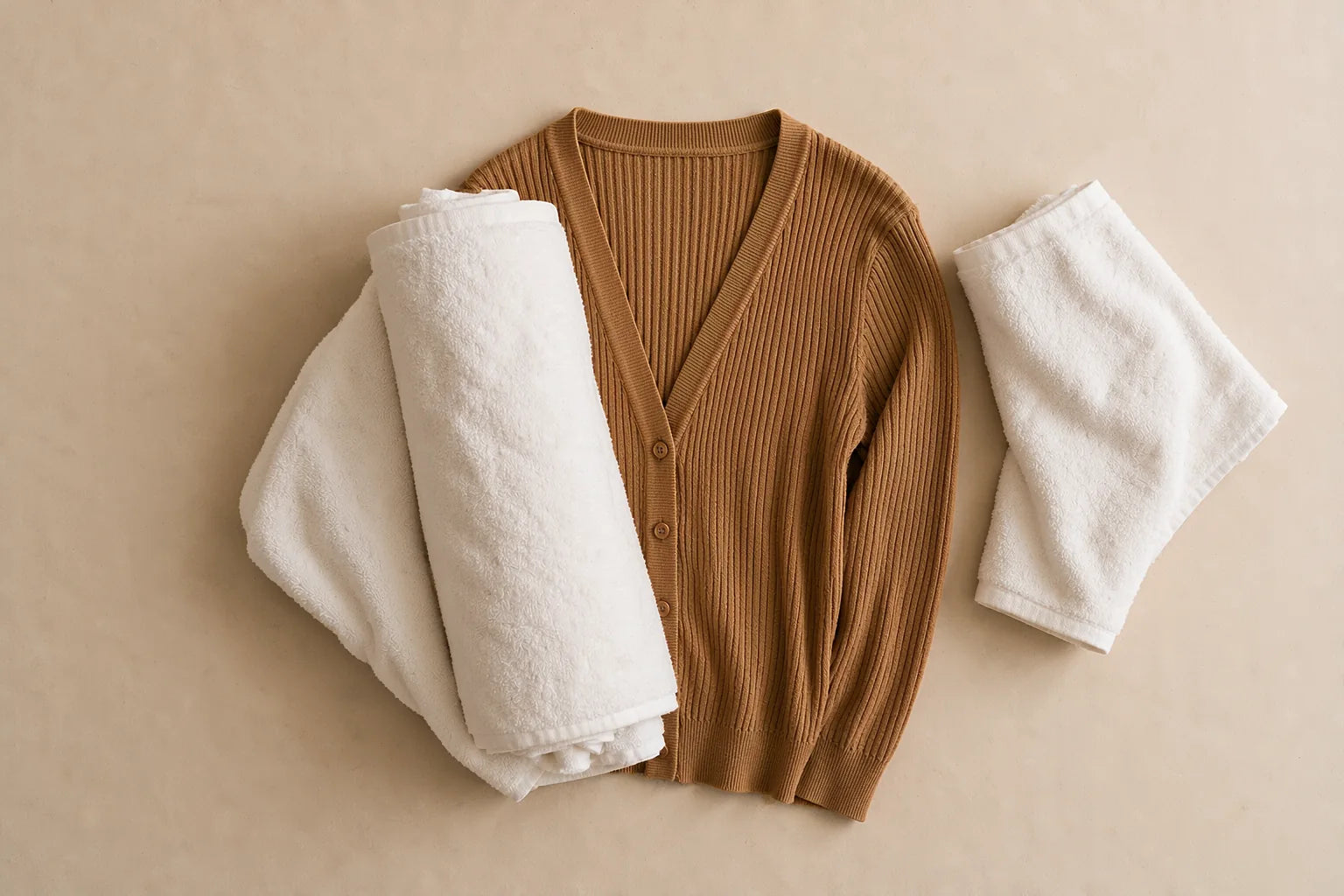
The care line on the Short-Sleeve Knit Cardigan — "Hand wash cold, lay flat to dry" — is this sequence compressed into four words. The washing half of the routine, including temperatures and mesh-bag habits, is covered step by step in the cold-wash, flat-dry care routine.
Which Fix Is Safe for Which Fabric?
Most knit tops today are blends, and blends are exactly where generic internet advice fails — hot-water tricks written for wool can quietly wreck an acrylic body. Here is the ruling table:
| Fabric | Reshape method | Steam? | Never do |
|---|---|---|---|
| Combed cotton (pointelle knit top) | Lukewarm soak, towel blot, pin-dry flat | Yes — hovering steam relaxes loops | Tumble dryer, wringing, hanging wet |
| Lyocell-linen blend (patch-collar knits, tailoring) | Cold-to-lukewarm soak, dry flat | Light steam from 10–15 cm | Hot iron pressed onto the fabric; dryer |
| Acrylic-nylon blend (fine-gauge v-necks) | Lukewarm soak, reshape flat, air only | Brief hover at 10–15 cm at most | Hot water, iron contact, tumble dryer — heat sets the wrong shape permanently |
| Wool blend (ribbed-trim cardigans) | Lukewarm only, minimal handling | Cautious hover, never press | Hot water or vigorous agitation — felting is irreversible |
One search worth redirecting here: how to stretch out a cotton sweater usually means a cotton knit shrank in a hot wash. The fix is the same sequence with more pulling and pinning — cotton cannot felt, so its recovery ceiling is high. Blend in wool and that ceiling drops; blend in acrylic and heat stops being an option at all. The crew-neck knit sweater with a lyocell-linen patch collar is a useful case study: its body is an acrylic-nylon blend with a touch of mercerized wool, while its collar panel is 30% linen and 70% lyocell — two fabrics with two different comfort zones in one garment.
A quick audit for your own shelf: if the stretched knit is acrylic-heavy, plan on water and patience only. If it is cotton or lyocell, steam is back on the menu. If you are choosing new pieces for this climate, the RUIJIN knit collection leans on combed cotton and lyocell-linen precisely because they forgive more — our guide to the best fabrics for hot, humid weather explains why.
How Do You Fix a Stretched Neckline or Loose Cuffs?
Necklines and cuffs fail first because rib fatigues first. The full-garment reshape works on the body, but edges usually need local treatment:
- Damp the edge only. A spray bottle aimed at the neckline or cuff keeps the body of the knit dry and untouched.
- Scrunch inward. Push the damp rib toward the center of the garment, hold for ten seconds, release, and work your way around the edge.
- Steam at a distance. Hover steam 10–15 cm above the fabric while scrunching — comfortable for cotton and lyocell; for synthetic blends, keep it brief and distant.
- Pin slightly smaller and rest overnight. Ease the edge a little beyond your target, because rib relaxes back as it dries; pin it on the towel and let the night do the setting.
The same local approach is the honest answer to how to fix stretched out sweater sleeves: damp the cuff, scrunch, steam, pin. On a fine-gauge v-neck knit top, the neckline is where sag shows first, so treat it at the first widening rather than after a month. Ribbed trims resist better than plain stockinette edges — but resisting is not immunity, and a neckline rescued early almost always beats one rescued late.
Does Humid Weather Make Stretching Worse?
It does, through drying time. At roughly 80% humidity, a knit that would dry in a few hours in a temperate autumn can take the better part of a day in Singapore — and every extra hour is time spent heavy, drooping, and (if you hung it up) actively stretching.
Three habits flip the equation:
- Dry flat in an air-conditioned room or under a fan. Cool, moving air is the biggest accelerator available in SG/MY, cutting flat-drying from all day to a few hours.
- Never store a knit that is even slightly damp. Damp storage sets the distorted shape, invites mustiness, and quietly undoes the rescue you just performed.
- Retire hangers during the wet weeks. Through a monsoon stretch, move every knit onto shelves until the weather — or the air-conditioning — is back in charge.
No air-conditioning? A dehumidifier in a closed wardrobe does similar work on still air, and an ordinary standing fan earns its floor space the rest of the year. What matters is air exchange across the fabric surface, not the temperature itself.
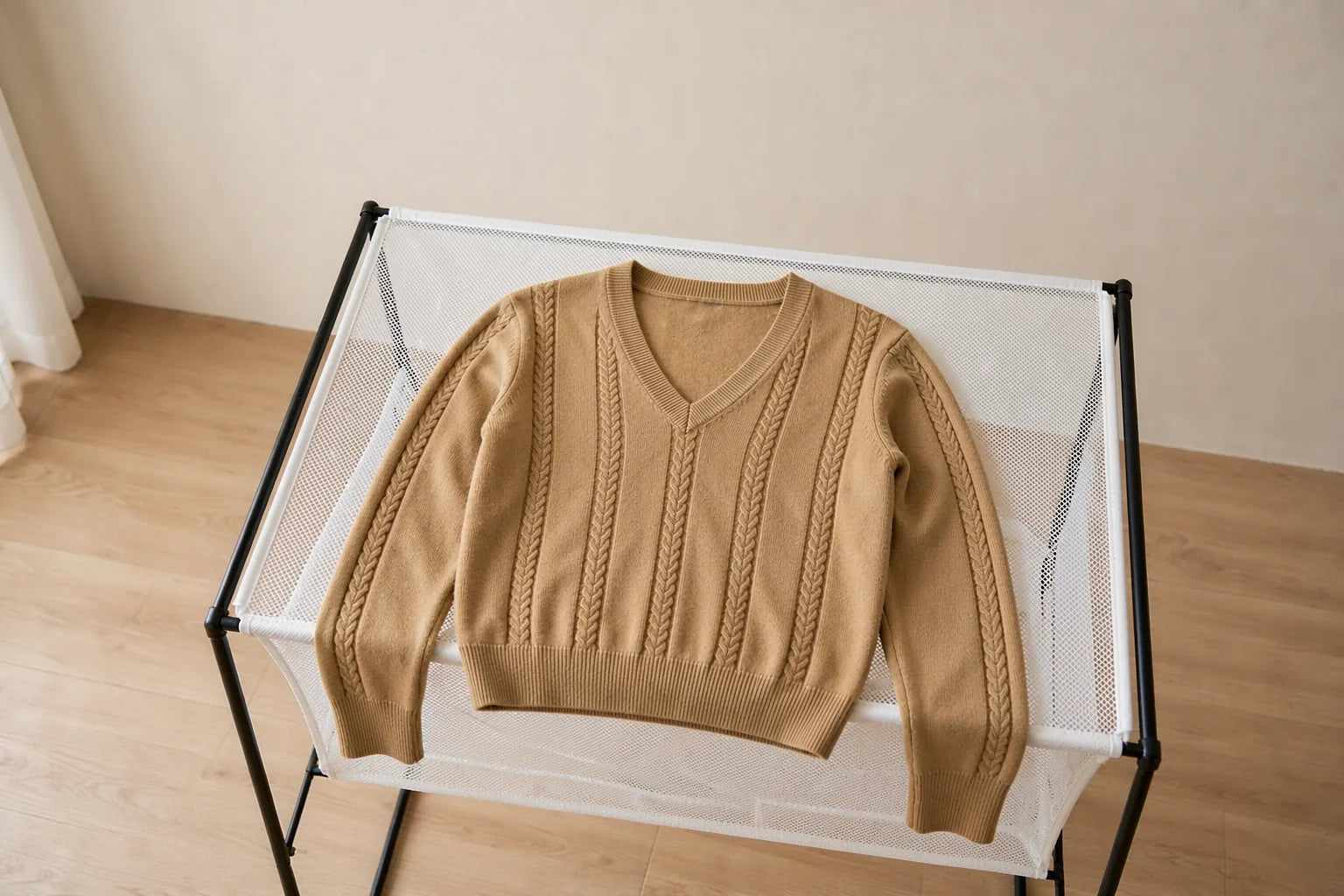
A rescued knit deserves the same discipline after the rescue: flat, shaded, moving air until the inner seams are fully dry.
Does Hanging Sweaters on Hangers Stretch Them?
So, does hanging sweaters stretch them? Knits, yes — through three mechanisms: the hanger's shoulder points load a few loops continuously, the hanging hem stretches under gravity day after day, and clips bite dents into whatever they grip. Skip spring-loaded clip hangers for knits; the clip that grips a silk skirt neatly bites a permanent dent into a ribbed cuff. Wovens shrug all of this off; knit loops slowly accept it.
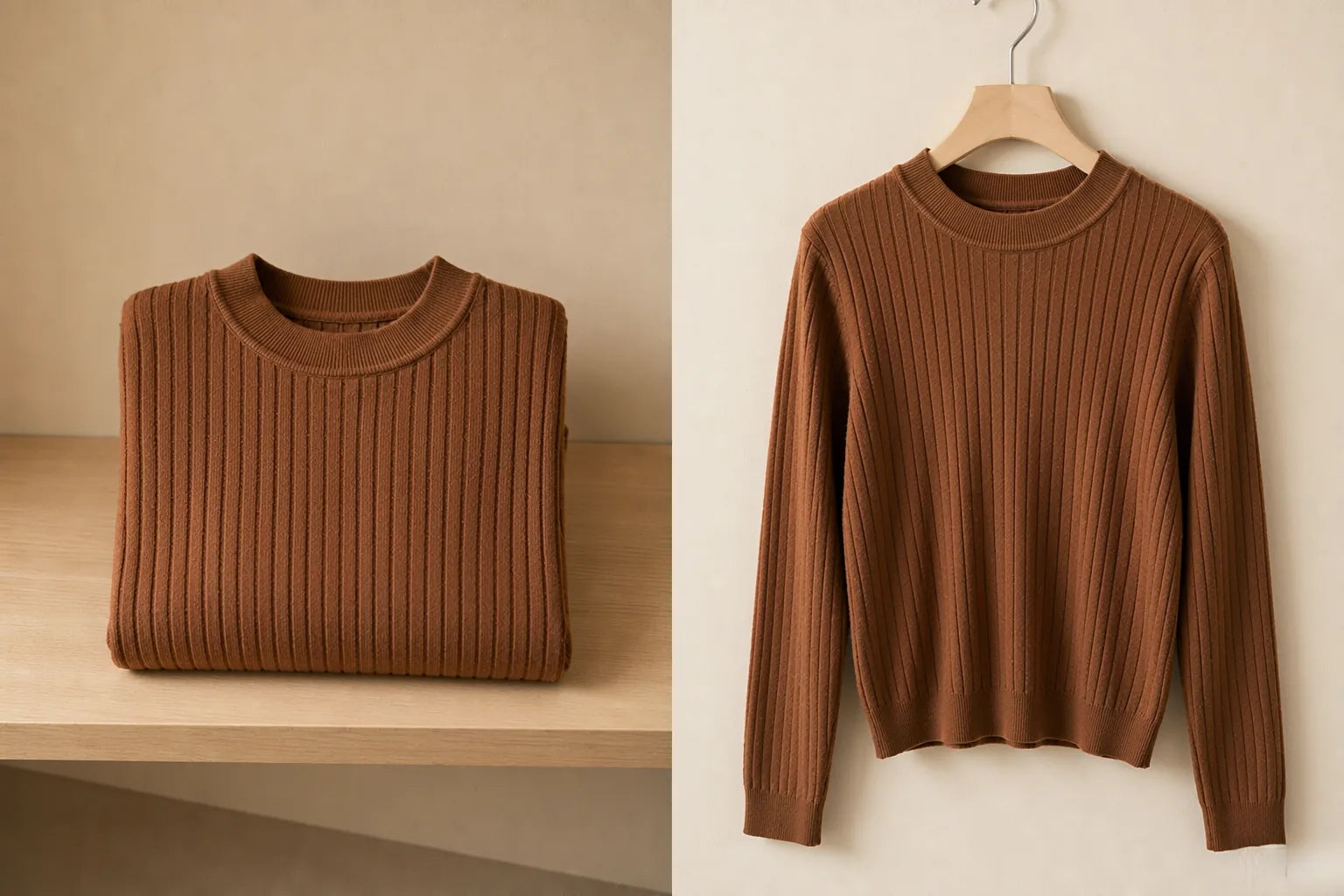
The default rule is to fold: shelf or drawer, fully dry, with breathing room. For pieces in weekly rotation, the fold-over method gets you both convenience and safety — lay the sweater front-down, fold the sleeves in, fold the hem up to the shoulders, and drape the result over the hanger's bar. The weight then spreads across the fold instead of the shoulders. A relaxed piece like the ribbed-trim knit cardigan earns exactly this treatment: its wool-blend body creeps slowly under sustained hanging, while its ribbed trims hold their shape far better when the weight is shared.
Frequently Asked Questions
Can vinegar help restore stretched clothes?
A: The honest evidence is thin. Vinegar does not re-form knit loops; recovery comes from re-wetting and repositioning the fabric while damp. A diluted rinse can lift odors, but as a rescue agent it is a detour — spend the effort on towels, pins, and flat moving air.
How should I store knitwear between wears?
A: Folded on a shelf or in a drawer, fully dry, with breathing room. Weekly-rotation pieces can live on the hanger bar using the fold-over method above. Keep shelves away from damp exterior walls; in a humid flat, an air-conditioned room or a dehumidifier closet is worth claiming for knits.
Can a washing machine cause stretching?
A: Yes — through agitation, spin pressure, and the wet weight of the load. Wash cold on a gentle cycle, ideally in a mesh bag. The store's care note applies across the range: "All garments are pre-washed during production to prevent shrinkage. Most pieces can be machine washed cold on a gentle cycle (max 40°C); a few delicate fabrics are hand wash only." Frequent washing also raises friction, which is a pilling problem — how to stop knitwear from pilling covers that half of the story.
How long does reshaping take to dry in humid weather?
A: Plan on 12–24 hours indoors, less with air-conditioning or a fan. Flip the knit halfway, re-check the pins, and store it only when the fabric — inner seams included — feels completely dry.
Can I put a stretched sweater in the dryer to shrink it back?
A: No. Heat is the one input that converts reversible stretching into permanent damage — felting wool and warping acrylic or nylon. The store's own care line caps machine washing at 40°C and asks for flat drying; a dryer exceeds both by a wide margin.
Knits that hold their line
Rescue works, but the quieter win is a wardrobe that rarely needs it: knits washed cold, dried flat in moving air, and folded rather than hung. If you are rebuilding the rotation, the Short-Sleeve Knit Cardigan and the pointelle top are the two pieces this guide returns to — both dry flat within a day in air-conditioning. Browse the RUIJIN knit collection — combed cotton pointelle, fine-gauge v-necks, and lyocell-linen layers made for exactly this climate — and start with the habit, not the rescue.
0 comments