

Dressing for one climate when your morning actually runs through two is the quickest way to ruin a workday in Singapore or Kuala Lumpur. Outside it is 32°C with humidity pushing past 80%; inside, the air-conditioning holds a brisk 22–24°C, and the strongest vent always seems to sit directly over your desk. I've been commuting through that swing for the better part of a decade — these days I edit content for a small knitwear boutique, which means my wardrobe has financed every mistake on record. And nearly all dependable work outfits for hot humid weather turn out to do the same three jobs: breathe hard on the street, insulate gently indoors, then fold flat between the two without creasing beyond repair. Get any part of that combination wrong, and by 9:15 you are damp, creased and quietly freezing.
If you have ever stepped out of a lift feeling immaculate and reached your desk looking like you slept in your clothes, you are in the right place. Below you will find a three-step layering formula built around commute-friendly workwear and lightweight layers, fabric rules for smart casual work outfits that don't wrinkle, honest notes on shoes and bottoms that survive a swampy walk to the station, five ready-to-wear formulas, and a budget-friendly capsule plan. Every suggestion assumes real equatorial conditions — not an airport-magazine fantasy of linen in the sun.
Key Takeaways - One breathable outdoor layer, one indoor warm layer, packed flat between them. - Fine-gauge cotton-modal knits, lyocell and seersucker beat lined suiting every morning, year-round. - Yes, cardigans belong in the tropics — loose-knit, featherweight ones that live at the office rather than on your back. - Tencel-blend pull-on trousers, cushioned flats and rotated shoe pairs outlast any humid commute. - Five mix-and-match formulas cover boardroom days through hawker-centre lunches.
Why Is Getting Dressed for SG/MY Offices a Two-Climate Problem?
Because your day contains two seasons with no transition period between them. Equatorial cities such as Singapore, Johor Bahru and the Klang Valley hover around 31–34°C in daylight with humidity that routinely sits between 70% and 90%. Walk indoors — the office, the bank lobby, the mall shortcut — and temperatures drop 8 to 12 degrees before you have found the lift button.
Offices here run cold deliberately. Facility managers size their chillers for servers and formal dress codes, not for whoever just cycled fifteen minutes through the noon sun, and nobody recalibrates for the person actually wearing the blazer.
The mismatch produces three specific failures. Sweat sheen and damp patches show up before 9am. Fabrics that looked sharp on hangers crease along seat lines and tote-bag folds — exactly where you cannot smooth them out. And sneakiest of all, you start the day overheated and finish it shivering under a vent, which tempts people into heavy outerwear that then punishes them the moment they step back outside.
You will recognise the scene anyway. It is 7:45am, the MRT carriage (or BRT bus) is wall-to-wall bodies, windows fogged, every shirt clinging between stops. Then the doors open onto the platform and pre-cooled air rolls past your ankles like something out of a supermarket freezer aisle. Thirty seconds, and you have gone from steaming to goosebumps. Once you accept that both halves of this happen twice a day, everything else becomes logistics.
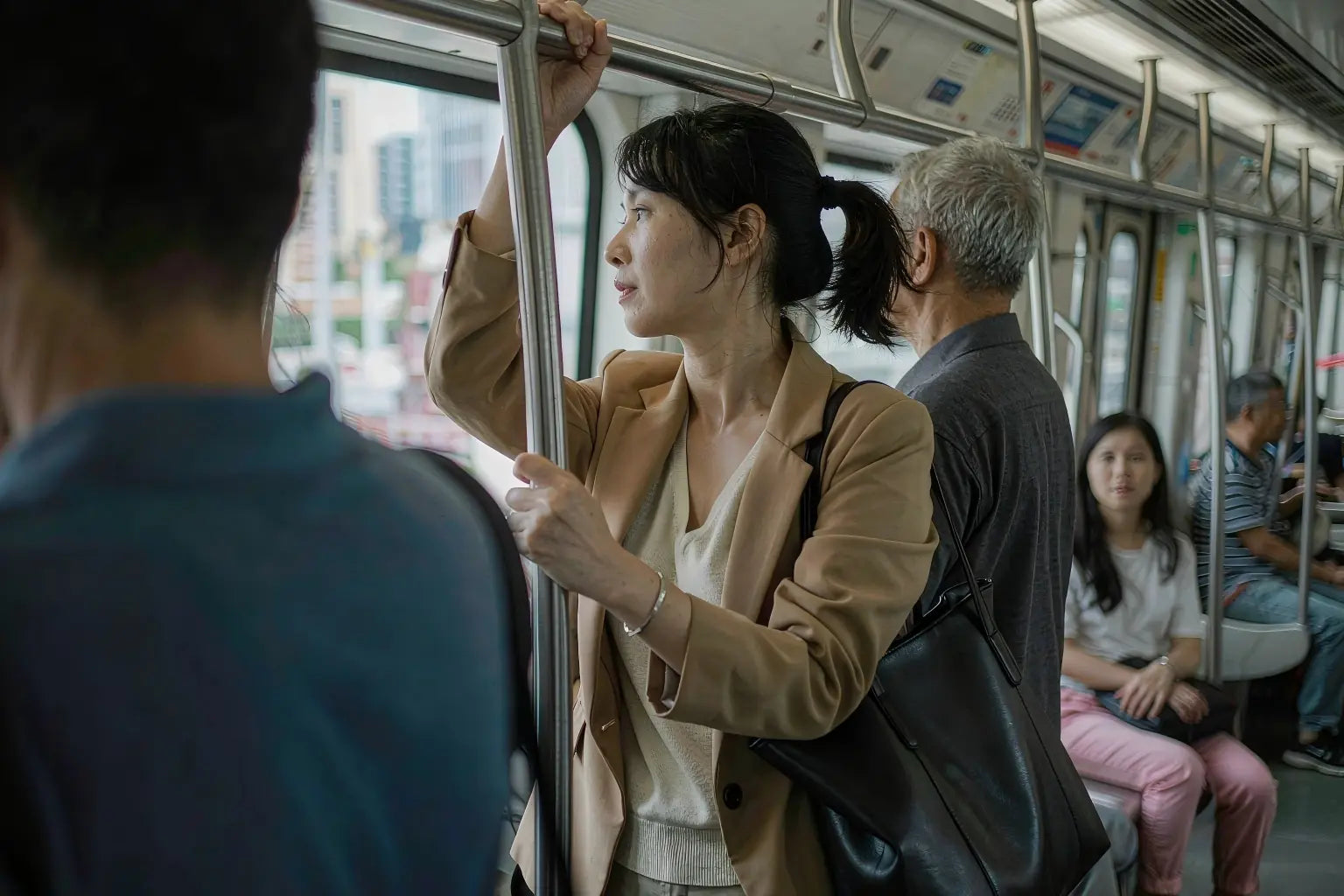
What's the Layering Formula When It's Hot Outside and Arctic Inside?
Work backwards from the coldest point of your day — the indoor afternoon. Three steps, in this order:
- Wear the breathable outdoor layer as your base. This is whatever you would happily stand at a bus stop in at noon: a fine-gauge knit top, a lyocell-blend shirt, a sleeveless shell. It has to wick moisture, dry fast, and look intentional on its own — because for most of the day, that is the outfit.
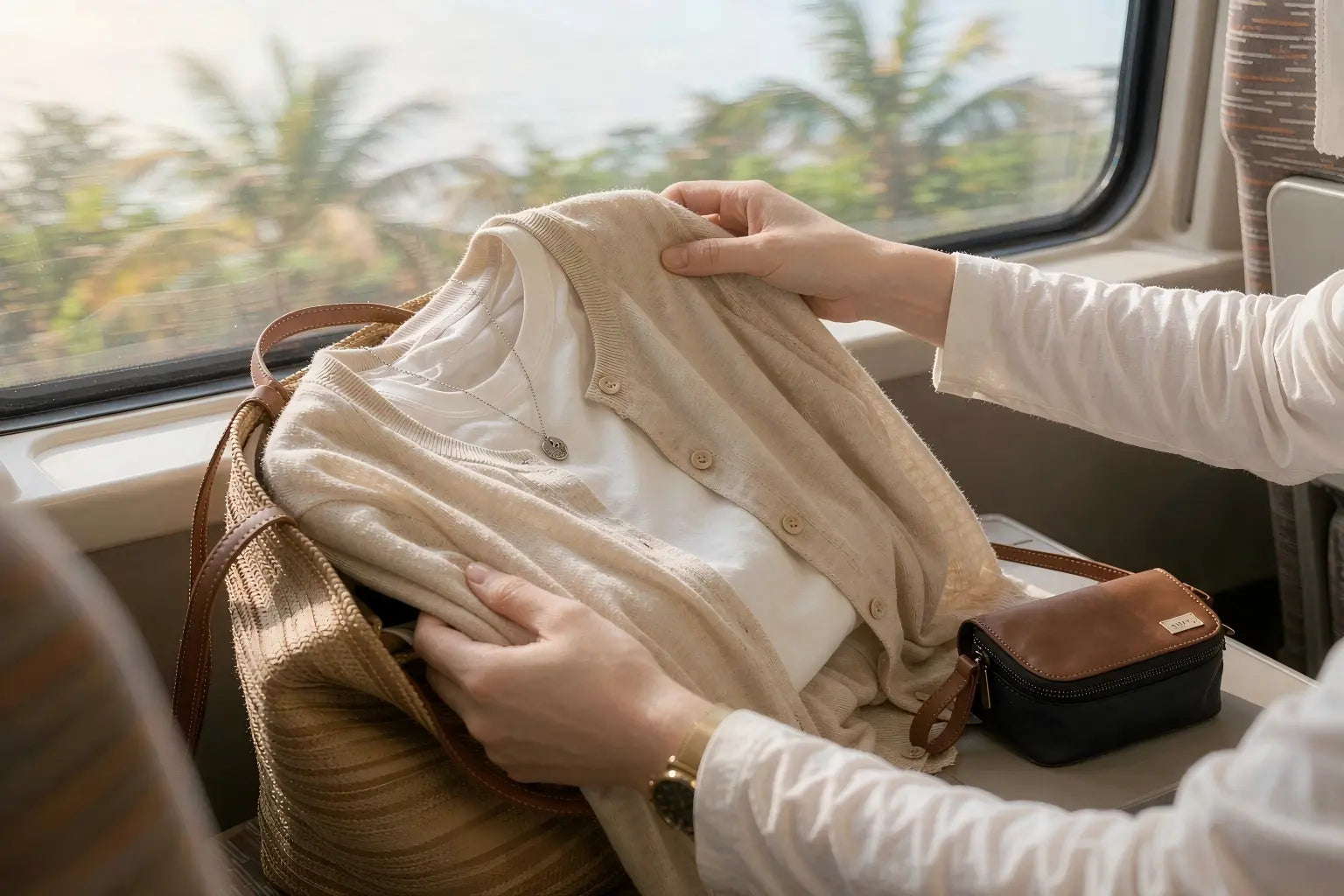
- Pack the commute stage. Anything removable goes into a slim zip pouch or straight into the tote. Roll knit layers instead of folding them; the fibres spring back while woven linings never do. If a layer won't compress to water-bottle size, it fails this step and stays home.
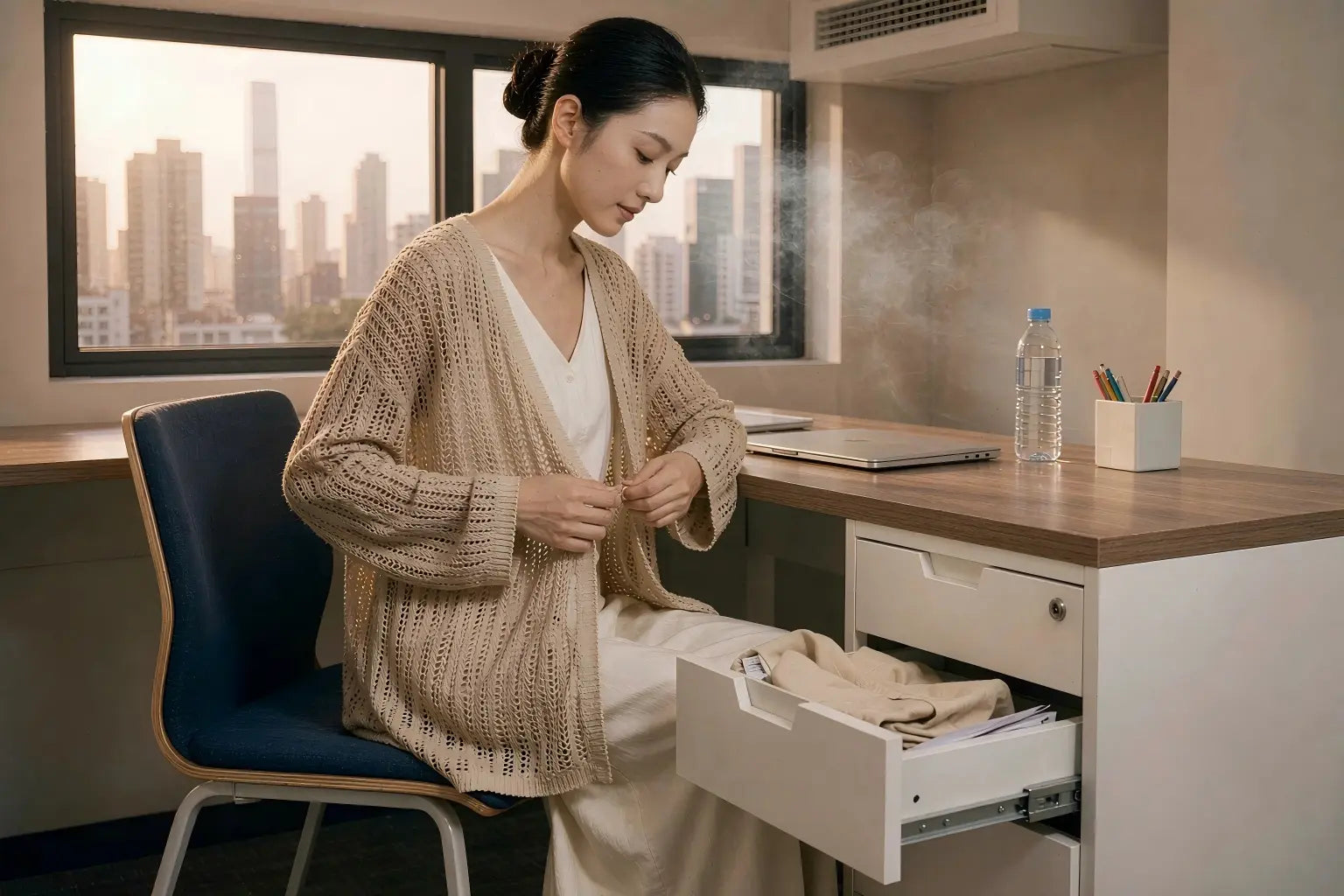
- Add the indoor warming layer once seated. A featherweight open-knit cardigan living in your drawer handles the vent aimed at your neck. Folded over the chair back, it also tells hovering colleagues that you're in the zone.
No costume changes required anywhere in this system — the same shell carries the whole day, and warmth gets carried rather than worn, which is roughly how locals across the region have always dressed for business casual in a tropical climate.
Which Tops Stay Polished Without Trapping Heat?
Start from fibre, not fashion. The best tops for aircon offices share three traits: a breathable natural or semi-natural blend (cotton-modal, cotton-silk, lyocell/tencel), a matte finish — shine reads as sweat long before anyone registers the heat — and structure achieved through knitting rather than fusible interlining, which bubbles the moment humidity arrives. Seersucker's puckered weave keeps fabric off skin and hides travel creases brilliantly; fine piqué and ribbed knits manage the same trick with a neater silhouette.
Retire the thick polyester blouses, anything acetate-lined, and stiff heavyweight linen that creases on sight. Adopt knit polos, easy button-downs in tencel blends, shells with clean bound edges, and short-sleeve knits cut with a little shoulder — the gap between "relaxed" and "sloppy" usually comes down to tailoring at the seam.
Priya, a 29-year-old account manager in Petaling Jaya, learned all of this expensively. For a 9:30am client workshop she wore her sharpest shirt — poly-cotton, lightly lined. One dash to the LRT, one packed carriage, one breezy platform later, the shoulders were damp, the elbows showed permanent quarter-moon creases, and the collar interlining had warped into waves she couldn't iron out even standing in front of the office mirror. Her fix now is a cotton-modal knit button-down with an open-knit cardigan waiting in her desk drawer; the same workshop routine runs smoothly because knits forgive the commutes that wovens don't.
Before buying anything new, give it the test I run on my own pieces: roll it tightly, leave it ten minutes, unfurl it and judge harshly. Smart casual work outfits that don't wrinkle get built from pieces that survive that treatment, and knits pass far more often than wovens do.
Can You Really Wear a Cardigan in the Tropics?
Absolutely — refusing to believe this is why half the office freezes by mid-afternoon. The category itself was never the problem; gauge and weight are. You want a loosely knitted, featherweight piece in open stitches, cotton-modal or silk-cotton blends that add exactly one degree of warmth and pack down to almost nothing. Chunky cable knits belong in Cameron Highlands, not Raffles Place.
Styled properly, nobody clocks it as outerwear. Slip it over a fitted shell so shape remains underneath. Button just the middle closure for an effortless column, or wear it fully open with sleeves pushed to the forearm. Since knit fibres recover from folds, you can scrunch it into your tote every evening and shake it out wrinkle-free each morning — behaviour no tailored jacket will ever reward you with.
For reference, a versatile button-down cardigan, RUIJIN by RQFashion ticks every box above: fine gauge, solid colours that lean understated, and a drape that flatters layered over camisoles or knit tees alike. Keep one neutral shade at the office and one dark shade rotating at home, and 22°C interiors stop being an ambush.
Which Bottoms and Shoes Survive a Humid Commute?
Bottoms win or lose on airflow below the knee and resilience where your bag strap crosses the hip. Relaxed tapered trousers in tencel-viscose blends drape like tailoring yet shrug off creases; pleated pull-on styles read as deliberately soft rather than accidentally sloppy; A-line midi skirts let air circulate while staying office-appropriate even on 34-degree days. Straight cropped pants pair neatly with flats on back-to-back errand days — handy whenever friends visiting from further north ask what to wear to work in Singapore heat and I have to admit my answer is boring: whatever dries fastest. Save raw denim, heavy twill and fully lined suiting trousers for genuinely cool weeks; they hold heat and sweat in all the wrong places.
Shoes deserve equal planning. Cushioned flats with perforated or woven uppers, softly structured loafers and knit slip-ons cope with station staircases and surprise rain puddles alike. Rotate two pairs through the week so each dries fully overnight — trapped humidity wrecks footbeds faster than distance does.
My real benchmark, though, is the lunchtime queue. It is 12:40pm, the pavement holds 33°C like a griddle, and twenty people stand ahead of me outside the tze-char stall. Nobody glances at your top half first. They notice whether your legs look comfortable and whether your shoes survived three crossings of hot asphalt. Whenever someone asks me about office outfit ideas for Malaysian weather, I tell them to imagine standing in that line and check whether they would be thinking about the menu or their clothes.
What Five Outfits Actually Work Through Hot Humid Workdays?
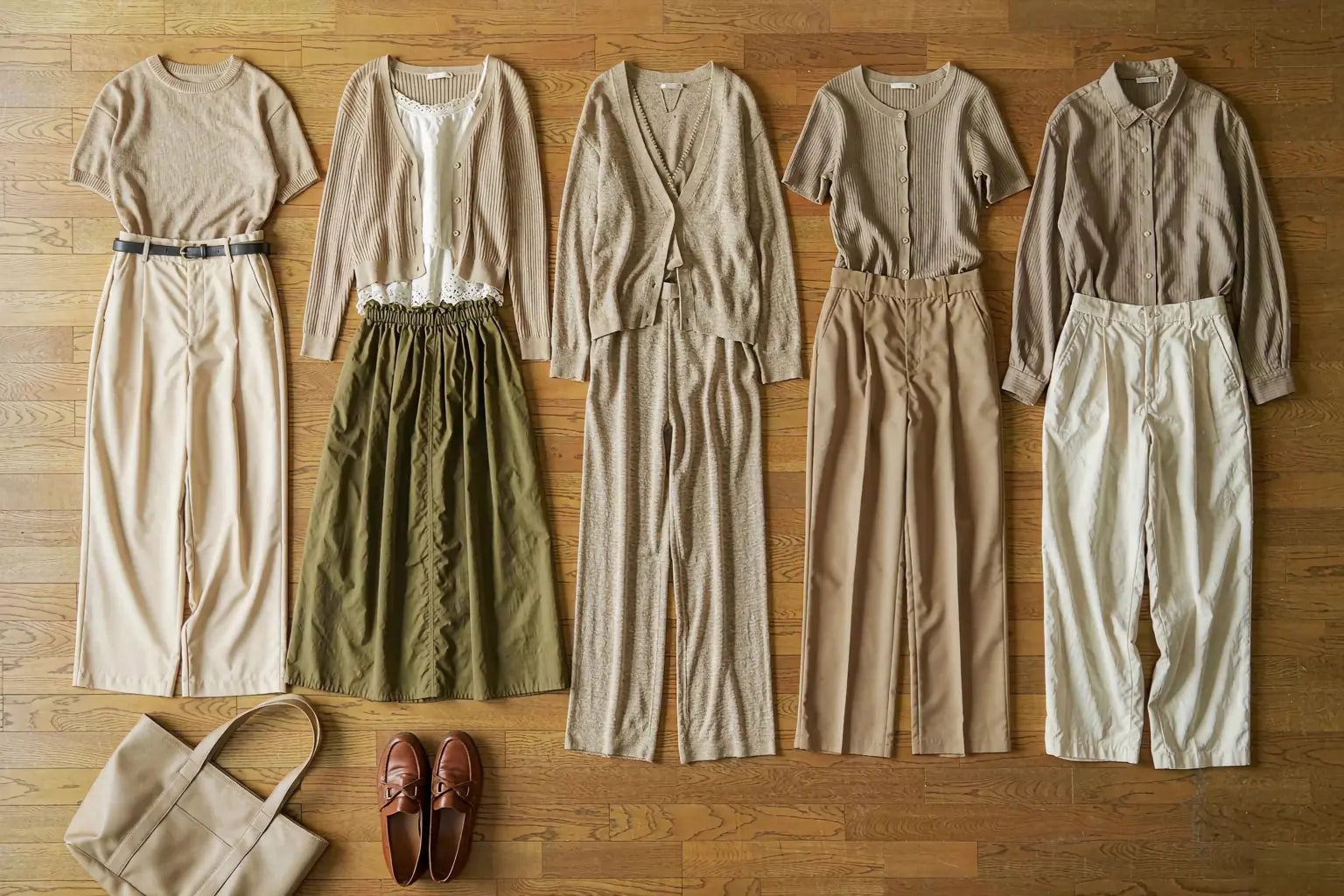
Formulas beat frantic mornings. Each one below uses the layering system from earlier and contains at least one piece from our boutique so you can see the whole equation assembled. Treat them as templates: swap colours freely, keep the silhouettes.
Formula 1 · The Long-Commute Layerer
Fine-gauge knit tank or tee → relaxed tapered tencel trousers → a featherweight open-knit cardigan rolled compactly in the tote until the office chiller makes its case → cushioned flat mules built for stairs and platforms. Built for door-to-door journeys over an hour, where the layers genuinely earn their places.
Formula 2 · The Smart-Casual Daily
Matte knit polo or easy lyocell shirt, pleated pull-on trousers, woven slides or cushioned loafers, finished with a slim watch or lanyard. On hybrid weeks this is my default — and when pieces finally wear out, I restock from the same knit family by choosing to browse all RUIJIN pieces, the founding brand in residence at our boutique, whose womenswear knits anchor this formula neatly.

Formula 3 · The Client-Visit Crease-Fighter
Unstructured seersucker or cupro-blend overshirt, fitted shell beneath, straight cropped trousers, cork-soled loafers. Every piece follows principles we unpack in why these fabrics stay cool in 33°C humidity, which is also why this trio is my safest pick when meetings stack three appointments across town before sunset.
Formula 4 · The One-and-Done Set Builder
Rushed mornings ended for me the day matching knit coordinates came home. This short-sleeve knit two-piece set does double duty: worn together, it reads as a unified look on presentation days; split apart later, the top pairs with jeans on weekends and the bottoms feed Formula 1. Add woven slides and a structured mini tote, and you are dressed before the coffee brews.
Formula 5 · The Boardroom Column
Sleeveless column dress, or shell plus wide-leg trousers, with a featherweight cardi standing by and pointed-but-padded flats beneath. Understated tailoring throughout — disciplined colour, minimal hardware. For the thinking behind the aesthetic, see our old money style guide. Reserve this one for rooms holding at 20°C with expectations running higher.
How Do You Build a Capsule Work Wardrobe on a Budget?
Eight to ten pieces cover every situation above: two breathable knit tops, one crisp overshirt or lyocell button-down, one open-knit featherweight cardigan, two pairs of tencel-blend trousers (one tapered, one wide), one midi skirt, one knit set, and rotating flats. Insist that every item combines with at least three others; anything that pairs with only one companion ends up a wardrobe tax dressed up as a purchase.
Spend where humidity tests hardest — knits near the body and shoes. Save on trend-adjacent pieces and accessories. Cost-per-wear does the arithmetic for you: a two-piece set bought once splits into four outfits across other pieces, which beats four separate items at four separate prices. Browsing an edited selection beats scrolling thousands of listings too, since someone has already filtered for drape, blend content and finishing quality.
Two practical notes before checkout. Orders ship free once baskets clear $80 USD, so coordinating a capsule refresh with a colleague or housemate puts both orders comfortably over the threshold. And like many boutiques serving the region we operate DDU — Singapore GST applies only above SGD 400 and Malaysian import duties above RM 500, meaning everyday wardrobing orders usually clear customs untouched.
Building yours? Start with Browse all RUIJIN pieces for the knit anchors, then round out tops and bottoms from the rest of the edit.
FAQ
Are short sleeves acceptable in offices here?
Short sleeves are entirely normal beyond banking, law and government settings. Pick matte knits or crisp cotton-poplin shirting, keep fits tailored rather than skin-tight, and stage a light cardigan at the desk — that way sleeve length never becomes a problem when conference-room air-con drops the temperature noticeably.
How do I stop looking sweaty by lunch?
Swap thick polyester for moisture-wicking cotton-modal knits, tencel and fine piqué, keep darker colours away from high-sweat zones, and blot rather than wipe. Carry a compact fan if you queue outdoors, rotate your lightest fabrics through the hottest weeks, and remember that one breathable layer beats three stacked ones in the tropics.
What fabrics transition best indoors-outdoors?
Cotton-modal and lyocell knits transition best, followed by cupro and seersucker. They absorb and release sweat quickly, resist creasing while rolled inside a commute bag, and never feel clammy stepping off 33° pavement into chilled air — exactly the twice-daily shift every Singapore and Malaysia commuter makes.
Can two-piece sets count as office wear?
They do, provided the knits are fine-gauge and the colours are solid. Matching sets read as deliberate dressing rather than gym-adjacent comfort. Wear both halves together on smart-casual days, then split them — shell under an overshirt, bottoms under a classic knit top — to effectively double your outfit count without stretching the budget further.
0 comments